Agnes Collard’s June 24, 2023 article in the New Yorker, The Case Against Travel, ignited a desire for an immediate response from me, even before I read it. Then, after reading it, my passion was tempered. In fact, I believe that Agnes and I are essentially in full agreement. Allow me to elaborate.
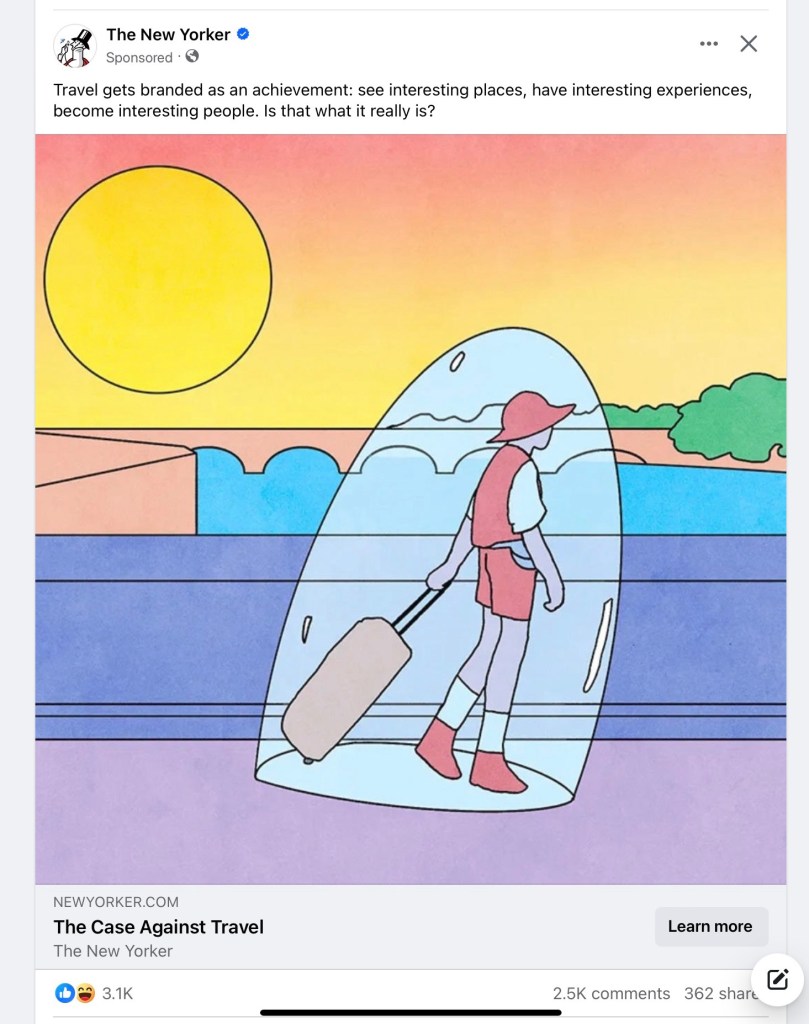
Her title could be more accurately titled, The Case Against xxx Travel, where ‘xxx’ is a specific adjective, possibly voyeuristic. My book-in-process proposes that travel (including the decision to travel) is a potential change agent and one worth pursuing. Agnes considers change and who or what is changed by travel. Unfortunately, too often, Agnes and I agree that the destination is changed, far more often than the traveler. Agnes, in fact, refers to “inflicting change on others.”
When considering the thrust of my book-in-process, I have consciously avoided criticism of what I will now label common travel, which Agnes describes and denigrates. She is clear about excluding from her target travel for the purpose of learning or benevolence. I am not so brave. She has beautifully and very clearly described her scorn for travel done merely for the purpose of seeing some place different or for collection of souvenirs. I am reminded of a message seen in national parks, essentially, “Leave this place exactly as you found it.” In other words, don’t leave your trash or your excrement or graffiti or anything else. I am reminded of my 2006 trip to a Kenyan orphanage, when we were urged to deliver with us useful supplies, such as pencils and books, excluding things like magic markers, so often used here in the U.S. The reason? Perhaps fun and attractive to use, they have a relatively short useful life, and then, would remain in a pile of plastic discards forever. This is because, in Kenya, there is not the illusion of recycling. More can be said about this, but not from me, not now.
Back to Agnes’ excellent article. She has bravely described common travel as leaving the traveler unchanged, when purported to be done with the intention of change. Her description of tourists seeking an authentic experience and being repeatedly disappointed when not finding experiences that match their expected images or, conversely, when being delighted when they find a close match, comes close to my perspective. Agnes does not touch on the single area that I believe makes a difference in the travel experience, that makes it transformative. The closest I can come to it is ‘spiritual attitude.’ That requires another article to describe. Briefly, it is an openness, a personal risking, that can be a part of travel, but is not a requirement. Its absence may be the difference between what gets changed by travel: the traveler or place visited.
Copyright 2024
 Carole's Words
I agree with your term ‘spiritual travel’ as “an openness, a personal risking, that can be a part of travel.”
LikeLike