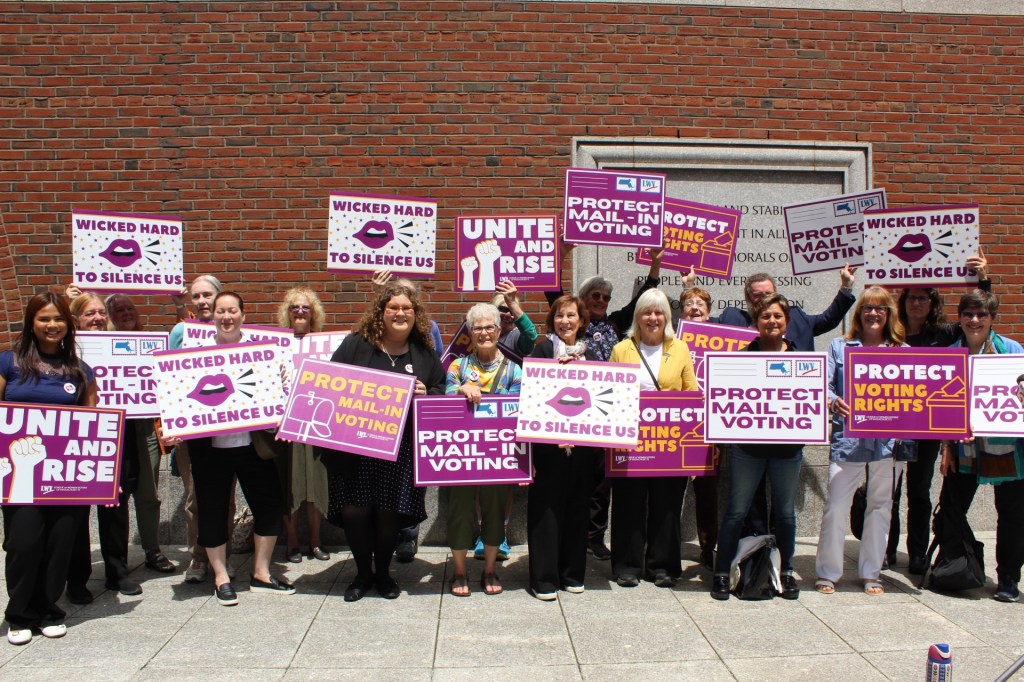
I was present at Moakley Federal Court in Boston on June 2, 2026, as a member of the Massachusetts League of Women Voters in a suit filed against Trump. We filled the courtroom, about 100 of us. The overflow room was also in use. I was seated next to a young woman from Plymouth, perhaps in her 30’s, who had recently joined and never taken part in anything like this.
This was a preliminary hearing. The next step is not clear to me. The judge was amazing, worked from 10:10 until 12:45, without a break, continually conversing with the attorneys representing the Department of Justice, Massachusetts League of Women Voters, and the ACLU. Certain other states were represented, too, including Texas, Florida, and California. She allowed attorneys to speak, then asked questions, always calmly, eliciting these ideas as she teased apart the various sections of the suit.
1. Trump issued an executive order that may not be legal, because it requested particular actions of the postal service, a national service, that may impose on individual state’s freedom to control elections, per our Constitution.
2. The order requested that a citizenship list be created that would contain all those who are eligible to vote.
3. Barriers to creating such a list are many, including the Privacy Act, which prevents federal departments from sharing their lists. As an example, the IRS cannot provide a list of tax filers to anyone else.
4. Trump’s order is that the USPS would use this list, only this list, to determine who would receive mail-in ballots.
5. It seems likely that any list would not actually contain every eligible voter.
6. It is the right of every citizen to vote. To deny that right is wrong, equally as wrong as a noncitizen voting.
7. Part of the order requires that any state not providing such a list to the postal service would not be allowed to offer mail-in voting.
8. There were many timing restrictions (60 days prior to the election, etc.) that were restricting and unclear.
9. All of this would apply only to federal elections, unclear about primaries.
10. The question was raised about whether people may be harmed by this, by being deterred from voting or being fearful.
11. The DOJ raised the point that in a previous suit, it was determined that potential fear was not a reason to avoid action.
Habits, perhaps a subset of rituals, have been on my mind lately. When I think of habits, I immediately consider whether a particular one might be bad or good. Perhaps there are also habits that are neutral, which don’t seem worthy of contemplation. Many habits are concerned with consumption, either dietary or monetary. The bad habits are the ones that we want to decrease or avoid altogether, such as eating sweets or smoking cigarettes; or buying single-use plastics or unneeded trinkets or lottery tickets. Of course, you can immediately see that judgment comes into play with my labeling of good or bad.
There is another kind of habit, though, that is not necessarily, though can be, a choice. This habit is, for me, unbidden, the habit of awe, of saying WOW to the universe. It comes very naturally right now, during spring, when the entire world is blooming or seems to be. Perhaps particularly as I age, I am wowed by the sight of the clouds in the sky, the grape hyacinths and tulips beside the street, and the generous, sprawling spring green of the sprouting trees.
This is in sharp contrast to the horrors taking place right now in the wider world. Yes, I know they are there and I take action when/where I can. That does not diminish my wonder at the world that I see on my street and in my neighborhood. Is my surprise because it seems impossible to hold two opposite ideas simultaneously? Or, is it because we must do exactly that?
Recently, a friend who holds very different political views than me, asked me how I would spend my time if I did not spend so much of it protesting and advocating. That question provoked some deep thought. First, it seems impossible to me that I would ever want to stop protesting and advocating, given the state of the world. But, I said to her that I would probably spend more time attending plays, concerts, and movies, which I love. Later, I thought to myself, how selfish to lead that kind of life, where I would only consider and feed my own pleasure.
Back to habits. I strongly believe that cultivating wonder and awe as a most admirable habit would be good for each of us and for the world. Part of that awe, for me, is of the bazillion parts in our bodies that must work properly to allow us to walk and talk and think and act with any degree of normalcy. That so many of us live these ‘normal’ lives is incredibly amazing! We generally take this for granted, hence are always surprised when a friend has a stroke or dementia or a heart attack. What if we developed the habit of thanking our bodies every day for functioning, our legs for carrying us around, our eyes for seeing, and our noses for smelling?
So, yes, let’s cultivate good habits and reduce the bad ones. And, let’s begin with increasing our awareness of the wonders that surround and fill us. We don’t have to forget the flaws that need our attention, in order to appreciate what we have.
Thank you to those who have asked about my absence from writing, which I know has been missing. This was an assignment in one of my writing groups, which initially seemed like a boring topic. However, as I wrote, it became richer for me. I hope you enjoy it:
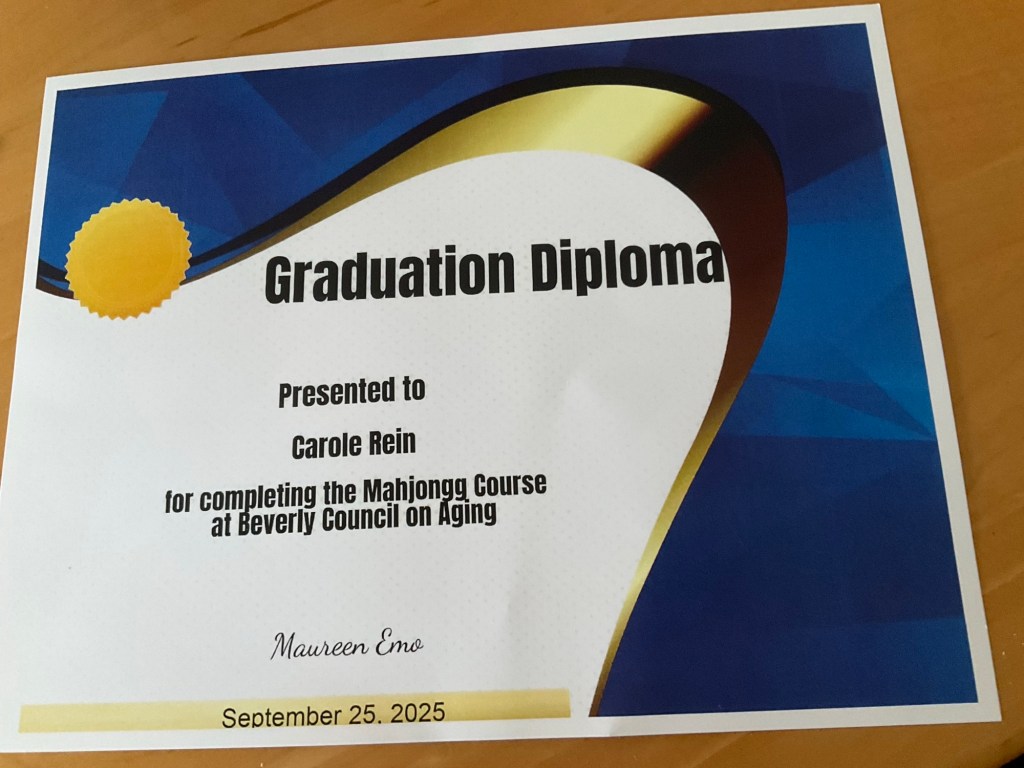
I’ve just received my ‘diploma’ for completing a four-week course in mahjongg, feeling a bit proud of it, too. I know several people who have been playing for years, so when I heard about this class being offered at my local senior center, I signed up. Initially, I was on a backup list, then was called the day before class started to learn that there was space for me to participate. Because of the late notice, I needed to borrow the ‘2025’ card from Reeny, my instructor, until I bought my own card.
My Diploma!
It is a complex game, which now leaves me with a choice to make. It is clear to me that if I really want to play, I need to have a weekly commitment to begin playing and continue learning. I have come nowhere close to really knowing the game. First, there are the suits: bams, dots, and cracks, plus flowers, winds, and dragons, and, of course, jokers. After the complex rules of the game setup, the real challenge begins with understanding the more than fifty possible winning hands. Those hands change annually in the American version of the game, unlike the original Chinese.
This is so different than the card games I played as a teenager, which included Pokino with my family and poker, blackjack, or twenty-one with my friends, each relatively simple to learn, requiring minimal focus.
Remembering those simple games, a memory surprises me as it returns from about sixty years ago. In junior high, I made a new friend, Susie. Throughout high school and beyond, we remained friends and spent many hours together, engaged in multiple activities, including card games. During one game, after she kept winning, Susie showed me how she had been cheating. Her nonchalance about it surprised, even shocked me. This was my introduction to the possibility of cheating.
That was about sixty years ago, when I quickly forgot about it. However, the memory returned to me recently and has nagged me. I was brought up with a father who believed and taught us that lying and cheating were the worst possible actions. He used to say, “I don’t care what you do, but don’t lie about it.” Now, I wonder what Susie was taught. Yes, she told me, after the fact, that she had cheated. But, I wonder, how in the world did it even occur to her that cheating was a reasonable thing to do?
Beyond that, has it played a role in her life beyond high school? Has she continued to cheat? I am still in relationship with her. Her name is not Susie. Can/should I bring this up with her now? The enormous presence of cheating and lying in the world right now feels like the aftermath of cheating in a game and distresses me greatly.
So I am left with two unrelated decisions to make: should I raise this topic with ‘Susie?’ Should I make a commitment to mahjongg? Part of the weight of the second decision rests on thinking that it might interfere with my activism work. But, maybe that would be healthy for me.
We frequently celebrate the firsts in our lives. Today, I’ll describe and celebrate one of the ‘lasts’ of my life.
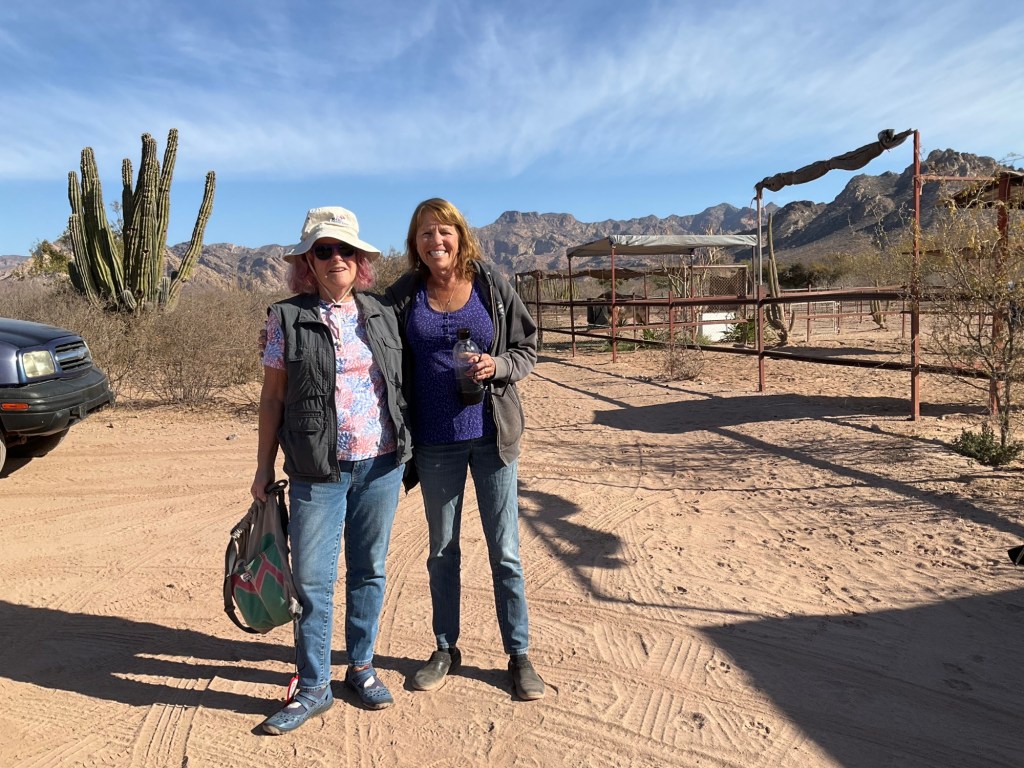
During the past few years, after watching a Netflix series that included a ranch with many horses, I’ve been longing to ride a horse again. I briefly investigated some nearby riding stables, but never acted on my whim. But, here I am in the Mexican desert, Sonora state, through the grace of Suzanne, a generous and gracious writing buddy, and, now, my hostess.
Suzanne and me
On one of my first days here, during a sightseeing excursion, we passed a riding ranch. Suzanne mentioned that she sometimes rides there and that riding in the desert is wonderful. I immediately said that I’d like to ride, if there were an opportunity. Outstanding hostess that she is, she quickly arranged for us to ride with another friend of hers, Jean, yesterday morning.
I’d already met Jean at Suzanne’s birthday party, when we (with other friends) were all entertained with songs of the seventies by the singing duo, Janice and Abraham. Imagine us singing along to Dancing Queen and familiar songs by Roy Orbison, Carly Simon, Neil Diamond, and more. Next, imagine us dancing on Suzanne’s back porch, overlooking the Pacific. Is this real? Am I dreaming? No, it is real, so real.
I digress. Back to the promise of horseback riding. So, Jean picked us up at about 9 am and drove us along a really bumpy road to the ranch, where I met Astrid, the owner and friend of Suzanne and Jean. When asked, I told her that I had ridden previously, though not for a while and not often. I said that I needed a horse who knew what he was doing, who didn’t need to depend on me. Jean had told me that she usually rode Gordo, because he was so dependable and calm, but that I could ride him today.
We had a discussion about the length of the ride and the course we should take. The others immediately dismissed a simple one-hour ride. When asked, I said I’d be fine with a 2 1/2 hour ride. After all, I’d only be sitting on a horse. Suzanne suggested that probably an hour and a half would be best for me.
Astrid, with the aid of a helpful man and a concrete set of steps, assisted me in mounting Gordo. There was a moment when I thought it was impossible: it seemed doubtful that my right leg could lift as high and wide as was needed to get into the saddle. But, with the help of these two knowledgeable folks, the set of steps, and Astrid’s shortening of the stirrups, I made it! Ok, I thought, now, all I need to do is stay here until the end of the ride.
Astrid gave me a brief lesson on how to sit (feet out, not against Gordo), how to hold and guide the reins (with one hand), and how to stop (pull the reins, then release.) I was to be in last place, following the others behind Suzanne, and was not to allow Gordo to get too close to the others.
I was so excited to be riding a horse again! And into the desert! You know how we each occasionally have moments of blending both seeing ourselves, as if from outside, and experiencing the experience from the inside? Well, this was one of those for me.
From the front: Jean, Astrid, and Suzanne
Off we went, the others looking so beautiful on their beautiful horses, and me, behind. I adjusted to being in the saddle, reminding myself to relax, to trust Gordo, as my legs tried to adjust to this unfamiliar wide stance. I was pleased with myself as I led Gordo to the right or to the left with my use of the reins. Or, was he simply following the horse in front of him? I gave myself credit for my part in this operation.
So, we rode through the desert, surrounded by dried-out shrubs, an occasional green cactus, and the beautiful mountains around us. I frequently thanked Gordo for his sure-footedness and his good care of me. It was probably after about half an hour that I began to wonder when we would turn back. Occasionally, Astrid would look back to me and ask how I was doing. “Great!” or “fine,” I would respond, until, finally, “OK.” I was beginning to wonder how I would get off of Gordo, remembering the challenge of mounting him.
After maybe an hour, I asked if we could stop, so I could take a few pictures. Of course, they agreed and I snapped a few pictures, trying to include some green cacti with the mountains. Then, we continued riding. I looked at my watch occasionally and wondered when we would turn back. Jean had been leading us. Occasionally, she asked Astrid about the route. We were sort of lost. At one point, someone suggested that we should take the shortest route back, for my benefit. We stopped again and were reminded to drink water, which I did gladly.
At one point, we were near the edge of a cliff, making me really anxious. “How do I make Gordo back up?” Astrid told me to steer him to the side, which I unsuccessfully attempted. Finally, she rode over and led him away. Later, others assured me that Gordo would never have walked over the cliff, so probably my anxiety was unfounded. However, there it was.
As we rode back, I wondered whether I would ever be able to walk again. I was torn between wanting to arrive back at the ranch and dreading to dismount. Probably the ride was about two hours. I held these two contradictory thoughts: I was so glad to be riding and I desperately wanted to be off this horse!
Well, of course, we did arrive back at the ranch. I was skillfully helped off of Gordo, told to sit for a few minutes to regain my equilibrium, then, given a chance to feed Gordo some carrots.
I again thanked him for his sure-footedness and his good care of me. As I walked around, I felt quite a discomfort in my hips and crotch. Still, I was satisfied. I’d gotten to ride again and this would be my last ride ever. And, that was ok.
What is this question that I am wondering about asking? Here it is: When we need or want help from someone, should we ask for it or wait until it’s offered? Although there are reasons for either ask and wait, I lean more towards ask, though, of course, the ‘right’ answer depends on both the situation and the need.
As usual, I begin with my own experience. When I gave up driving last summer, because of my decrease in both physical and mental agility, I shared my decision with others. I wrongly assumed that friends would be forthcoming in offers to drive me to shared destinations. My initial reaction was to be hurt, offended that they knowingly ignored my ‘need.’
Upon reflection, I considered that they, having busy lives themselves, did not immediately recognize that they could easily help me by offering a ride when they knew of an event that we were both attending. One of my assumptions was that these friends ‘liked’ me and would want to help me, because, of course, if that were not true, why would they want to help?
So, taking a step back, assuming they liked me, I considered the likely reasons they did not automatically offer me a ride. As soon as I reconsidered, I recognized the many reasons they did not. They, like me, were aging and each had other friends who were ailing or dying and who were also drawing on their time and attention. Chances were high that they, like me, had to fit a variety of activities into their weeks, including grocery shopping, meal planning, exercise routines, care for others, scheduled time with friends, and more.
It seems like such a small thing, asking someone for a ride to attend an event that we would both be attending, anyway. For whatever reason (pride, shame, embarrassment?), it was very difficult for me to ask. Until I began to do it, that is. The first time I asked, actually emailed a request for a ride to our Sunday morning Quaker Meeting, I quickly received a “Yes.” I’ve made a list of people in my neighborhood and those who must pass nearby and alternate asking them for a ride. Occasionally, someone isn’t available and sometimes, someone who attends only occasionally calls to offer a ride. The bottom line is that I always have a ride and it appears to be offered graciously, not under duress. I’ve become comfortable asking for this favor, despite the fact that, initially, my expectation was that it should have been offered automatically.
I’ve been reminded that it’s really easy to overestimate the time that others have available and to underestimate the demands on others’ lives. I am a firm believer in the innate goodness of people, although it can be well-hidden in a few. Let me share another personal story of asking and receiving that worked out well, both for me and the other person.
For about five years, I’ve attended a once-a-month class in Marblehead, about eight miles away, with Salem between us. Last month, my husband dropped me off at the location in Marblehead, knowing I could take an Uber home after class. When I arrived, I asked Nancy, our amazing instructor, if anyone lived in Salem. She pointed our Mary Ellen, who I knew from previous classes, though not well. I asked Mary Ellen if she would take me back to her house after class. From there, I could get home with Salem Skipper (a ride share service) for only a dollar. She agreed, than generously offered to take me home.
Nancy’s Dance Class, Halloween 2023
For the next class, my husband drove me to Mary Ellen’s house and she graciously drove me to and from the dance class again. I had made plans to see a movie (Wicked) in Salem. Another friend, who doesn’t care much for movies, had offered to meet me at the theater after the movie, then have dinner together before taking me home. So I asked Mary Ellen to drop me off at the theater. She asked which movie I was seeing. When I answered, Wicked, she asked if she could join me! So now, I not only had a ride to the theater, I had company!
So the bottom line (again) is that, in general, it is better to ask for help than to to put the burden on others to recognize your need. Let’s make it easy for people to be good, as I believe they’d like, rather than putting the burden on them to intuit or guess our needs.
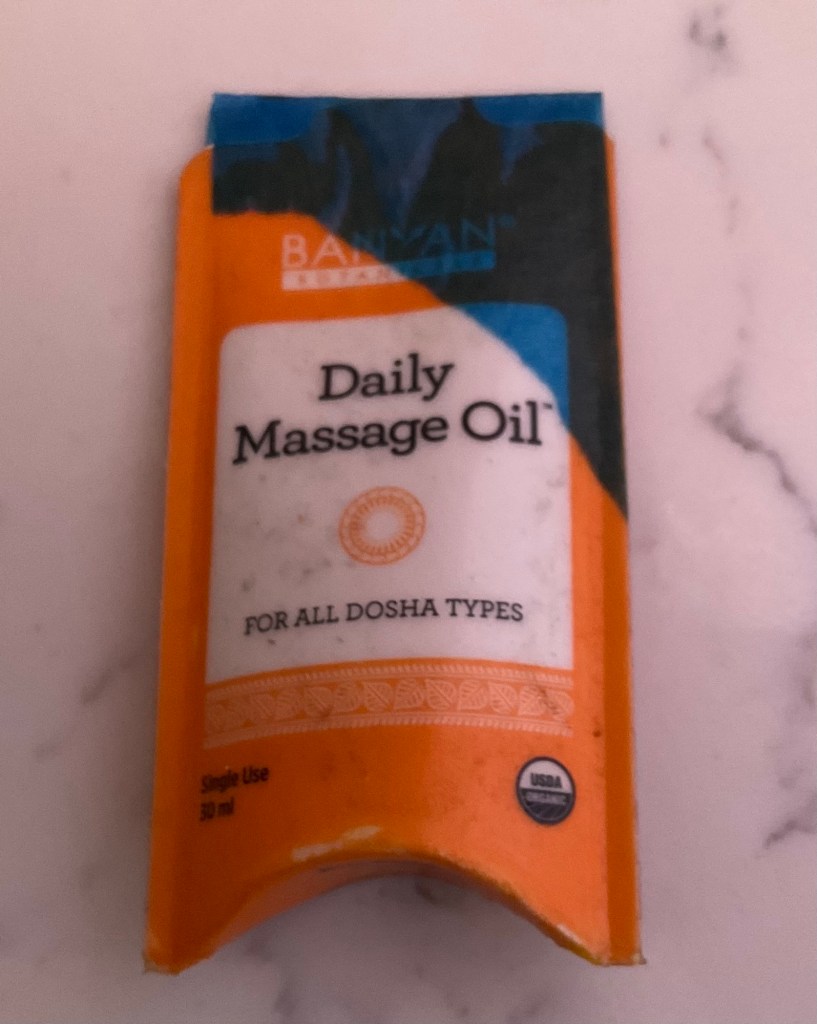
This morning, as I ended my shower, I noticed something on my shelf that has been there for about a year. It was something that I took home from a retreat that left me feeling worthwhile, loved, treasured, even and it was simply a packet of body oil. During the retreat, this packet of Danyan daily massage oil was distributed. We were invited to remove our shoes and socks, then to massage our feet and ankles slowly and generously with this luscious oil. The entire atmosphere, the culture of the retreat was focused on self care, so spending this time and energy on ourselves felt totally right. We were then offered a strip of blue masking tape and encouraged to close up the remainder of the oil for later use for ourselves. I did that and have been looking at this small packet in my bathroom ever since.
The oil packet
In those first days and weeks following the retreat, I’d think about how wonderful it had felt to indulge in that self care, deciding over and over that it wasn’t the right time to use the remainder, that I didn’t have the time, that I should save it for a better time, a time when I had extra time to use it with the care it deserved.
What was different about this morning? Perhaps it was that recently, I was invited to be a Guinea pig for an acquaintance, Susan, who was in training to be a life coach for senior citizens. My initial response was mixed. At my age (78), how could it make sense to have future goals? On the other hand, I’m still alive and I want to be as alive as possible!
In our initial sessions, which were held in-person at downtown cafes sipping tea, she interviewed me, seeking to understand what mattered to me, what I cared about, and what might make my life richer, fuller. Susan is an extraordinary listener! She sifted all of my chatter and identified two needs/goals/desires with potential conflict. One was my lifetime interest in supporting human rights; the other was my acknowledged need for self care, which I often consider as self-indulgent.
So, my homework is routine self reflection, not actual action to make changes. My guess is that, although I was not consciously thinking about it at the time, when I got out of the shower and spied that oil on the counter where it has sat for almost a year, I thought to myself, I have the time right now to use this and to relish using it.
I dripped the oil onto each thigh, then massaged it all over each leg, slowly and consciously, remembering the delightful experience at the retreat, taking my time and allowing myself to simply enjoy it.
Why had I been unintentionally saving it? For what? I’m not against saving, whether for a rainy day or something else. There is no reason to continue saving this oil. It’s luscious, but not precious. I wonder it I am unconsciously saving other things that I should simply be using, particularly if it would give me a simple pleasure. It’s ok, better than ok, to allow ourselves these simple pleasures. Is there something you are saving that you could be using with pleasure or satisfaction? Stop saving it!
Among the many things that have changed during my life is my inclination to host parties and family events. From the time that I was a young mom in my twenties, I relished everything about hosting family parties — the planning, the inviting, the decorating, the grocery shopping, the preparation, the serving, and finally, the gathering itself with the eating, the overeating. Actually, the final piece was, of course, the cleanup. I even enjoyed that, as I recalled the party, the interactions, and the mutual pleasures we all enjoyed. Christmas, Thanksgiving, Easter were the biggest gatherings and celebrations, but I also loved hosting dinner parties for six to eight people.
I remember one New Year’s Eve from my twenties when my husband and I entertained four other couples with a stretched out dinner with multiple courses, starring baked stuffed lobster, and ending with flaming baked Alaska. Ah, the pleasure in all of it! I also enjoyed impromptu gatherings when a couple of friends would stop over unexpectedly. I always had a few treats that I could put together, maybe an excellent cheese, gourmet crackers, good olives, and a chilled wine. Eating and talking with good friends, what a delight!
These are lovely memories and so different from my reality now. I have no awareness of how or why it changed, but my pleasure in hosting gatherings ended some time ago. I still love being included, when others are hosting, but the pleasure of planning and preparing for others is no longer mine. This is true, even if the guests are friends or relatives who I dearly love. My mind is empty of ideas for interesting foods, whether main courses or appetizers.
There’s not much else to say about it. However, let me describe an event at which I’m a willing guest, when others are taking pleasure in the planning, preparation, and serving. A few years ago, one of my cousins, Lucy, arranged a GIANT event for Thanksgiving, to be held in a nearby community hall.
Lucy contacted dozens of relatives, both local and out of state, to extend invitations to attend and contribute to the preparation. The foods — have I mentioned that my family is Italian — included multiple turkeys, homemade ravioli, and tomato sauce. After discussing with Lucy, it was determined that I would prepare butternut squash. I think I needed about a dozen and a half. The gathering lasted about six hours, with many courses, ending with sumptuous homemade desserts. There were probably about a hundred of us there, catching up with all the news. In between courses, we’d walk around, attempting to talk with as many people as possible.
After making all that squash and enjoying the full event for a few years, now we go for dessert and visiting during the last two hours. And, I love every minute and every bite!
So my pleasure in planning the food has diminished. My pleasure in being with others has not.
My 60th high school reunion was celebrated last week and it was a complete pleasure! Except, perhaps, for reading through the names of more than a hundred who have died. It was sobering to read, most of the names so familiar to me, reminding me of my good fortune to be among us, still walking around, still making choices on this earth. Almost a hundred were at the celebration, few that I could recognize without a name tag.
One of the guys I talked with at the beginning was someone I didn’t recognize. We hadn’t put on our name tags yet, so I asked him his name. When he told me, the memories came flooding back so clearly. He was still handsome, though different than my memory. We chatted for a while, each establishing that our spouses were not present, as they were not from Beverly and wouldn’t know the others there or particularly enjoy this occasion. We also expressed our happiness with our lives and our relationships.
After several moments’ consideration, I told him that, in high school, I’d had a crush on him. This, of course, clearly pleased him. We chatted another few minutes, then separated to join others for dinner and conversation over a couple of hours.
I loved the reconnection that happened with so many! Part of the reconnection was remembering others who had planned to be there, but, because of unplanned illness or recent surgery, were not presence. Among these were two special friends of mine, Karen, who has chronic illnesses, and Patty, who has been my reunion date every time, except this one. She’d had surgery recently and was, sadly, unable to attend. There were many inquiries about these women, who had each given me orders to report back to them with all the news.
Each reunion is different, but this one felt extra special, in part, because it was to be our last. Although there is an annual brunch for all classes of more than fifty years, this would be our last reunion for the Class of BHS 1964. It seemed to me that there was a strong mutual feeling of appreciation for our lives, more than simply because we were still alive. We didn’t talk politics or jobs or work history or vacations. Maybe we were simply just glad to be alive.
When people were beginning to leave the event, that guy I’d talked with at the beginning came over to me and gave me a hug. “I want you to promise me something,” he said.
“What?” I asked.
“In our next life, don’t wait sixty years to tell me.”
I think I said OK, shortly before returning home to my dear husband.
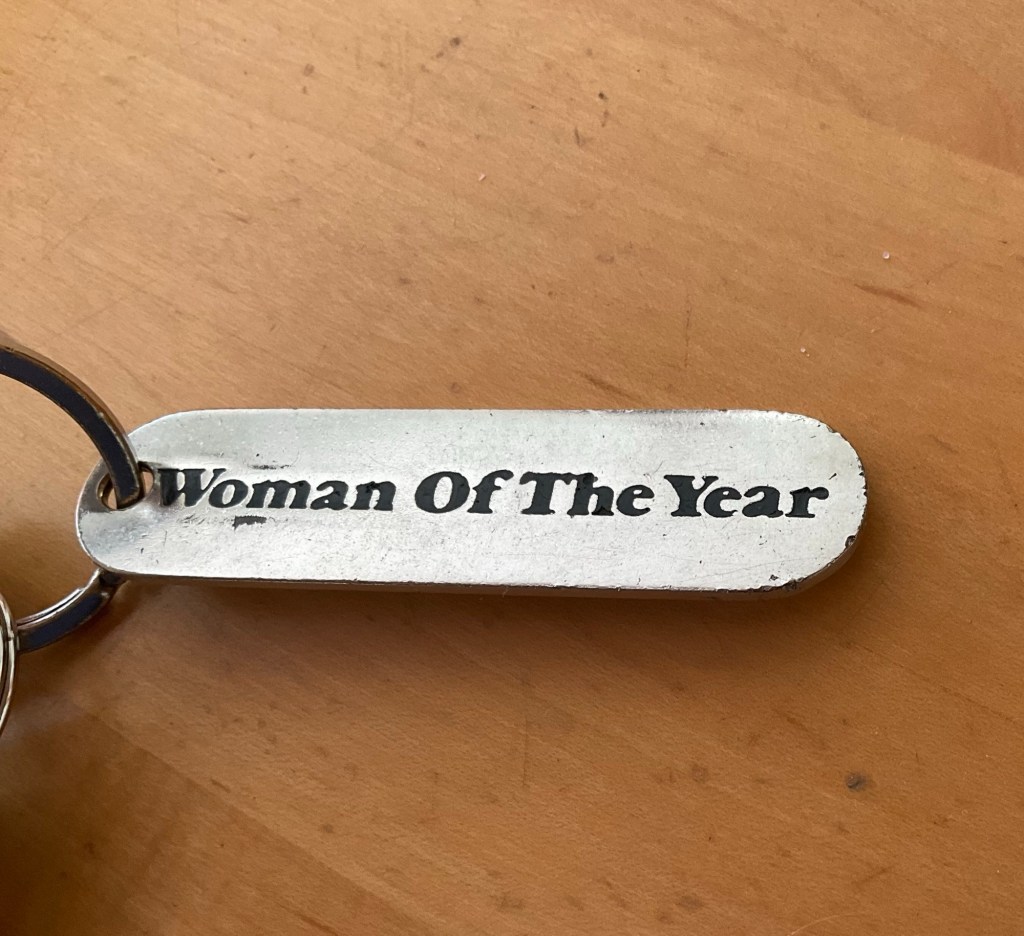
My personal history of public speaking has been inconsistent. During high school and college, it was nonexistent; in fact, I avoided taking any class that included any speaking requirement. It was not until I was in my thirties and becoming active in the women’s movement that I began to speak — and speak out. My terror of speaking was finally overcome by my desire to influence others with my words. Evidently, I was effective as well. While serving as president of the local Pennsylvania branch of the American Association of University Women (AAUW), I was honored as their Woman of the Year. I still have the dog tag given to me by my then-husband.
For the past four decades, I have frequently spoken for social justice in a variety of settings, often extemporaneously. It’s interesting to me that it’s not something I enjoy or seek. However, when it seems to be needed, I don’t hesitate to stand and open my mouth. Sometimes, it is planned and thoughtfully arranged.
For example, in 2019, I traveled to Israel and Palestine with a Jewish family, that I had recently met. They were (and are) activists, working to help others examine the glaring inequities in that region. Before the trip, I assured them that I was already quite active, with no intention of adding another cause to my life. By the time I returned home, I could not remain silent. Within the two months following my trip, six talks had been arranged for me in Massachusetts, New Hampshire, and Florida. Reading newspaper reports about conflict in other parts of the world is useful, but limited. When I had the chance to experience it firsthand, I could not remain silent.
I also wrote about it. That writing also influenced others, resulting in seed-money funding to support others desiring to travel there. In fact, one recipient of that funding is there right now. She has altered her initial intention to be there a month and is now committed to three months of service work, to return to the US at the end of November. One of the commitments she has made is to speak about her experiences upon her return. I greatly look forward to being in her audience.
On a completely different topic, I was recently asked to speak to the Salem Explorers, a learning group, about some of my vacation travel experiences. Evidently, I cannot speak publicly without sharing my convictions and attempting to influence my audience. My talk began with a quote from Mark Twain: Travel is fatal to prejudice, bigotry, and narrow-mindedness.
I have been invited to speak again next year about my planned trip on a canal boat in France. I said yes, though I still don’t enjoy public speaking.
In the spring of 2002, we spent two weeks in southern France with our 16 pound dog, Saffron. Why take a dog to France? Well, if you love your dog and he’s healthy and you want to travel in France, he’ll be most welcome there. The French love dogs, which are welcomed almost everywhere, including bakeries, shops, and restaurants. Churches are the exception.
There is a widespread myth that dogs must be quarantined before entering or re-entering the United States. There are probably circumstances where that is true. However, there are no quarantine requirements when traveling from Europe, if the dog has a current rabies shot and is in good health. The UK is a different matter with more stringent requirements.
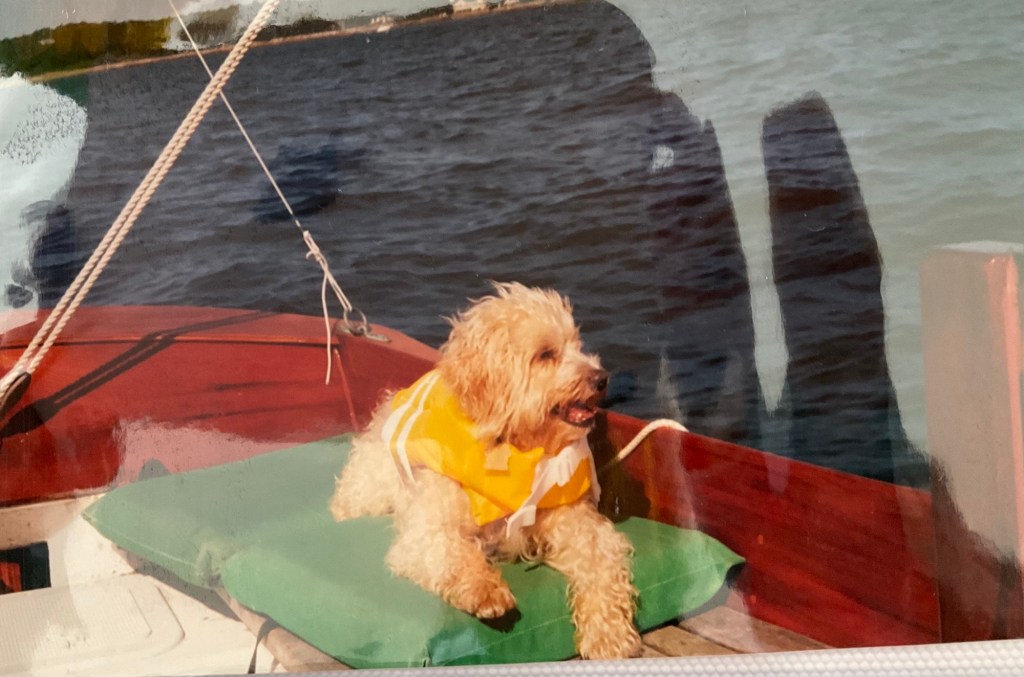
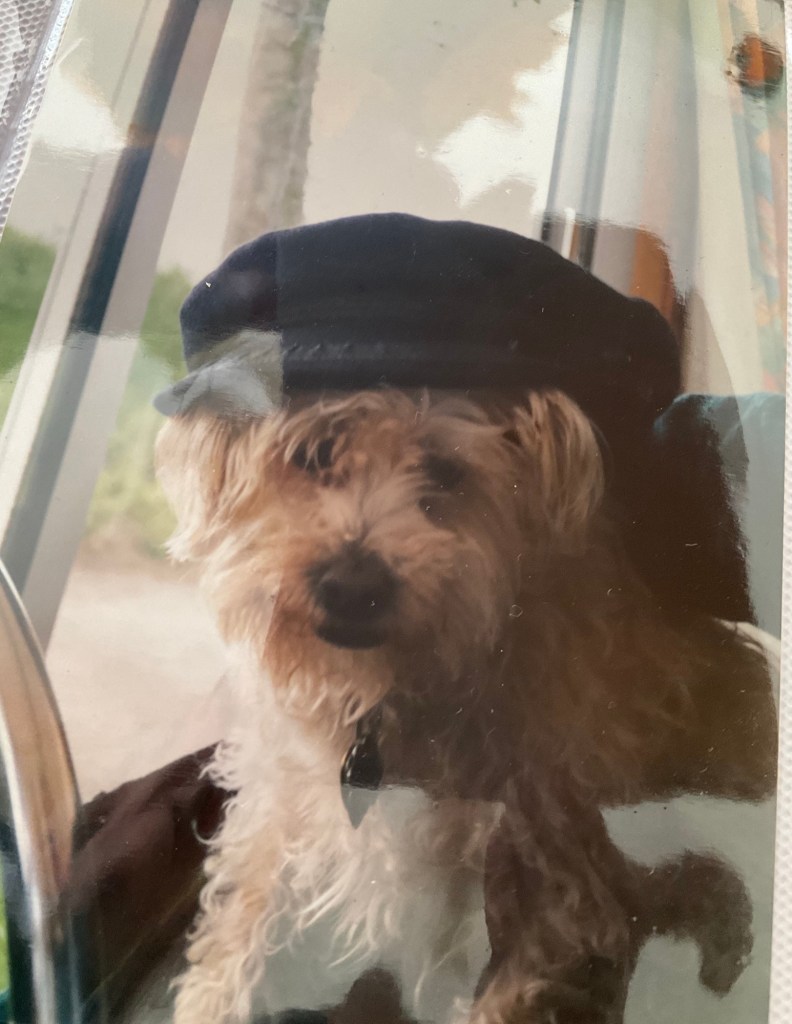
Saffron at home, on our boat
Before we traveled, I investigated entry and customs requirements for the US, France, and Germany, since we were flying Lufthansa and had a one hour stop in Germany. Note that you must investigate requirements before any contemplated travel, as the requirements could be changed at any time. I’ll share my experience from 2002.
Through the web, I read the US, German, and French requirements and then printed out two vaccination certificates, one each for Germany and France. The former was in English and German, the latter in English and French. The requirements were these:
• An exam by a licensed veterinarian during the five days prior to travel and a certificate to show:
• The animal is in good health and has no contagious diseases.
• The rabies shot is at least 30 days and no more than one year old.
• France required a certificate in French.
• Germany required a certificate in German.
During his preflight check up, Saffron’s veterinarian graciously filled in three copies of health certificates: the French, the German, and the standard US version.
After making the airline reservations for the people and receiving the tickets, I called to reserve space for Saffron. Pets under 15 pounds (we cheated a little on saffron‘s weight) can travel in the cabin with their people in a regulation airline pet bag as carry-on luggage under the seat in front of their owner. However, they limit the number of pets per plane.
A reservation is required for the animal and there is a charge. It was $105 each way, Boston to Toulouse, France. A couple of years earlier, we had taken Saffron to the West Coast for about $50 each way. Your vet may offer medication for sedation, depending on your dog’s nature. Saffron had traveled well in the past, so we didn’t medicate him.
To ensure the most comfortable flight for Saffron, we didn’t feed him for 16 hours before the flight and didn’t give him water for two hours before. Of course, he wasn’t going to be able to use the bathroom during transit. I was not concerned about the long flight to Germany, but about the time until the next short flight to France, not knowing whether there would be time and a place to walk Saffron between the flights.
The flight from Boston was unusually warm, so after arriving in Frankfurt and concerned about dehydration, I poured Saffron a little water. We hadn’t given him much to drink during the hours immediately prior to the flight, the unexpected delay, or during the flight itself, not wanting him to have to pee while in transit. Anyway, he didn’t quite finish the water. I looked around and there were no trash barrels in sight. After imagining trying to handle the cup of water along with Saffron, and my carry-on bag, I drank the water from Saffron’s cup, giving both Paul and Victor fodder for teasing me during the rest of the trip. Fortunately for Saffron, there was a visitors’ park within the Frankfurt airport, where he got the break he needed before the next short flight. We used this park again between our return flights. Saffron didn’t seem bothered by the flights, other than being a little whiny and squirmy from when we landed until he could leave his airline approved Sherpa bag.
At German customs, they asked to see his papers, so I was glad I’d gotten the vet’s certificate in German, as well as in French and English. We were never asked again for any of his papers, either in France, returning from Germany, or when we landed in Boston. We had joked that, if asked, we would present Saffron as a schnauzer in Germany and a poodle in France, since he’s half of each.
Saffron in France, on the Canal du Midi
In France, Saffron was with us virtually all the time: in our hotels and all the markets, in the shops and bakeries, in the restaurants. There were frequently other dogs in those places too, though the dogs don’t socialize with other dogs the way American dogs do. They stick to their master’s side, often without leashes, and are very well-behaved. When we made hotel reservations for Toulouse online, there was an option to check if you were bringing a pet. In restaurants, Saffron was usually offered a bowl of water.
In the French and German airports, Saffron was on his leash until we were actually boarding, otherwise walking through the airports with us. When we arrived in Boston and took Saffron out of his Sherpa bag, a guard immediately asked us to put him back in the bag until we left the airport. We were home again.
A final note — upon return, Saffron experienced jet lag along with us, falling asleep at night and waking in the morning much earlier than usual for the first couple of days. Traveling with him was a pleasure and I wouldn’t hesitate to do it again.