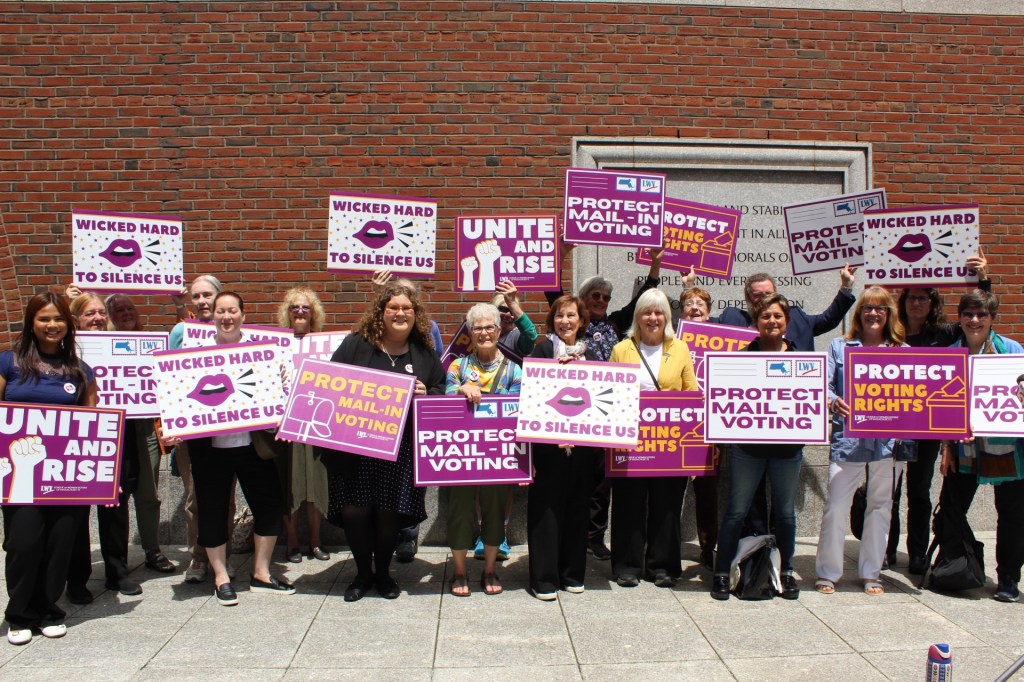
I was present at Moakley Federal Court in Boston on June 2, 2026, as a member of the Massachusetts League of Women Voters in a suit filed against Trump. We filled the courtroom, about 100 of us. The overflow room was also in use. I was seated next to a young woman from Plymouth, perhaps in her 30’s, who had recently joined and never taken part in anything like this.
This was a preliminary hearing. The next step is not clear to me. The judge was amazing, worked from 10:10 until 12:45, without a break, continually conversing with the attorneys representing the Department of Justice, Massachusetts League of Women Voters, and the ACLU. Certain other states were represented, too, including Texas, Florida, and California. She allowed attorneys to speak, then asked questions, always calmly, eliciting these ideas as she teased apart the various sections of the suit.
1. Trump issued an executive order that may not be legal, because it requested particular actions of the postal service, a national service, that may impose on individual state’s freedom to control elections, per our Constitution.
2. The order requested that a citizenship list be created that would contain all those who are eligible to vote.
3. Barriers to creating such a list are many, including the Privacy Act, which prevents federal departments from sharing their lists. As an example, the IRS cannot provide a list of tax filers to anyone else.
4. Trump’s order is that the USPS would use this list, only this list, to determine who would receive mail-in ballots.
5. It seems likely that any list would not actually contain every eligible voter.
6. It is the right of every citizen to vote. To deny that right is wrong, equally as wrong as a noncitizen voting.
7. Part of the order requires that any state not providing such a list to the postal service would not be allowed to offer mail-in voting.
8. There were many timing restrictions (60 days prior to the election, etc.) that were restricting and unclear.
9. All of this would apply only to federal elections, unclear about primaries.
10. The question was raised about whether people may be harmed by this, by being deterred from voting or being fearful.
11. The DOJ raised the point that in a previous suit, it was determined that potential fear was not a reason to avoid action.
The actual suit is 56 pages:


Carole, how wonderful that you were there, part of this appalling Trump action! It seems to me that another objection would be that the establishment of the USPS has no provision whatever for any role in elections of any kind – federal, state, or anything. The mission of the USPS is completely irrelevant to elections. In no way is the USPS qualified or permitted to decide who receives what mail. The work of the USPS is to deliver. Outraged, Bev 😊
LikeLike
Thankful that people like you actively participate in efforts to keep our voting rights intact, including mail in ballots. tRump will stop at nothing, whether or not it stomps on the rights of all citizens to have a voice, including involving the USPS. Interesting that he cries election interference and then attempts to create said interference to benefit himself.
LikeLike