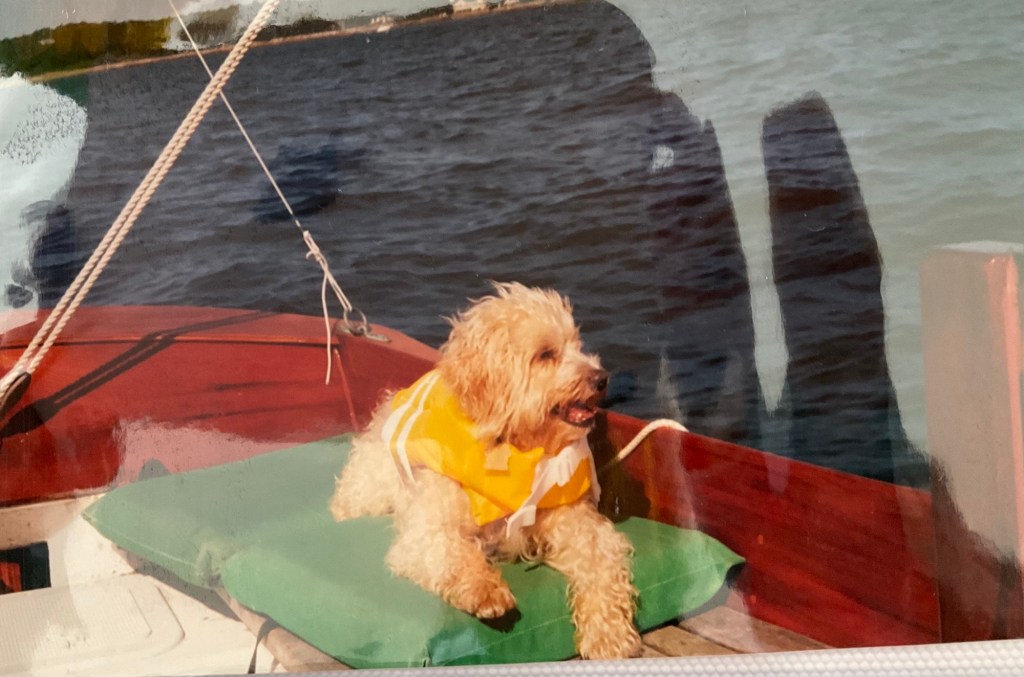
In the spring of 2002, we spent two weeks in southern France with our 16 pound dog, Saffron. Why take a dog to France? Well, if you love your dog and he’s healthy and you want to travel in France, he’ll be most welcome there. The French love dogs, which are welcomed almost everywhere, including bakeries, shops, and restaurants. Churches are the exception.
There is a widespread myth that dogs must be quarantined before entering or re-entering the United States. There are probably circumstances where that is true. However, there are no quarantine requirements when traveling from Europe, if the dog has a current rabies shot and is in good health. The UK is a different matter with more stringent requirements.
Before we traveled, I investigated entry and customs requirements for the US, France, and Germany, since we were flying Lufthansa and had a one hour stop in Germany. Note that you must investigate requirements before any contemplated travel, as the requirements could be changed at any time. I’ll share my experience from 2002.
Through the web, I read the US, German, and French requirements and then printed out two vaccination certificates, one each for Germany and France. The former was in English and German, the latter in English and French. The requirements were these:
• An exam by a licensed veterinarian during the five days prior to travel and a certificate to show:
• The animal is in good health and has no contagious diseases.
• The rabies shot is at least 30 days and no more than one year old.
• France required a certificate in French.
• Germany required a certificate in German.
During his preflight check up, Saffron’s veterinarian graciously filled in three copies of health certificates: the French, the German, and the standard US version.
After making the airline reservations for the people and receiving the tickets, I called to reserve space for Saffron. Pets under 15 pounds (we cheated a little on saffron‘s weight) can travel in the cabin with their people in a regulation airline pet bag as carry-on luggage under the seat in front of their owner. However, they limit the number of pets per plane.
A reservation is required for the animal and there is a charge. It was $105 each way, Boston to Toulouse, France. A couple of years earlier, we had taken Saffron to the West Coast for about $50 each way. Your vet may offer medication for sedation, depending on your dog’s nature. Saffron had traveled well in the past, so we didn’t medicate him.
To ensure the most comfortable flight for Saffron, we didn’t feed him for 16 hours before the flight and didn’t give him water for two hours before. Of course, he wasn’t going to be able to use the bathroom during transit. I was not concerned about the long flight to Germany, but about the time until the next short flight to France, not knowing whether there would be time and a place to walk Saffron between the flights.
The flight from Boston was unusually warm, so after arriving in Frankfurt and concerned about dehydration, I poured Saffron a little water. We hadn’t given him much to drink during the hours immediately prior to the flight, the unexpected delay, or during the flight itself, not wanting him to have to pee while in transit. Anyway, he didn’t quite finish the water. I looked around and there were no trash barrels in sight. After imagining trying to handle the cup of water along with Saffron, and my carry-on bag, I drank the water from Saffron’s cup, giving both Paul and Victor fodder for teasing me during the rest of the trip. Fortunately for Saffron, there was a visitors’ park within the Frankfurt airport, where he got the break he needed before the next short flight. We used this park again between our return flights. Saffron didn’t seem bothered by the flights, other than being a little whiny and squirmy from when we landed until he could leave his airline approved Sherpa bag.
At German customs, they asked to see his papers, so I was glad I’d gotten the vet’s certificate in German, as well as in French and English. We were never asked again for any of his papers, either in France, returning from Germany, or when we landed in Boston. We had joked that, if asked, we would present Saffron as a schnauzer in Germany and a poodle in France, since he’s half of each.
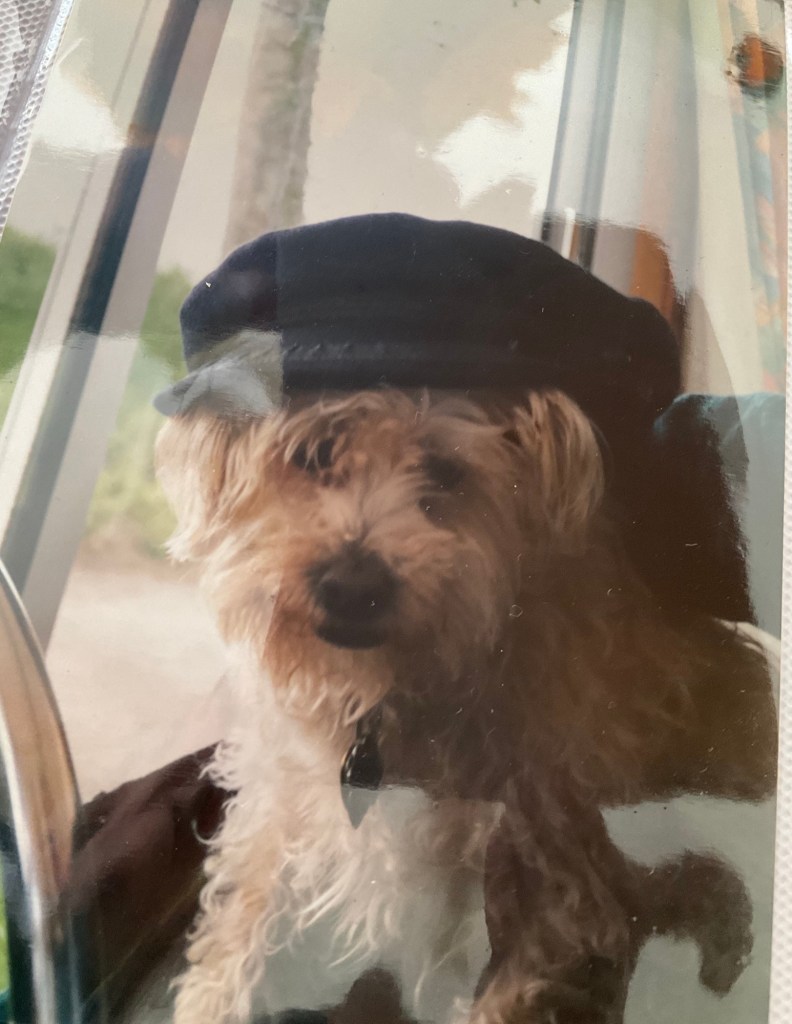
In France, Saffron was with us virtually all the time: in our hotels and all the markets, in the shops and bakeries, in the restaurants. There were frequently other dogs in those places too, though the dogs don’t socialize with other dogs the way American dogs do. They stick to their master’s side, often without leashes, and are very well-behaved. When we made hotel reservations for Toulouse online, there was an option to check if you were bringing a pet. In restaurants, Saffron was usually offered a bowl of water.
In the French and German airports, Saffron was on his leash until we were actually boarding, otherwise walking through the airports with us. When we arrived in Boston and took Saffron out of his Sherpa bag, a guard immediately asked us to put him back in the bag until we left the airport. We were home again.
A final note — upon return, Saffron experienced jet lag along with us, falling asleep at night and waking in the morning much earlier than usual for the first couple of days. Traveling with him was a pleasure and I wouldn’t hesitate to do it again.
Copyright ©️ 2024


What a wonderful story, and it’s exactly what I needed to read this afternoon: Thank you, Carole!
LikeLiked by 1 person