Thank you to those who have asked about my absence from writing, which I know has been missing. This was an assignment in one of my writing groups, which initially seemed like a boring topic. However, as I wrote, it became richer for me. I hope you enjoy it:
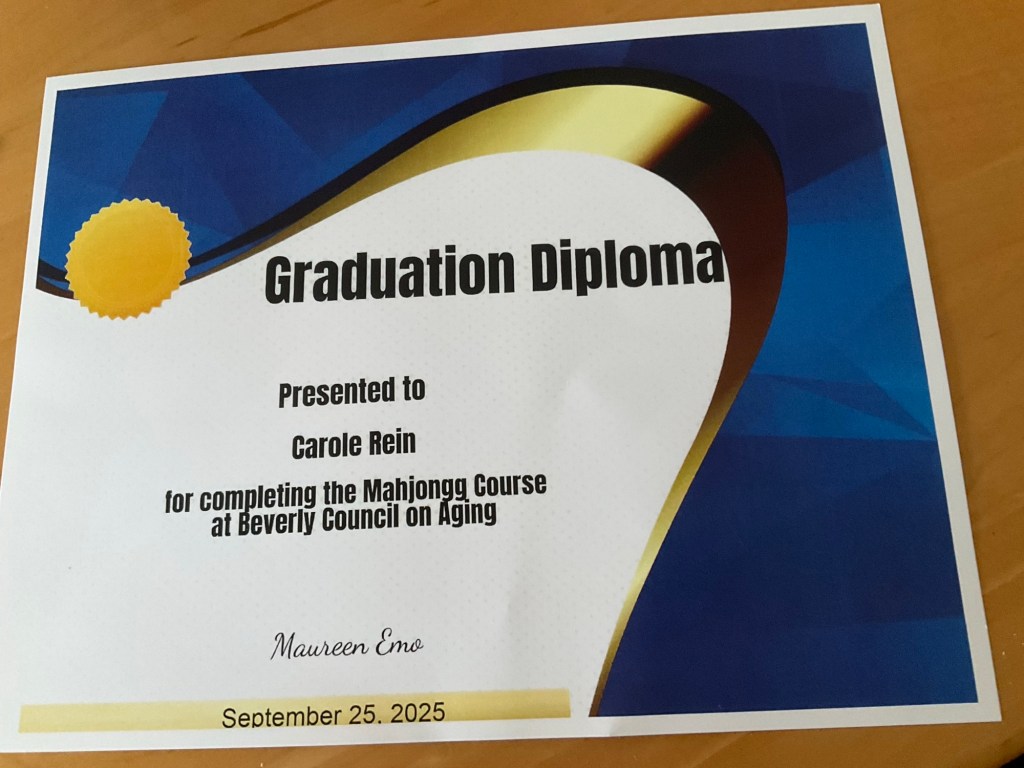
I’ve just received my ‘diploma’ for completing a four-week course in mahjongg, feeling a bit proud of it, too. I know several people who have been playing for years, so when I heard about this class being offered at my local senior center, I signed up. Initially, I was on a backup list, then was called the day before class started to learn that there was space for me to participate. Because of the late notice, I needed to borrow the ‘2025’ card from Reeny, my instructor, until I bought my own card.
It is a complex game, which now leaves me with a choice to make. It is clear to me that if I really want to play, I need to have a weekly commitment to begin playing and continue learning. I have come nowhere close to really knowing the game. First, there are the suits: bams, dots, and cracks, plus flowers, winds, and dragons, and, of course, jokers. After the complex rules of the game setup, the real challenge begins with understanding the more than fifty possible winning hands. Those hands change annually in the American version of the game, unlike the original Chinese.
This is so different than the card games I played as a teenager, which included Pokino with my family and poker, blackjack, or twenty-one with my friends, each relatively simple to learn, requiring minimal focus.
Remembering those simple games, a memory surprises me as it returns from about sixty years ago. In junior high, I made a new friend, Susie. Throughout high school and beyond, we remained friends and spent many hours together, engaged in multiple activities, including card games. During one game, after she kept winning, Susie showed me how she had been cheating. Her nonchalance about it surprised, even shocked me. This was my introduction to the possibility of cheating.
That was about sixty years ago, when I quickly forgot about it. However, the memory returned to me recently and has nagged me. I was brought up with a father who believed and taught us that lying and cheating were the worst possible actions. He used to say, “I don’t care what you do, but don’t lie about it.” Now, I wonder what Susie was taught. Yes, she told me, after the fact, that she had cheated. But, I wonder, how in the world did it even occur to her that cheating was a reasonable thing to do?
Beyond that, has it played a role in her life beyond high school? Has she continued to cheat? I am still in relationship with her. Her name is not Susie. Can/should I bring this up with her now? The enormous presence of cheating and lying in the world right now feels like the aftermath of cheating in a game and distresses me greatly.
So I am left with two unrelated decisions to make: should I raise this topic with ‘Susie?’ Should I make a commitment to mahjongg? Part of the weight of the second decision rests on thinking that it might interfere with my activism work. But, maybe that would be healthy for me.
Your thoughts are invited . . .
 Carole's Words
Oh Carole, Have many memories of my paternal grandmother playing mahjongg with her friends. The women would gather, gossip, share stories about children and grandchildren, and make rye comments about the body politic, all the while moving their tiles with expert ease. When in China about 12 years ago, once again saw people vigorously playing mahjongg, balanced on nothing but their haunches for hours! Chinese elders are in much better shape than ours! While games like this keep your mind sharp they seem to serve the greater call for community, something we all need, especially in these times. So play play play and then teach us!
LikeLike
Judith, ❤️978-922-7244 (land)
LikeLike