“Hallowed be thy name . . .” Many religions honor the name of God; at least one major religion never even writes or pronounces it. Even that word, God, is capitalized, as we capitalize our own names. I have often wondered why the name itself should be honored or hallowed, distinct from the Being.
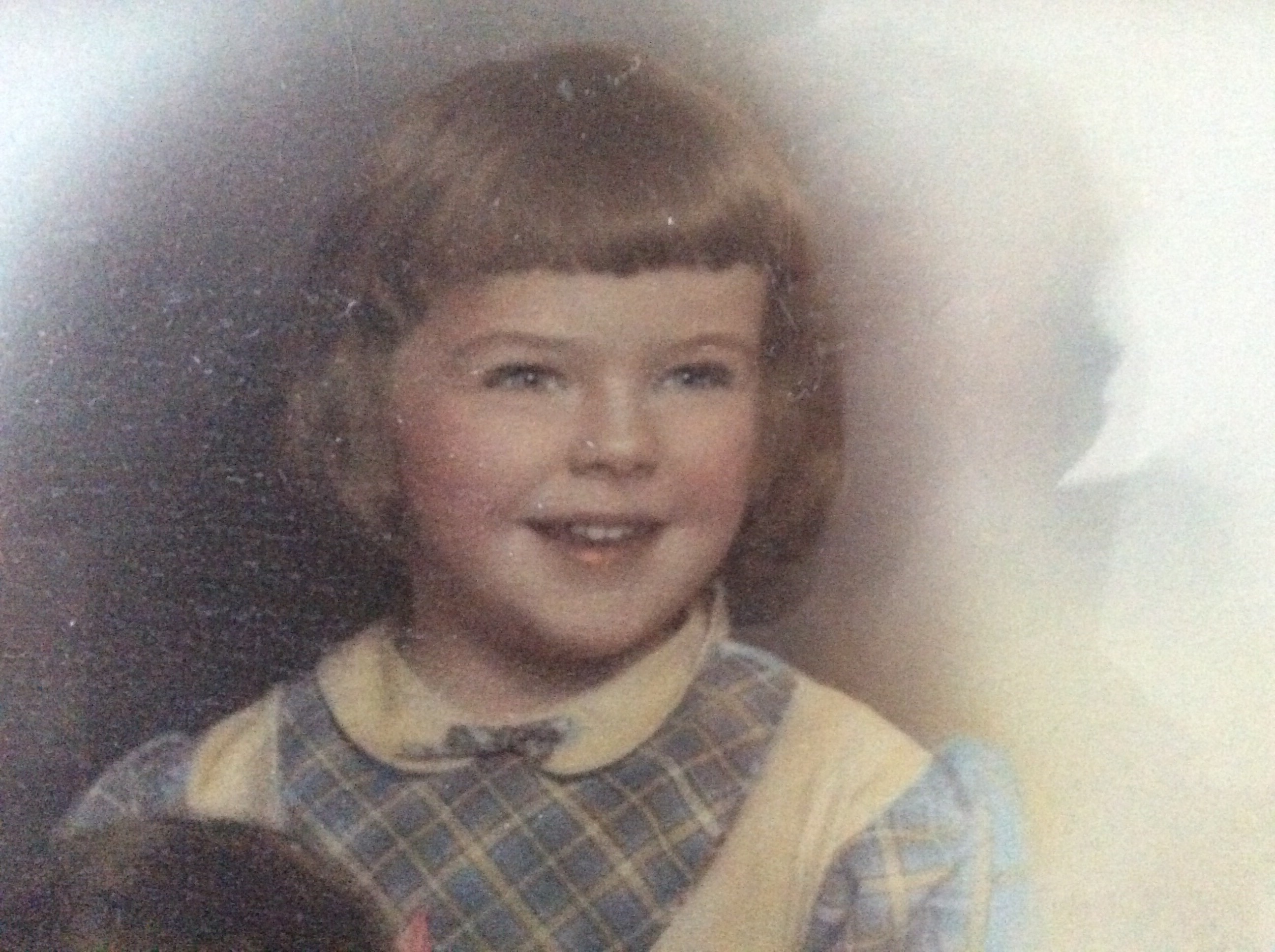
Without knowing the answer to that philosophical question, I recognize the importance that my name has had for me, through multiple iterations. At birth, the name given to me, the first child, adored from my first breath, was Carol Yolanda Rein. Although Rein was my father’s name, the other parts of my name were chosen by my mother: Carol, because she loved it and Yolanda, the name of her much-loved sister, who had died at 21 from a goiter.
From when I was old enough to consider it, I disliked the name Carol. It seemed plain and boring to me. When I applied for my driver’s license and first passport at age 17, I added an ‘e’ to it and it was processed successfully. It felt prettier to me and I was thrilled to be Carole, not Carol.
My next name change came three years later, when I was very happy to give up my father’s name for my first husband’s, LaRoche, which sounded quite elegant to me. For months before our wedding, I joyfully practiced writing “Mrs. Richard LaRoche,” pleased to be giving myself away. Oh, how young and foolish I was!
Fifteen years later, when I divorced, I chose to keep this name, not wanting our son to feel abandoned. After a year passed, I finally discussed it with my teenaged son, John Valentine LaRoche, born on Father’s Day and named after my father, but that’s another story. He clearly recognized my feminist tendency and expressed his surprise that I had not immediately taken back my own name at the time of the divorce. He assured me that he would not be hurt by my choice and that he fully supported my giving up his father’s name. (There’s a reason I love him so much!)
So I went through the routine court process to take back my father’s name and was genuinely surprised at the feeling that emerged in me, a freeing that was greater than when my divorce was finalized. When I remarried, there was no way I was going to take another man’s name again. I am fortunate to be married to someone for whom that’s fine. In fact, he may even be proud of it. He often tells the story of when we taught at the same school, that one of his students, a young woman, asked him why we had different last names. He explained to her, and I would say with pride, that I was a feminist. Clearly, it took nothing away from him, because it was about me, Carole Yolanda Rein.
Let’s go back to Yolanda. If I hadn’t liked Carol, you can imagine how I felt about Yolanda! The custom of using family names is common in many cultures. I grew up understanding how my mother’s love for her sister had influenced her choice for my middle name; however, I still disliked it. That changed when I was about twenty and recognized that the gardenia was my favorite flower, because of its gorgeous scent. When I mentioned it to my mother, she cried, then told me that it had been Yolanda’s favorite flower. This connection changed my feeling for the name, which I then came to love.
Another connection with Yolanda occurred more than thirty years later, when I learned that I had thyroid cancer and that the goiter that had caused Yolanda’s death at 21 was probably the same. I’m not concerned, because my thyroid has been removed, an option not available to my namesake in the 1930’s.
There’s one final chapter to my name story and it’s about Rein. It was my dad’s name, modified by his father from the original Reinhardt. My dad always pronounced it with two syllables, Re-in, as in reincarnation. That’s how I pronounced it for fifty years. Then, when my great-nephew, Shane, was in school, one of his teachers called him ‘Shane Rein,’ with rhyming names. His siblings liked it and began to use that pronunciation, and even my mother adopted it! For me, when I began to teach, I decided that was the time for me to change, so I became Ms. Rein, as in reindeer. This has caused some confusion for anyone I grew up with, but don’t see routinely, so I have think before self identifying, am I Carole Re-in or Carole Rein?
If I had it to do over again, it would be Rein, to rhyme with Gertrude Stein and Einstein, two of my heros.
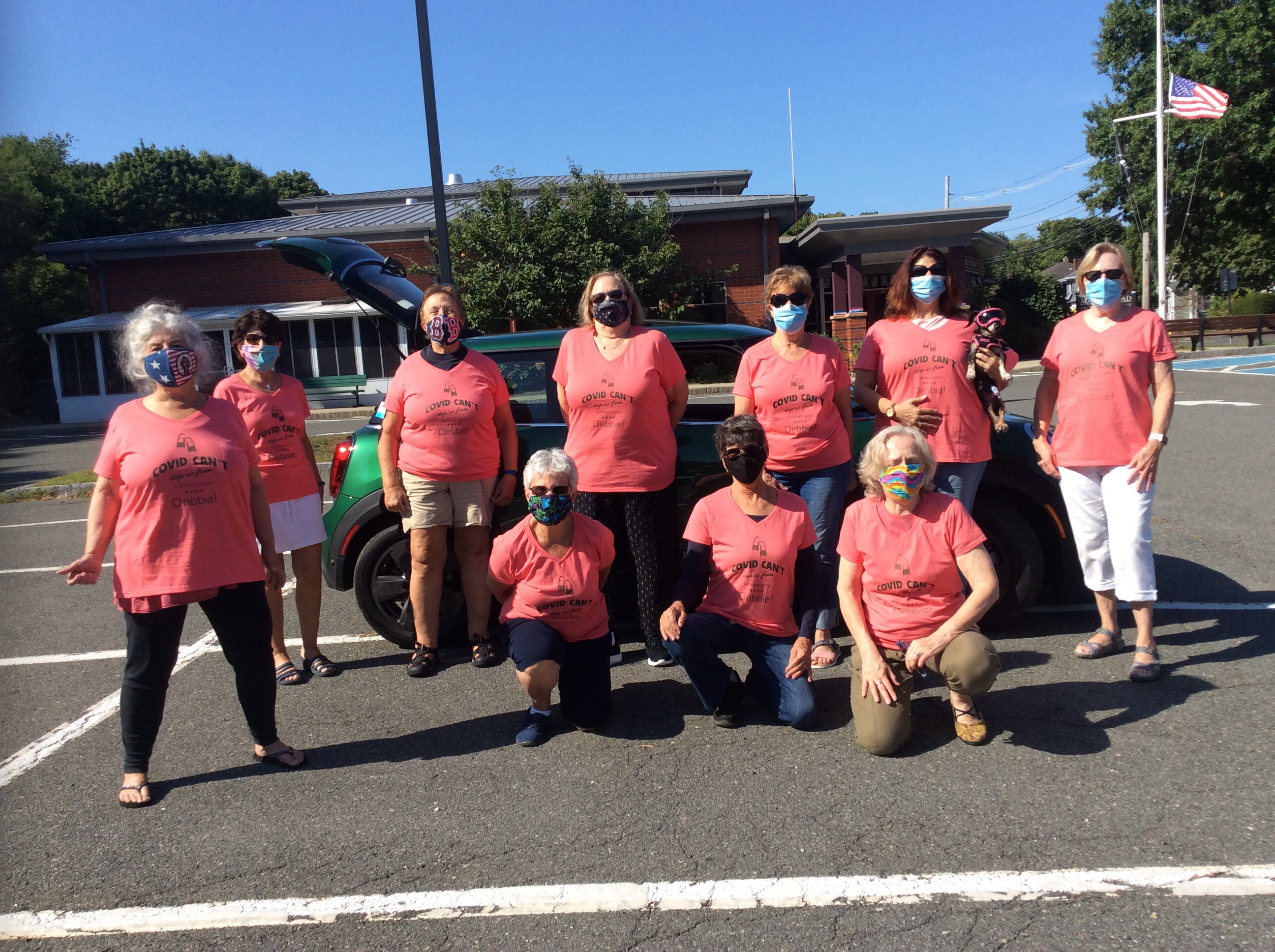
Some tap-dancing-mates, with new t- shirts, “Covid can’t stop us from dancing with Debbie!
How many people in their seventies still have teachers? I have no idea, but I have several teachers for whom I feel grateful. Thanks, Debbie, Emily, Barbara, Nancy, Barrie, Maile, Nerissa, and JoAnne, this is for you.
Eight teachers, that’s a lot or the number seems high for people my age. Let me tell you about each of them, because I love each one. The person I’ve known the longest is Debbie, my tap dancing teacher, introduced to me through a friend, Nanda, who I know through a neighborhood group. She arrived at our group about five years ago and mentioned her tap-dancing class, held at local Senior Centers, and I was captivated. As she answered my many questions, I gradually recognized how much I wanted to try this.
Unlike some of my classmates, I had never taken tap or any dance class as a child. Nanda told me that Debbie had shoes available to borrow, that she loved the class, and that Debbie was kind and patient. I was determined to try it, knowing that I could return the borrowed shoes and quit anytime. Or, if I liked it, I could buy my own tap shoes. I tried it, I liked it, I bought my own tap shoes, and I love the women I tap with. Debbie’s patience with us is just about infinite. The songs we dance to are all oldies, fitting for our ages, sixties through eighties.
After attending tap at the Marblehead Senior Center, I noticed an ad for another class there, Dance for Joy. That class, taught by Nancy, was a combination of Tai Chi, yoga, stretches, and jiggling. Nancy is someone whose persona permeates joy.
Then came Covid. Each of these classes ended for a month or so, then each started again on Zoom. Each teacher went through a technology learning curve quickly, I think, and I believe them to be responsible for maintaining my sanity during this past Covid year.
Two other dance teachers who use a similar dance style to Nancy (Shake your Soul) are Emily and Barbara. They are located at senior centers about two hours away from me, so it is only because of Zoom that I can participate. Also, it is only because each was willing to share information about the other classes that I even knew that they exist and that they welcome new students.
Another class that I started about three years ago at the Beverly Senior Center was in writing, taught by Barrie. She provided a writing prompt, which we would use as fodder for writing prior to our once-a-month class. Then, during class, we would read aloud from our work and hear classmates’ responses. This class was also interrupted by Covid, then resumed six months later, every two weeks on Zoom. Barrie intermittently used one of our papers to offer corrections and comments as instruction, always with permission and with kindness.
It was during the period before Barrie’s Zoom sessions began that I signed up for a writing class with Nerissa, who I knew only as a singer/songwriter. This was significant, because this class cost real money, not the token few dollars that we paid for Senior Center classes. It marked a transition for me, in recognition of what writing was starting to mean to me. I’m now on my second ten-week commitment with her and two months into authoring a blog, publishing one article each week.
Then, a casual friend, Maile, now working at a local library, started a new one-hour class: Shut Up and Write! It was simply a commitment to write during that hour. Maile has a sweet and supportive attitude that makes me happy to join her for this writing hour.
The last teacher who I want to recognize is JoAnne, who was my math teacher forty years ago when I was a math major as an undergraduate. She was the only woman professor in the math department. It had recently occurred to me that, without being conscious of it, she had served as my role model during the eleven years I taught Algebra before I retired. I looked her up on Facebook about six months ago and we have reconnected with Zoom. I have loved our time together, whether remembering past times or enjoying sharing bits of our current lives.
So, Emily, Barbara, and JoAnne are in my life because of Covid. To each of you eight teachers in my life right now, I am very grateful. I cannot imagine this past year without you in it. I thank you for your patience, your desire to teach, your acceptance of my limited skills, your talent in what you do, and the delight you each give to my life. Thank you, teachers❤️.
Recently, the press has presented the pros and cons of leaving middle seats empty for virus protection. I’m not thinking about traveling soon, but I am reminded of the last time I was in a middle seat. It’s never a desirable seat, but on that flight, it was cause for anxiety, then hope.
The flight in January 2019 was from Tel Aviv to Toronto and lasted about twelve hours. I fly often and am never nervous about it, but prior to this flight, I was somewhat worried. I was returning home from sixteen days in Israel and Palestine, with a small group led by a Jewish couple who had visited there often. I had the advantage of their experience and thus visited with several NGO’s, had dinner with a Palestinian family in their home, had tea with Bedouins in their cave, watched a concert at Aida refuge camp, and hitchhiked — for the first time ever in my life, on the road beside the Dead Sea. Although I have spoken about these things, I haven’t yet written those stories.
Our group’s leader, Steve, had given us careful instructions for our return flights. I had stayed an extra few days on my own, so was traveling alone, that is, without friends, so yes, did feel a little nervous. Let me tell you why.
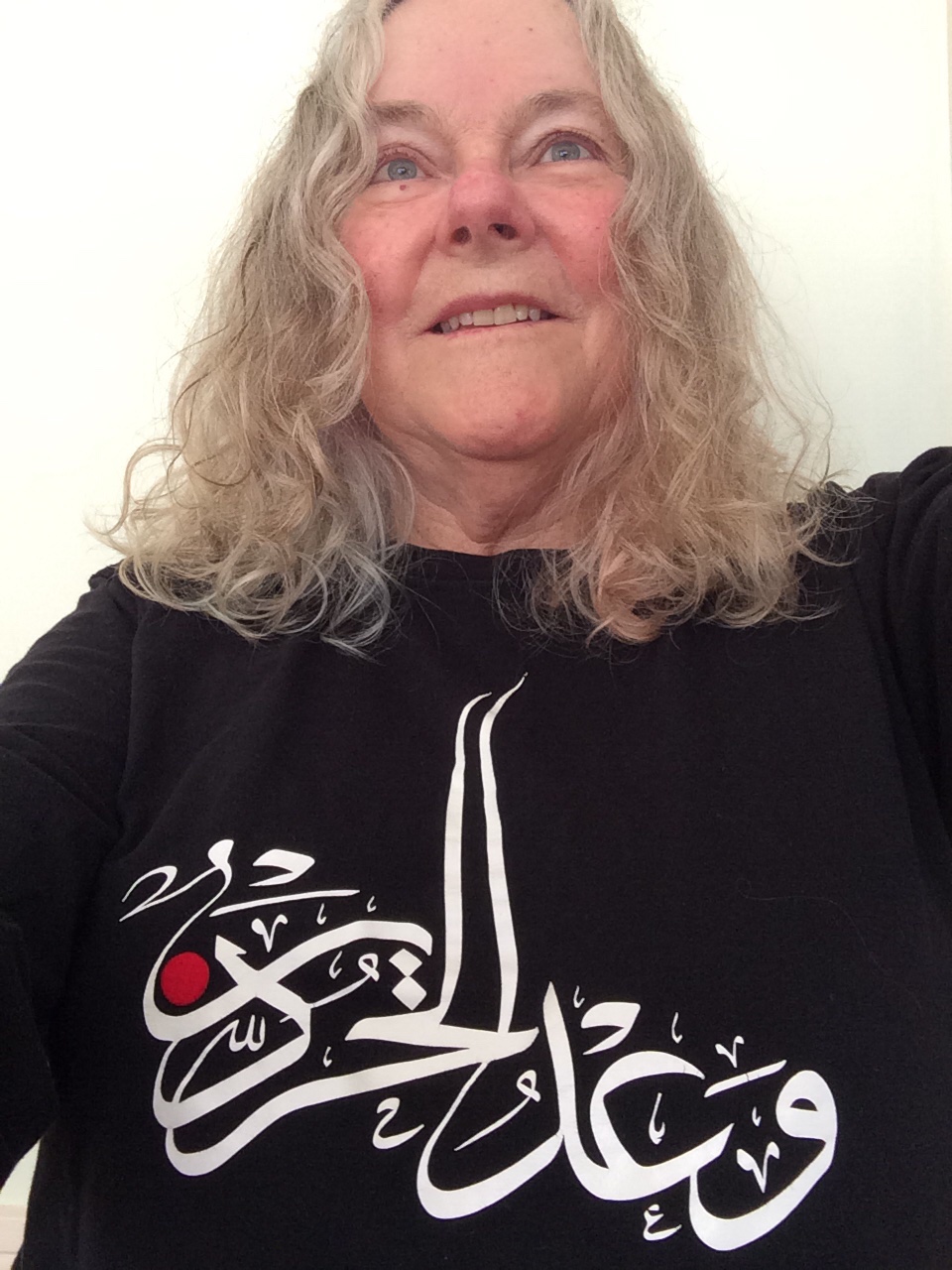
Steve had strongly suggested that anything we had bought from Palestinians be packed in the middle of our luggage, so that any quick checks by Israeli soldiers would not disclose any items they might confiscate. This included books and clothing. I had one particular shirt that I was determined to wear home — it was a soft, black cotton, long-sleeved shirt with beautiful Arabic script that meant ‘the promise of freedom.’ I decided to board wearing it inside out, intending to visit the restroom in mid-flight to turn it right-side out.
I’d gotten through customs successfully, with my other contraband items safely concealed. I boarded and found my seat, a middle seat between a young man and a woman. I loved knowing about the secret message on the inside of my shirt!
Shortly after take-off, the young man to my left chatted with me briefly and I learned that he had been an Israeli soldier. My heart sunk. My experiences during those past two weeks included watching soldiers harass school children as they passed through checkpoints on their way to school and having some soldiers point their machine guns at us, as they stopped us from driving onto a Palestinian road where we had planned lunch with some Palestinian schoolteachers. No, there would be no casual conversation on this flight.
But, somehow, we talked. After my initial disappointment that he had been a soldier, I returned to my more typical frame-of-mind, wanting an open discussion. I asked if he remembered how he felt prior to his duty, anticipating it. He said that, because it wasn’t a choice, he didn’t think about it; he just had to do it. I described the mental turmoil that many U.S. students as seniors feel as they choose their college.
Then this soldier told me that he had relocated to Toronto after completing his required two years of duty and was returning home now, after visiting his ailing father, who still lived in Jerusalem. Then, he surprised me by saying that, after his required tour-of-duty ended, he had been asked back on two occasions to participate in government studies investigating reported PTSD.
What followed was the most amazing conversation. So, I asked him, did soldiers really have freedom to describe events that may have caused PTSD? The setup was that soldiers from the same platoon (that may not be the right word) were invited back for a weekend, then again six months later, for a weeklong discussion of their experiences. The reasoning was that soldiers who had served together would have similar shared experiences.
He described to me the story he shared with his soldier group and assigned therapists. His platoon’s assignment was to remove Palestinian families from their homes, to enable the houses to become part of an Israeli settlement. In one house, the Palestinian dad refused to leave. As a result, the soldier experienced anguish and actually brought food to this man, an act forbidden by the government.
I’ve forgotten the details of the story, but clearly remember how it affected this soldier. So, when he described it to me and its telling to his commanders, I asked about the response. The response was that other soldiers told similar stories and they were heard; their stories were listened to.
From the middle seat of the plane, I was beginning to get a stiff neck and finally asked if we could take a break from talking, watch a movie, then go back to talking. My new friend agreed and we took a break.
When we started talking again, he described how the commanders were learning how harmful this was to their own soldiers, as many soldiers shared similar disheartening experiences. I visited the restroom and turned my shirt right-side out. When I returned to my seat, my new soldier-friend smiled. We continued to talk, even crying together, and the twelve-hour flight ended too soon.
When I left Israel, I didn’t have much hope for future peace there, but after twelve hours in the middle seat, by the time I landed in Toronto, my hope was starting to bud.
August 1994, that’s when this story is centered, though it didn’t begin or end then. It actually begins right now in February, with my watching the Netflix series, Merlin. I have always been fascinated with magic or its possibility. Maybe miracles, too. But, is there any difference? People can believe in either or neither or both. Here are my thoughts on the matter.
I have always believed in the power of imagining my future and have watched it materialize in my own life more than once. For example, when I was an uneducated housewife and mother, with no idea of what my future held for me and no idea of my direction or desires, I would intentionally picture myself in an airport, wearing a broad-rimmed hat and carrying a briefcase, walking briskly. For whatever reason, this symbolized for me a woman of importance with work to perform. I used this imagery, perhaps for a few months and then forgot it, until one day, years later.
It was after finally earning a college degree and securing a job that occasionally involved travel. I was traveling for business (I don’t remember where or when) and suddenly, in an airport, I recognized that I was living the life I’d imagined for myself many years earlier with an overwhelming sense of deja vu.
I was working for an international company, Price Waterhouse, as a computer specialist. In that position, I had the privilege of working with computers and software during that time when personal computers were relatively new.
Price Waterhouse was an elite company that was very classist, if that’s a word. I was proud to work there, but I was not in their ruling class, because my work supported their accountants, who were the ruling class. In 1993, there was an announcement of a future award, the Merlin Technology Service Award, to be given for ‘innovative and creative use of technology.’ When I saw the award, a crystal and brass sword, an eight-inch letter-opener, I wanted it, however, I knew that it was intended for the accountants, to inspire their use of technology, not for the technology support staff, me.
This was in another age, before internet use was common. Price Waterhouse had about 50 offices in the United States, each with its own technology support group. The culture at that time was to protect your own knowledge, not to share it. Your personal knowledge was your power. Somehow, I never absorbed that message, but instead, developed networks across the country among technology staff, where we shared common technical problems and their solutions.
In August 1994, technology staff from all US offices were to gather for our national conference, as we did every year. Three days before we were to meet, I received a phone call, asking me to be prepared to be one of the recipients of the Merlin Award, but to not let anyone else know.
For any of us, there are only a few days that stand apart from all the rest, maybe a wedding day or graduation or a special birthday. That day of receiving that award – the certificate hangs on my office wall – is one of those days for me. The recognition and praise for the information sharing that I had facilitated, in front of my peers from across the country, was a magical day for me.
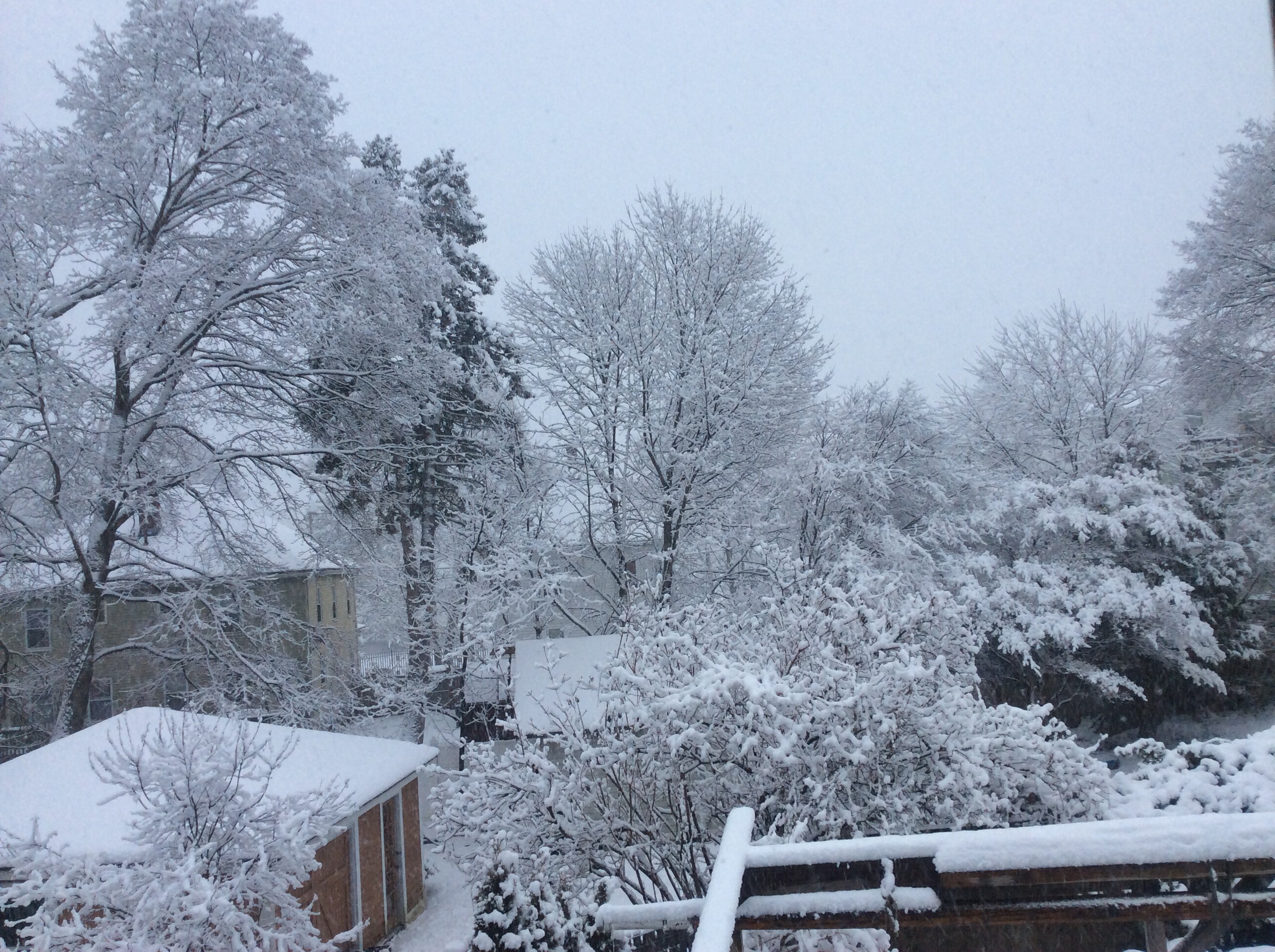
There is magic today, too, in the snow clinging to the trees under a bright blue sky, while we spin on a planet circling a ball of fire. How can we not believe in Magic?
Let me begin with some of the basic facts of the event – the action, as we protesters refer to it. I’ve been a part of the climate disobedience team for several months. For that role, multiple sessions have included non-violence training, attorneys, and experienced protesters. I was one of many who were willing to be arrested. There were no guarantees about possible consequences, which included being bombarded with tear gas or otherwise being roughly handled by the police and being charged and/or convicted of a felony.
After a lifetime of being law-abiding, I became a criminal last summer when I participated in my first ‘action’ as part of a climate protest. I trespassed at a coal-powered energy plant in N.H. and helped to remove, i.e., steal, 500 pounds of coal. At that time, I was one of about 20 protesters. No action was taken against us, because the authorities wanted no press.
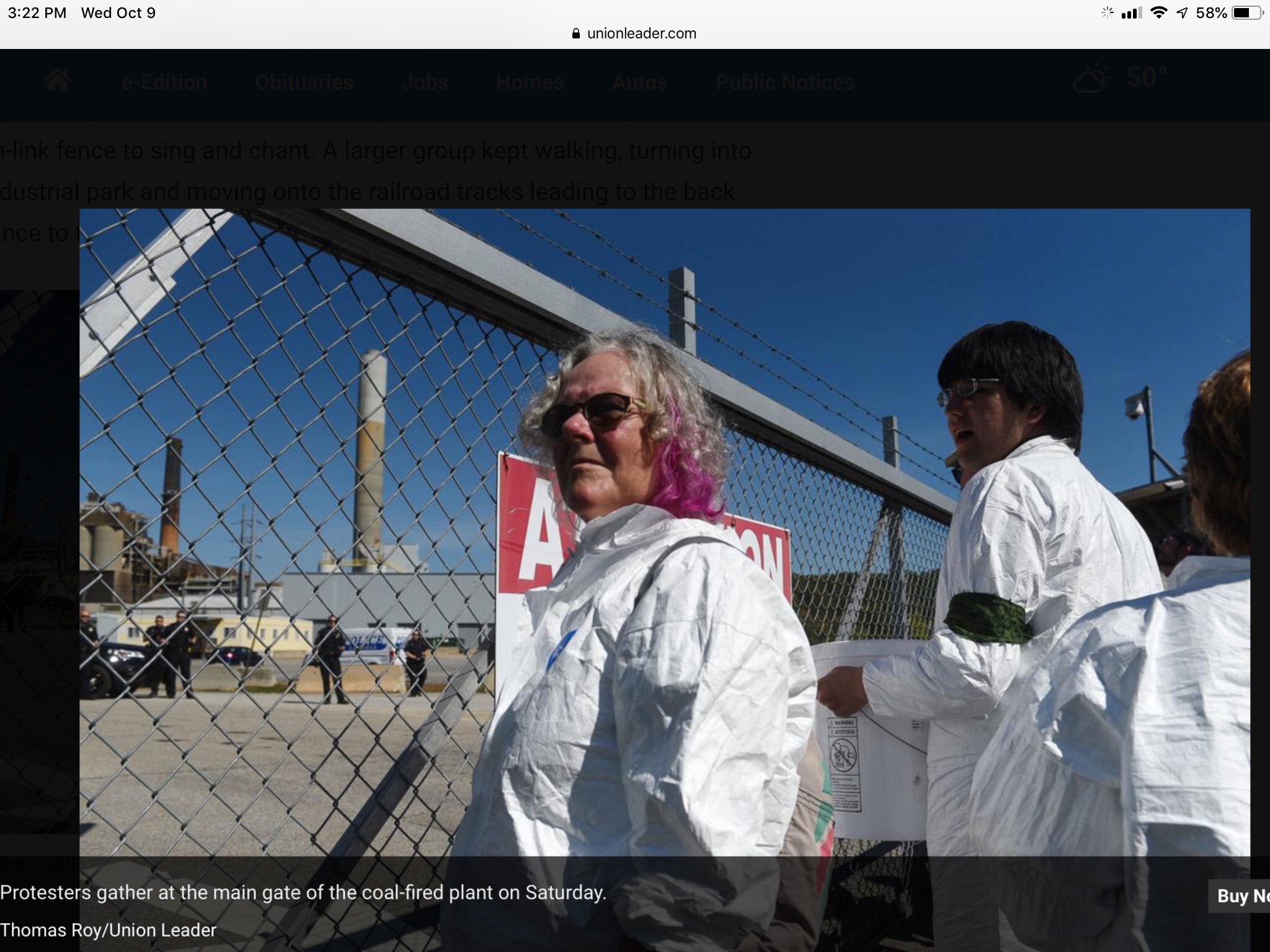
So, what’s a protester to do, when YOUR goal is press? We gathered more protesters, hundreds more, set a date (Saturday, September 28, 2019), and contacted the police in advance to let them know we were coming. The result was that by 9:00 am that day, the power plant was surrounded by dozens of uniformed police, both local and state, heavily armed, many in riot gear, plus a police helicopter overhead.
More than a hundred of us were willing to be arrested and dressed in our ‘uniforms,’ white tyvek suits (hazmat), carrying white buckets. We carried the buckets, with which we had removed coal on our prior visit, although we were told it was highly unlikely we would get anywhere near the coal piles.
Another hundred and fifty people who did not want to be arrested were there to support us, marching with us, rallying, giving speeches, singing, cheering with us until we crossed the giant ‘No Trespassing ‘ signs.
I just had an Alice’s Restaurant moment, you know, that old Arlo Guthrie folk song, where Alice’s Restaurant isn’t mentioned until well into the song. So, this paper is about the other person’s perspective, but I haven’t gotten to that part yet. It’s coming.
I’m leaving out a lot now about the hours of protesting in the sun at the front gate while some of us – not me – were being arrested on the other side of the plant. We were facing a huge fence, impossible to climb or trespass. At the back, there was only a short gate to get through. By 3:00 pm, we were hot — those hazmat suits act as personal saunas. I was tired, out of energy. We had a brief conversation among us to decide next steps. I felt ready to call it a day, go home, but somehow realigned, deciding it wasn’t yet time to quit.
Two to three dozen of us in our white suits headed to the road and walked the mile towards the back of the plant. When we arrived at the head of the short street leading to the piles of coal, there were three police cars blocking the entrance, the police officers outside of their cars. Knowing the road was public, we held another brief meeting among us. The No Trespassing signs were another quarter mile up that little street.
We linked arms, walking in groups of 2-3, singing what had become our theme song, 🎼 “Some people say, ‘That’s not my problem. Some folks do what must be done.” 🎼 Clearly, we were doing what must be done.
We arrived at the short gate with the giant No Trespassing sign. In case there was any doubt, the police officers on the other side told us firmly that, if we did cross that gate, we would be arrested. There was a moment’s hesitation, then one woman went over the fence, a man crossed under, and I crossed between the metal bars, followed by dozens more.
Just before I did, the police officer immediately in front of me looked me in the eye and said, “Please don’t do this.” All I could see was his humanity. Too often we are exposed to examples of police brutality, but I didn’t experience that. Then again, we protesters were mostly white. I saw a human being who wanted me to act differently, but respected my right to take this action. Was I a recipient of white privilege? I think so.
I crossed through the gate anyway. As soon as I did, he said, “You’re under arrest.” This became for me a moment frozen in time. I saw that my younger partners-in-crime had been told to sit on the ground with their hands handcuffed behind them. I thought, if he does that to me, I won’t be able to get up. My arresting officer turned my bucket upside down and asked me to sit on it. Before he got out the handcuffs, he asked me if I had any shoulder problems. I said no, but thanks for asking. Then, he gently pulled my hands behind me, asking if the cuffs were too tight. Was I a recipient of age bias, in this case, privilege? I think so and, I’m embarrassed to admit, I was glad to accept it.
We spent about 45 minutes there before being taken to jail. My first court date was November 18, 2019.
This announcement is for the benefit of those who are ‘following’ my blog. I’m sticking with my original intention of releasing one article per week, generally on Wednesday. However, I am adding several pictures to existing articles and fear that you will get an announcement with each change. Rest assured that I will be completing those changes today, so feel free to ignore today’s messages (just delete them), unless you want to see the fabulous pictures!
I don’t want you to be annoyed with the multiple messages and truly appreciate you following my blow.
Thank you!
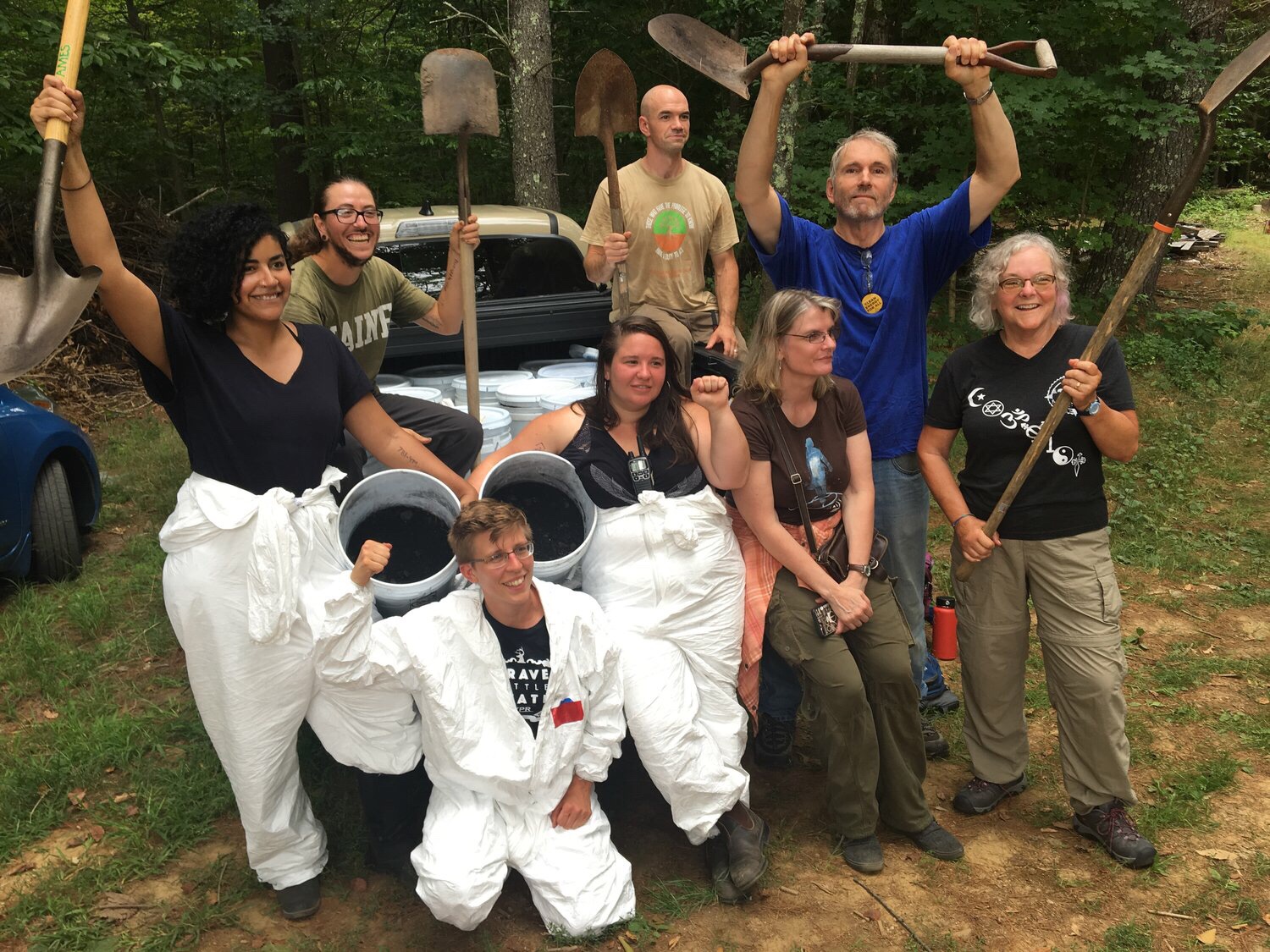
Here’s two of my favorites, taken after a climate disobedience action.
Bow, NH September 2019Two hours before being arrested
Among the major news items this week was the Ever Given, the enormous ship causing havoc in the Suez Canal by obstructing boat traffic by getting stuck in the shore at an angle that prevented the passing of any other vessel. After five days of eleven tugboats tugging at the vessel, while other equipment and people dug at the sand embedding it, help was anticipated from the full moon on Monday night.
Around the world, the moon pulls the tides in our oceans to and from all our beaches. Every day, there are two high tides, which are the highest during the full moon. Sure enough, the extra lift given to the vessel by the rising tide on Monday was enough, with the tugboats tugging and the land equipment digging, to free the Ever Given and release it. That was the same moon that shone into my eastern skylight during moonrise on Sunday evening and through the western skylight as the moon set Monday at dawn.
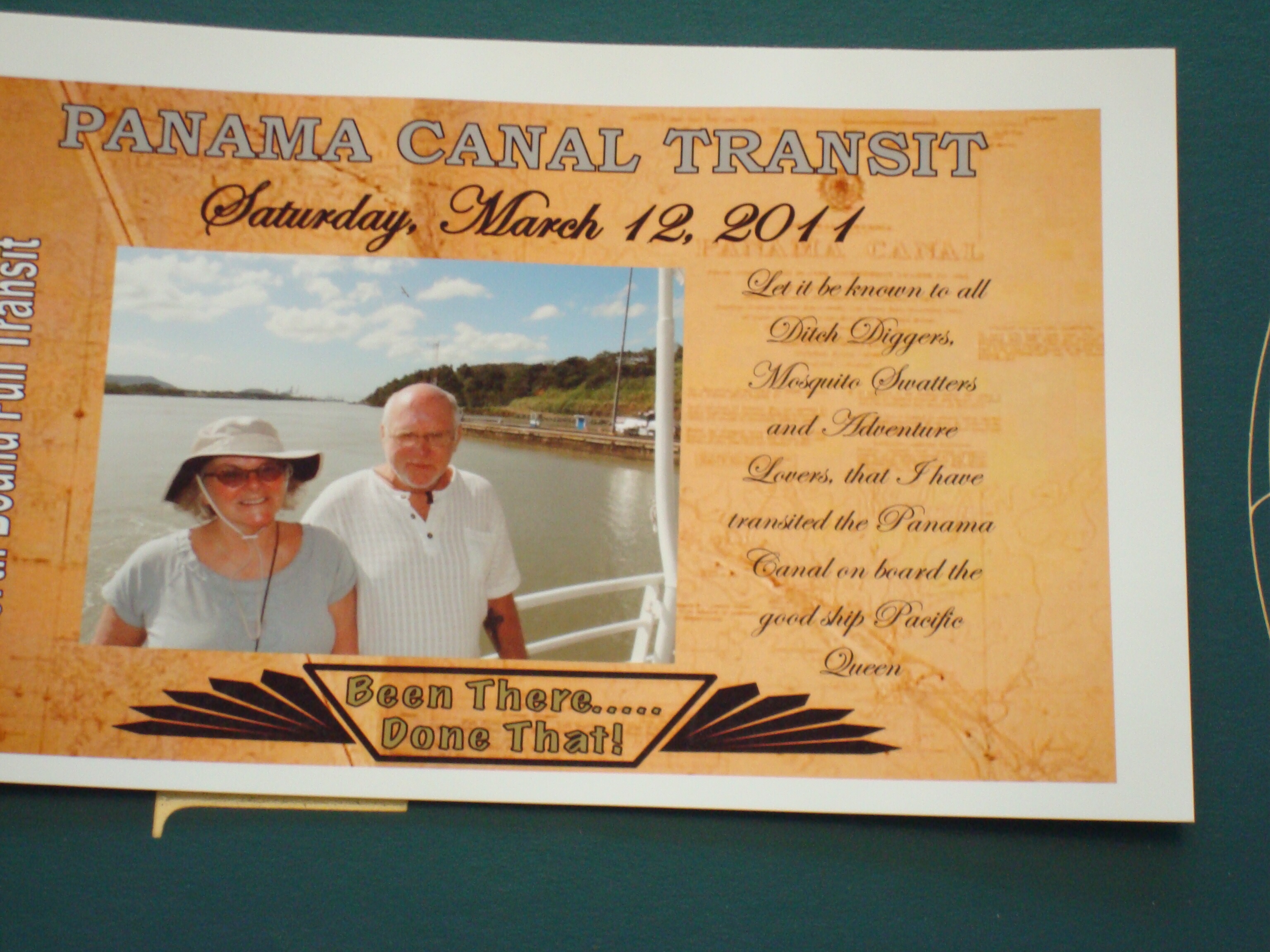
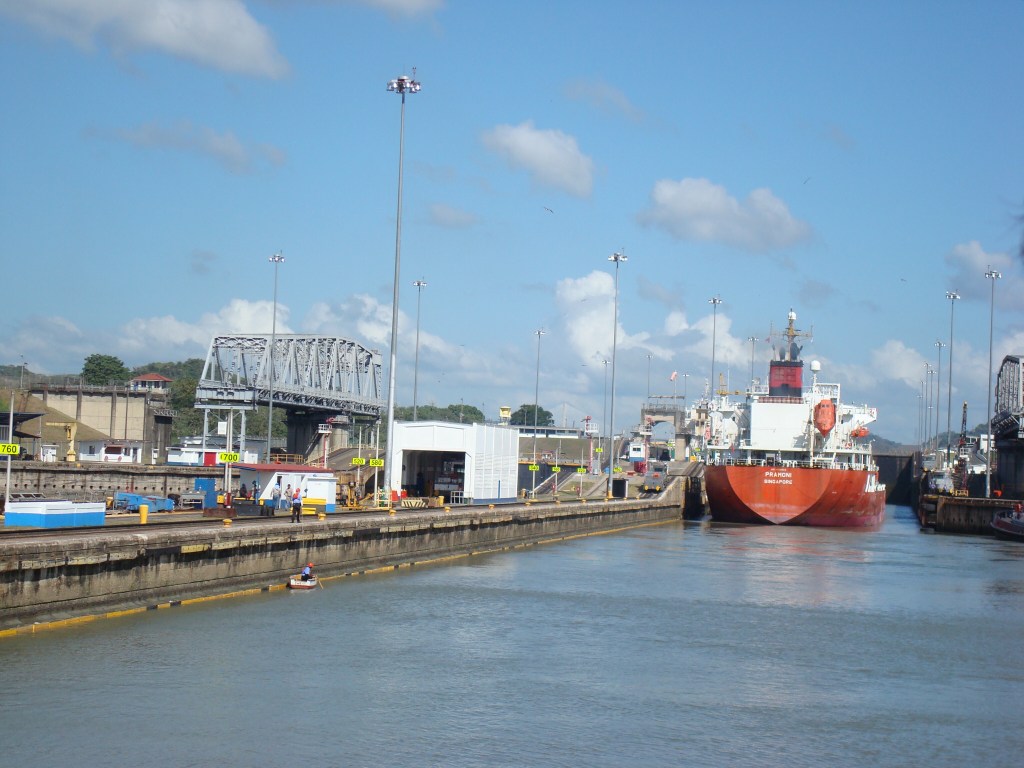
The news focus on the Suez Canal turned my memory to a trip we made in the spring of 2011 to the country of Panama, where we traveled the Panama Canal. We flew into the city of Panama on the Pacific coast, then spent several days exploring some small nearby islands. Our timing was planned around the availability of boarding a passenger ship to travel the canal one-way to its other end on the Atlantic, actually the Caribbean. The trip was to be about ten hours to travel about fifty miles. I had a good book with me, assuming the view would be interesting for about an hour, maybe two, after which I’d settle into my book in the shade.
The entire trip was fascinating and I didn’t read a page of my book! Do you know anything about canals and the locks they use to allow boats to travel in both directions at the same time? I’d traveled on a French canal, the Canal de Midi, on a boat we’d rented for a week, so was familiar with the process, small scale, but the process used for enormous vessels in the Panama Canal was at such a different scale that it was mind blowing.
In France, we would motor our canal boat into a marked section with metal gates that would close ahead of us and behind us. We would secure our boat to lines on one side, then would wait for water to fill our section, raising our boat to a higher level. When we reached the higher level, one of us would get out and rotate the mechanism that opened the gate in front of us, allowing us to continue on until we reached the next set of locks. It felt a little scary the first time, but we learned to trust the process.
Think of it as an elevator for ships. In the Panama Canal, between the Atlantic and the Pacific, the locks raised the ships 85 feet using three locks to reach Miraflores Lake before passing through another three locks to lower them to the level of the other ocean. A strong memory from the Panama Canal was watching one person in a small rowboat pulling a line from one of the giant container ships to lead it and secure it to a line from the land above. It was important to have each vessel firmly secured to prevent its movement when water was rushing in or out to fill or empty the lock.
To return to the Ever Given, about fifty ships successfully pass through the Suez Canal each day and have for decades. Supposedly, it was a combination of a strong wind storm (though they are not uncommon in that area) and human error that caused this ship to go aground. Likewise, it was a combination of human labor and a full moon that released it. As human beings, we are continually reminded of the importance of working with nature.
How do I introduce myself to people I have never met? Who do I want to be to these people I will be writing with or for? Who am I, actually? Am I who I am when I have been at my best or my worst or something in the middle? Averaging it out seems as if it (and I) will be uninteresting, so I’m choosing the parts I love the most.
I am 74 years old and love my life. That might be the most important fact about me, but don’t ask me to provide a rationale for believing that. I am an activist, recently found guilty for criminal trespassing during a climate protest, which I have appealed, asking for a full jury trial.
I am a wife of thirty years and the mother of a 53-year-old man, which sounds impossible, but is true. In my mind, mothers of men in their fifties are old and boring, and maybe I am, but I don’t feel old and boring. I am the former owner of a now-deceased therapy dog, who I loved wholeheartedly and took weekly to visit Alzheimer units. I love to travel and have sailed across the Atlantic in a 43-foot boat with three other people and two parrots. At seventy, I walked the Camino three months before having a heart attack and a stroke, followed by a triple bypass. Just before the anesthesiologist put me under, I said to her, “I want you to know that I love my life,” and she responded, “Don’t worry, we’ll make sure you’ll have plenty more of it,” which was the very nicest thing she could have said to me.
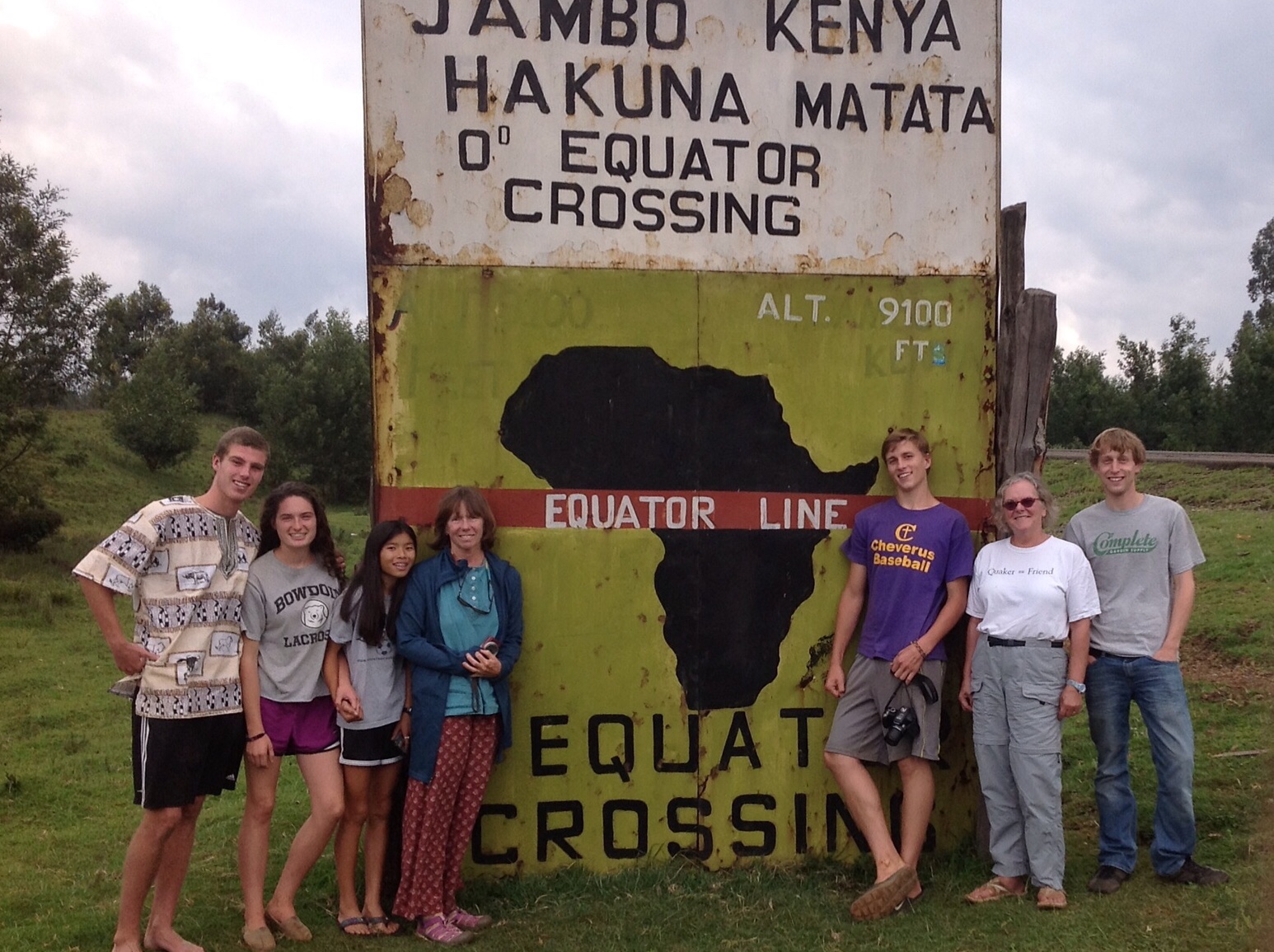
With my traveling companions in Kenya, 2012
I didn’t begin college until I was thirty, majoring in physics and math. I loved being in college, having no plans or concerns for after. I have traveled this winding path where I could never see the destination, I just followed what I loved doing. I worked for fifteen years in the corporate world, starting as the company’s first computer specialist in Boston, when PC’s were new, ending up as their first national technology help desk manager, responsible for fifty US offices.
In my late 50’s, I completed a master’s in psychology, with a focus on gratitude, opened an office for personal life coaching, which I loved doing, then made an enormous change and became a high school special ed teacher and completed a master’s in education. I taught Algebra and tutored reading and writing to kids with dyslexia. That was a joy.
Forty years after completing my undergraduate studies, I contacted a math professor I had loved and have been delighted to share stories with her. She is now retired, of course, and writes poetry about math. It was fun to share her work with the head of the math department where I taught.
I’ve neglected to mention an underlying joy, my life as a Quaker for decades, with a deep involvement among New England Quakers. Another chunk of my life worth mentioning is my writing, not a desire, but currently a compulsion. I’m leaving out much, of course, especially the less happy parts, but these are some significant parts of my life that have made me love it so fully.
Let me end with this – I have just made reservations for Egypt in November, where I’ll spend my 75th birthday meditating in the great pyramid.
Fall, 2017, in support of these two local candidates
[The pictures are from other activist events, that are not otherwise described here.] This has been quite a week and it’s only Wednesday. On Monday, I was arraigned in the Concord, NH court for criminal trespassing at a climate protest in September. The process went well, as expected. We, ten defendants, all pleaded not guilty and now have a February 14, 2020 court date for ‘trial management’, when we will work out details for a trial, which the court does not want. On February 14, all 66 defendants will be present, instead of 10-11 at a time, which is happening now, on consecutive Mondays.
The judge asked each of us, in turn, if we understood the offense we were being charged with: “that I, knowing that I was not licensed or privileged to do so, did enter onto a secure premises, the Granite Shore Power/Merrimack Station, in defiance of an order to leave or not to enter, which was personally communicated to her by an authorized person.” Each time I heard it read, in my mind, I saw the face of the officer on the other side of the gate with the No Trespassing sign, as he said to me, “please don’t do this.”
One at a time, we pled (pleaded?) ‘not guilty’. Our response was based on an ‘affirmative defense’, which is used when a lesser ‘crime’ is used to prevent a greater crime. For example, if I broke into a house to save a person from dying, the lesser ‘crime’ of breaking in would be excused. In our case, the lesser crime of criminal trespassing will, hopefully, be excused in recognition of the greater crime of climate damage by the coal plant.
I was the ninth defendant to respond to her questions and the eight before me each said, one at a time in response to the question, ‘How do you plead?’, ‘not guilty’. I said with confidence and satisfaction, ‘Your Honor, I am not guilty.’
It was quite an experience.
So that was Monday. Yesterday, Tuesday, I took the train into Boston to testify at the Massachusetts State House about three items at a hearing. I unexpectedly saw two Quaker friends, there with the same purpose as me, which added to my pleasure of the day. Adding to our excitement was the fire alarm going off after we had spent half an hour in line going through security, then another half hour at the beginning of the hearing. After calmly exiting the building, we were required to go through security again before settling into the hearing one more time.
I needed to have a written copy to give to the committee chair. When it was my turn, after about a dozen others had spoken, here’s what I said:
Resolve S 1877 and H 2776 each support creation of a special commission relative to the seal and motto of the Commonwealth. I support these because our state flag and seal are offensive to Native Americans, as they should be to all of us, because they remind us of the violent conquest of indigenous people in Massachusetts. At some point in the past, the image used on the Massachusetts turnpike was changed from a pilgrim’s hat with an arrow through it because its offensiveness was recognized.
When we are routinely exposed to images like these, we absorb implicit messages without being entirely conscious of them. These particular images position indigenous peoples as enemies, other, different, each of which promotes exclusion and separation, the opposite of what we want to promote among the people of our state.
I opposeH 2719, labeled as an act prohibiting discrimination in state contracts, which actually would penalize those who boycott for Palestinian rights. It was defeated last year and refiled. The right to boycott is an essential part of our First Amendment Rights. We must preserve it.
I am a Quaker and, as such, boycotting is often an important part of my nonviolent approach to encouraging and securing a desired change. Earlier this year, I had the opportunity to visit Israel and Palestine and to witness firsthand the sharp differences in rights and opportunities in their roads, their access to water and electricity, and their personal freedoms. Penalizing anyone wanting to boycott for Palestinian rights is not an acceptable path for us.
So that was yesterday. Today, recalling these actions in writing is the perfect action, because, as an activist, I want my actions to be underlined and bolded and shared.
The Women’s March, January 2017In Washington, DC, lobbying with AAUW
With my son, John LaRoche, celebrating his 50th and my 70th birthdays, 2017
When we make a choice to take an action out of the ordinary, many unexpected outcomes can result. For example, when I asked my manager for a leave of absence during January 2001, before she responded, she said that I had a lot of courage. “What?”, I said, because it certainly didn’t feel as if any courage was involved. She explained that because the company had been having layoffs, I might be sending the message that I didn’t want or need my job.
Hmmm, I hadn’t considered that. “Do you still want to put in a request for a six-week unpaid leave of absence,” she asked. “Yes.” I had no doubt about it. She assured me that she would encourage her director to approve, but could not guarantee it. Thank you, Tracy. Two days later, my request was approved. The immediate expected result was my one-month trip to Thailand on my own, with no tour guide, no agenda other than to be open to new experiences and adventure every day.
Fast forward to fall of 2001, after being back to work for six months. As had been the case before my leave of absence, every two weeks I flew to New York on Monday morning, returning home on Wednesday afternoon. I alternated between staying in Manhattan at the World Trade Center and staying in Jersey City, depending on where I had meetings. This time, I was in Jersey City, working on the 25th floor. I’d flown in on Monday, September 10, for a routine day. On September 11, I arrived at my office at about 8:30 and was working at my desk when a colleague several desks away screamed. Several of us ran to her desk, where she was clearly distressed.
“A plane just hit the World Trade Center!”, she screamed. The floor-to-ceiling windows in front of her desk looked across the river at that building. We looked with her and saw nothing unusual, just clear blue skies above the city. “Was it a little plane?,” I asked. “No, it was a full size plane!,” tears streaming down her face.
We stood by her desk for a few minutes, bewildered, watching. Seeing nothing unusual, we returned to our own desks. Another few minutes passed and her new screams brought us back to her desk again, facing the windows. “Another one hit”, she screamed. This time, we could see the smoke coming from the side of the World Trade Center facing us.
My immediate thought was: “My God, we are being attacked! We are actually being attacked, right here in the United States!”
We were in one of the tallest buildings on the New Jersey side of the river. “I wonder if we should leave the building,” I said. Just then, the building’s alarms began to sound, instructing us to leave quickly. I didn’t even take my computer, just grabbed my purse and walked down the stairs, the 25 flights.
My colleagues and I gathered at the base of the building, uncertain about what to do next or where to go. One person headed for an ATM, saying they might not be available soon. Another headed for a grocery store to stock up. Pretty quickly, ferries from New York with frightened passengers began to disembark near us. It became clear that on the New York side, roads had been closed quickly. The ferries were returning to New York empty, ready to assist people leaving.
My hotel was only a few blocks away and I invited others from my office to join me there. They were unable to return to their homes because the roads were blocked and public transportation was stopped. One colleague, Masha, was frantic with worry. She had a sister, Ruthie, who worked near the World Trade Center. This was hours before we knew the details of what was actually happening.
About a dozen of us walked to my hotel. Along the way, I was astounded by what greeted me. People who lived and worked there had spontaneously set up help stations with chairs for people who needed to sit and cups of water for those who were thirsty. I was overwhelmed by the kindnesses I witnessed and numbed by the steady blue skies that seemed out of place with what was actually happening.
When we reached my hotel, the lobby was packed with people who could not get to their homes. I stopped at the desk and told them that I was taking friends up to my room with me. The staff were understanding, assured me they were welcome.
As soon as we got into the room, we turned on the tv and learned what was happening. Over the hours, we watched the towers, thinking it impossible that they could fall, until they did. Then, we watched it over – and over – and over.
Have I mentioned that phone systems were not working? Somehow, I had expected that the hotel’s phones would work, but, no. This was in the days before cell phones were ubiquitous, but Tracy, remember Tracy who had ok’d my leave of absence? Well, Tracy had a cell phone and called others who had one. My room became the home base for identifying staff from our office and their safety. Somehow, Masha contacted her sister, Ruthie, and asked if she could join us. Of course! When she arrived, there was a collective cheer of shared joy!
Suddenly, the hotel phone rang, in service again. I answered it and it was my husband. Flying to New York had become so routine for me that I had neglected to let him know which hotel I would be staying at, so he kept calling both hotels all day, fearful that I’d been at the Millennium at the World Trade Center. After I assured him that I was fine, I asked him to call my mother to let her know I was ok. When the others in the room heard me say that, they began to ask if he would make a call for them. I passed around the phone and Paul wrote down names and numbers for the dozen calls he would make when we hung up.
The next call I made was to my son. Incredibly, Jack happened to be working in New York for the first time ever that weekend! He worked for an art storage company in Boston and was packaging, then delivering art from New York to Boston. Although he was on the other side of the city from me, somehow it made me feel better to know that he was nearby and safe. However, it was not clear when either of us would be able to leave, with all roads and means of travel shut down. We agreed to keep in touch.
By the time we were ready to sleep, everyone had been able to get back to their homes except Masha, Ruthie, and me. They shared one bed and I had the other. By morning, the commotion of the day before had diminished. When I looked out the hotel window, I could see a piece of heavy equipment in the distance with an American flag attached high. “Gave proof through the night that our flag was still there.” That line of our national anthem kept going through my head and I cried for the first time. I had been numb.
It was Wednesday now and the world felt new, raw, and unfamiliar to me. I don’t remember how it happened, but I learned that I could return to the office and get my computer. I wanted desperately to be home. It was unclear when planes would be flying again and trains were not running either. No cars were available to rent and it was unknown when any travel option would become available again. Somehow, we got through that day and the next, though my memory of it is blurred. Finally, on Friday, my son called to say that he had a van from his company and did I want to drive home with him?
I was so excited to be leaving and to have that time with Jack. He was to take me to Logan, where I had left my car. When we arrived at the airport, it was like something from an Alfred Hitchcock movie, nothing moving anywhere. No planes, no cars in motion. When we entered the parking garage, an attendant checked our identification, then stood by when I got out of the van near my car. That’s when I began to cry hysterically, with an awareness of being in a new world. Jack got out of the van and the attendant came to me, offering support, the attendant asking if I wanted someone to accompany me. “No, I just need a few minutes,” I said. Jack gave me a giant hug and I drove away.
The 20-mile drive to home was eerie, routes 128 and 1 deserted. I was – what’s the right word? Not happy, mostly relieved to reach home and be enveloped by my husband at last. That night, there was a lightening storm. The thunder woke me and I went to the front door, looked up, and thought we were being bombed. It took me a few minutes to recognize that it was only lightening. That evening and the next day, friends and neighbors stopped over to express their relief that I was unharmed. I felt like Dorothy, home from Oz, so grateful to see them all again.
So, what’s the connection to my month in Thailand? The company’s plan had been for me to be laid off on 9/11. Because of the attack on the World Trade Center, I got to keep that job for another few months. In early January 2012, my job ended and I gladly began a period of renewal before moving into my next career.