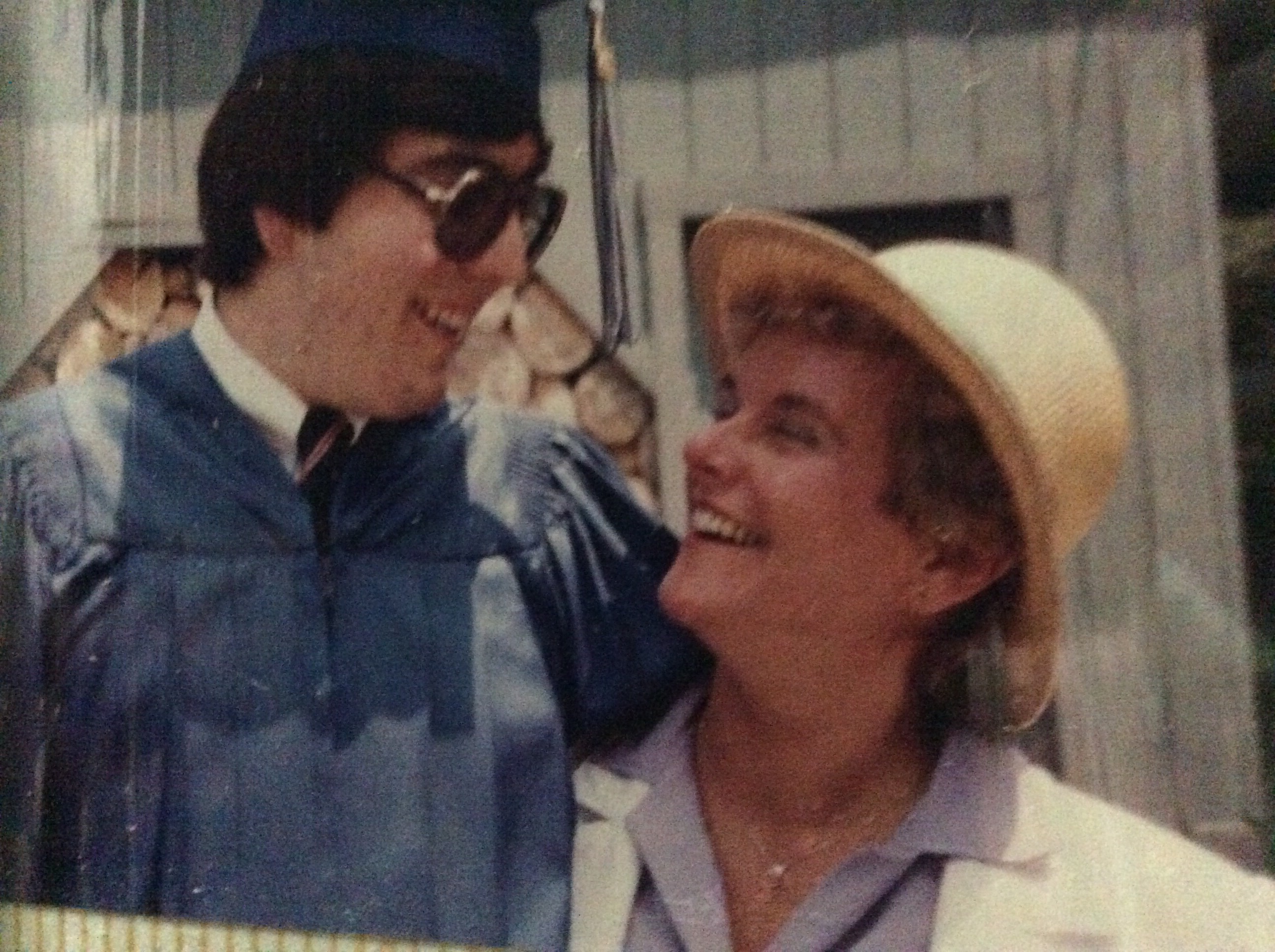
Life begins. Right now, I’m thinking of the life of my son, born 54 years ago. As I remember it, I think of a picture of me holding him while my then-husband, his dad, drove us home. It was before seat belts and child seats were either common or required, so my baby was held snugly in my arms. I’m wearing a dark green dress with large white polka-dots that I recall with pleasure. I also remember feeling overflowing joy at having this healthy baby. Another memory flashes immediately, that of walking into our apartment, and closing the door.
At that instant, I felt fear as, for the first time, I recognized that I was actually the mother of this infant, with no idea of how to be his mother. That fear subsided as we put him in his beautiful cradle, sorted out the gifts we received, and awaited the arrival of my own mother, who would visit every day for the next six weeks.
We named him John Valentine, after my dad, partly because he was born on Father’s Day, perhaps more because I loved my dad so much. We would call our son Jackie until he was about fifteen, then transitioned to Jack, although my mom called him Jackie until her death when he was forty years old.
When he started college, he decided he wanted to be John to others, except for his family. So, we continued to call him Jack. Shortly after he began college, I called his room — this was before cell phones. His roommate answered and when I asked for Jack, was told that I must have the wrong number. I hung up, confused at first, then called back a few minutes later, asking for John. ‘Sure, he’s right here,’ his roommate said. Ok, I guess he’s grown up now.
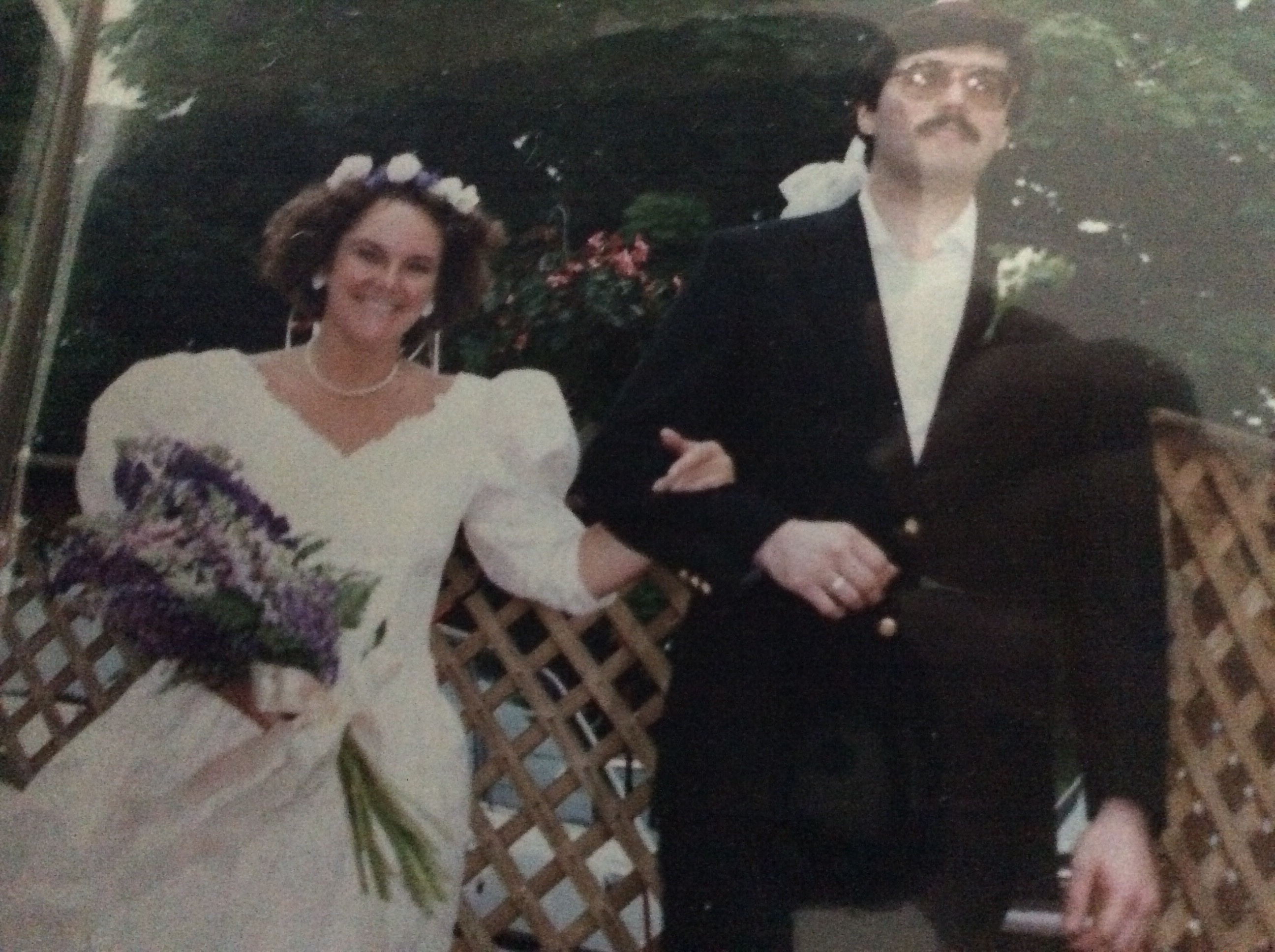
Jack walked me down the aisle in 1990.
Fast forward through many details and two decades to 2005, when he moved to North Carolina. We’d always had a good relationship; still, I was apprehensive that our closeness would diminish with the distance. It didn’t. He and his then-wife welcomed us warmly at either Thanksgiving or Christmas with delicious meals and activities planned that we loved, such as annual visits to Duke Gardens and the Carolina Ballet’s Nutcracker. Plus, he visited here every summer. In so many ways, he continued to make me feel loved.
Then, following plans made last year, he moved back to Massachusetts two weeks ago! He and his significant other, the woman he was engaged to about 35 years ago, are now living about twenty miles away from me, both having successfully transferred their jobs locally. We have been very happy to welcome her back into our lives. Of course, it didn’t hurt that she influenced his decision to move back here.
The week he moved back, he asked if they could come here for dinner, because the moving truck had just arrived and their apartment was in chaos. They promised to have us for dinner soon. Of course, I was thrilled to have them here, though I agonized about what to serve. The menu included stuffed artichokes and lobster rolls and I’m quite certain it was a success.
Then, when we tried to set the time for us to have dinner at their place, between their work schedules and my activist commitments, it was going to be two weeks. This morning, Jack called and said, ‘What are you doing for lunch?’ My brain rapidly considered skipping this writing class, but, no, I didn’t want to. I told Jack about the class and he offered to stop in at 2:30, when the class will end, because, he said, he didn’t want to go two weeks without seeing me.
There are many ways for a person to show love — with creative or expensive gifts, with cards and flowers. I believe that I have never felt my son’s love so much as right now, as I await his arrival. When his life began, I was both excited to be a mom and afraid of the enormous responsibility. He is certainly a caring and considerate person; it’s probably safe to say that I have faithfully fulfilled my duty as a mother.
My family includes many cousins, most of whom I love very much. I need to tell you who I’m including, because they’re not actually cousins. My mom had cousins, four brothers, who we treated as uncles. It followed that their many offspring were our cousins, fake cousins. Mom also had one sister with three kids and a brother with four sons, who were actually our cousins. I grew up with all of these cousins, seeing each other often at the beach in summer, at each other’s homes, and certainly on holidays. With our shared Italian grandmother, platters of good food were always a major part of our indoor gatherings.
Then we grew up and grew apart, as families do. About ten to fifteen years ago, one of my ‘fake’ cousins, Bobby, called to invite me to a ‘cousins party!’ One sister of his lived in Alaska and another in Florida; they were both going to be home for Christmas. Because he realized how long it had been since we’d all been together and recognized the importance of being with each other again, Bobby hosted a reunion party at his house on Christmas Eve.
It was the best party, his house packed with many generations of family and friends and loaded with many of the foods that I remembered, including stuffed shells and Italian cookies. It has become an annual event, except for last year, the Covid Christmas, 2020. It may have been the single event that I missed the most last year, this chance to see all of these people who I grew up loving, plus others who I’ve come to know.
Now, on to another fake cousin, Billy, who lives in West Palm Beach. A few years ago, my husband and I were spending most of February in Florida and were invited to spend a few days with Billy and his wife, both newspaper journalists. We gladly accepted and thoroughly enjoyed ourselves in the warm weather, reinforcing each other’s political views, including our shared love of independent bookshops. The following summer, they visited our area and spent a few days with us. As a thank-you gift, they brought us a gift box of postcards, from one hundred different independent book shops.
The cards were each wonderful and it was delightful to browse through them. But, I’m a practical person and didn’t want to waste them. I sent one to them as a thank-you, then, began to send them to people I’d had a nice connection with on Zoom. Sometimes, in my note I mentioned something I’d particularly liked or sent regards to someone who was sick or just said, ‘miss you.’ I’ve probably sent out more than half of them, including one to my son, Jack, in North Carolina.
I’d described the postcards to Jack and how I was using them. So, a few months ago,
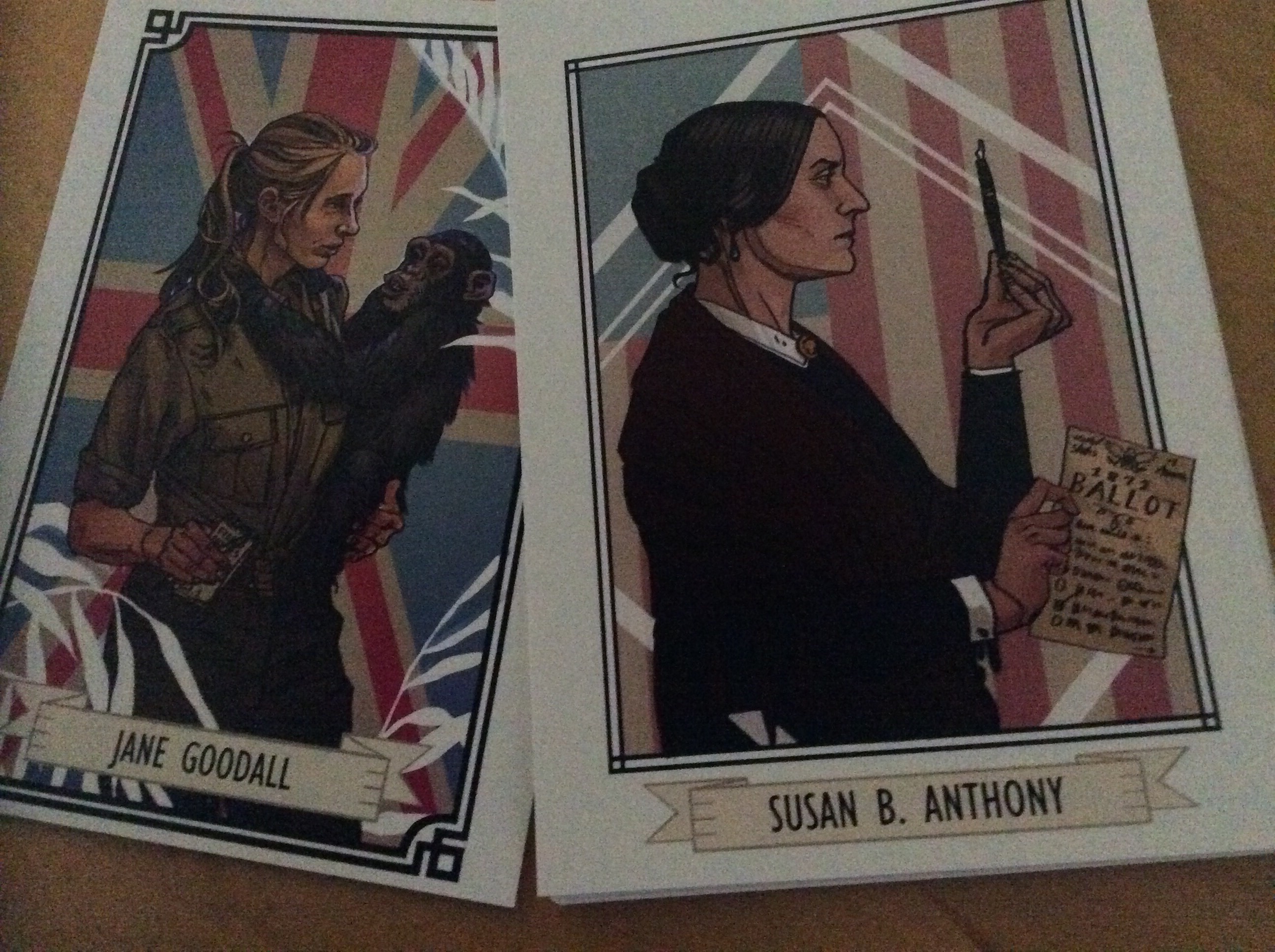
Jack sent me a packet of about thee dozen postcards. Each commemorated a specific concern of mine, either a Native American or a historically important, but under appreciated woman, or a person of color, each with a descriptive story and a corresponding picture. Now, I’m using these cards to send to friends when they take an action reinforcing a quality represented by one of the cards.
This practice of mine started with cousins and postcards. It’s my postcard ministry that began with a cousin.
I love to do puzzles, many kinds, though right now I’m thinking specifically of jigsaw puzzles. Most of our living takes place on the first floor of our house, but upstairs is a little room, well-lit with two skylights, with a table surrounded by a futon and two comfortable chairs. We seldom use this room, so it’s perfect to begin a jigsaw puzzle there, with no rush to complete it.
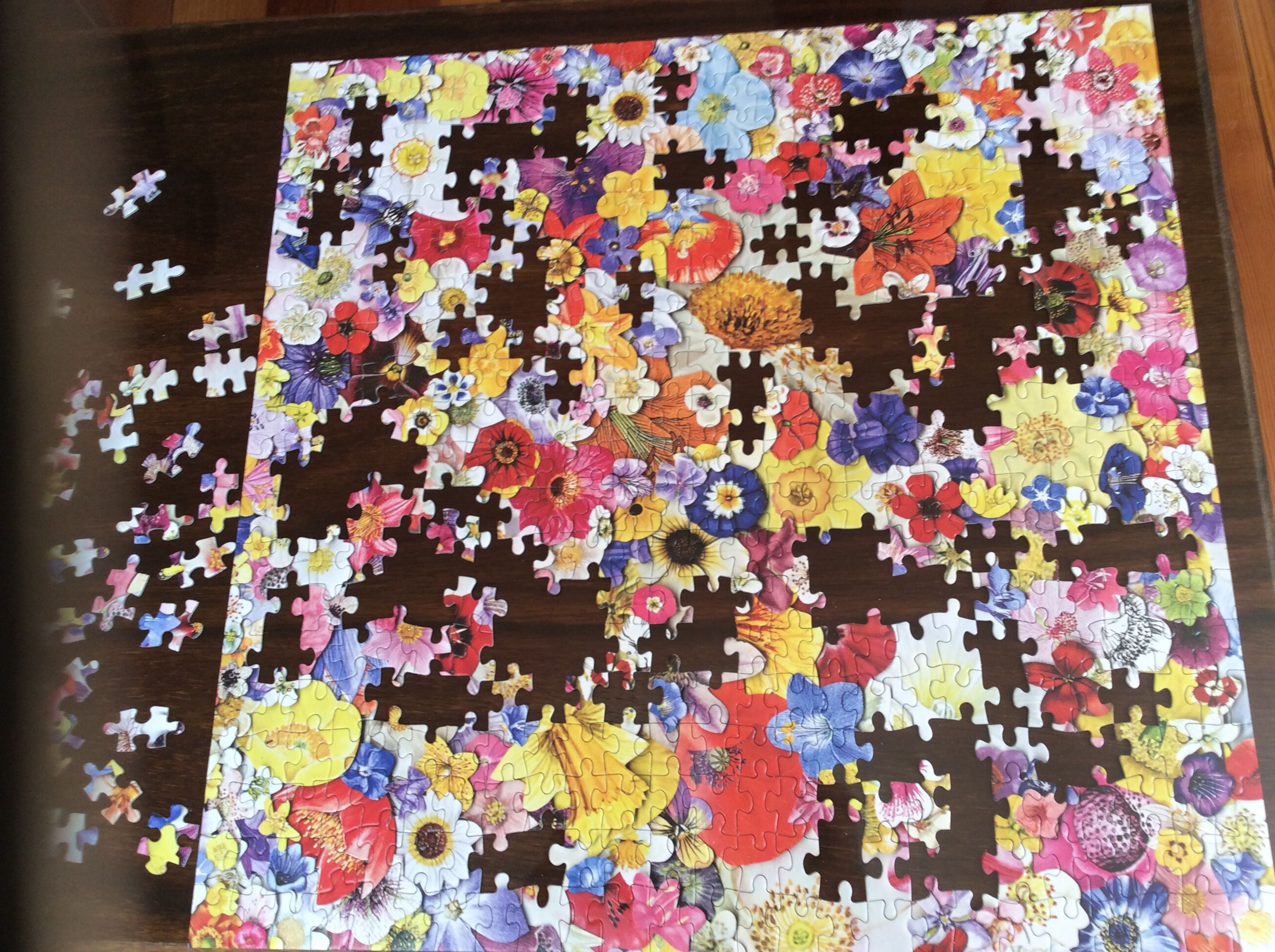
Of course, once I begin a puzzle, I am compelled to continue work on it, at least during daylight. During these weeks close to the summer solstice, that’s a lot of daylight! My puzzle right now is about half done. The border is complete and half a dozen little groups of connected pieces. It’s twenty inches, square, with five hundred pieces, filled with flowers, all sizes and colors. Not much green, though, as it’s all blossoms, no leaves. After completing the border, I focused on yellow, because there are several big yellow flowers.
I can’t wait to go back to it, pulled as strongly as to a good book, once you’ve read enough of it to get the characters and the plot tension. Sometimes when I leave the puzzle, even for an hour, then go back to it, I can quickly see where two sections should connect. Something about that feeds me, excites me. Why is that?
The puzzle has no natural up and down, no ceiling or floor, no sky or ground, no natural framing, just blossoms. Sometimes I look at one puzzle piece, then examine the picture, looking for a distinctive feature of the piece, for example, a bright bit of orange or the tiny stamens from the center of a bloom. This allows me to place it in the general vicinity where it belongs. I have no idea why this is so satisfying, but it is.
In fact, when I retired, the routine that quickly became mine was to linger in bed in the morning with my iPad. After checking my mail and news sources, I complete the New York Times mini crossword puzzle in three to five minutes. (It times me and reports back.) Then I complete a daily jigsaw puzzle on line, probably about half an hour. I’ve tried a few of the free puzzle apps and this particular one is my favorite, because it has few advertisements.
All of my life I’ve enjoyed puzzles, including Sudoku, crosswords and other word games, and math games, including solving equations. Please don’t groan! I actually liked taking SATs, got 795 out of 800 on math, and still wonder which one I missed. I know that math isn’t most people’s favorite. What is it that makes me enjoy it so much? It’s like a good mystery.
Is there something that all these kinds of puzzles share? When I’m working on one, my mind is always partly involved. Even when I’ve walked away from it, I’m connected; part of my brain is thinking about it. Then, when it’s done, there’s a clearing, a freeing up that’s like a deep breath. A short while passes, than I want another puzzle or book to begin the process again.
Writing is not like that for me. If I don’t have a group to write with, I don’t write. I might think about it, imagine a topic I’d like to try, but there’s no compulsion that pulls me to it. That unfinished puzzle upstairs, though . . .
Housecleaning is not like that, either. I can clean a bit in one room, get interrupted, and have no desire to return to it. My husband occasionally tells me that his next wife is going to be a good housekeeper. I won’t share my usual response.
This morning, we visited the PEM, a fabulous local museum. Like all museums, it has a fabulous gift shop. We ended our visit there and I bought another puzzle, 500 pieces, and this puzzle has a characteristic that’s new for me. It has a velvet-like surface! Can’t wait to open it, but I’ll finish my flowers puzzle first.
I’ve been married to the same man for thirty-one years today. He occasionally reminds me that when we met, he knew that I was a vegetarian and made the assumption that I ate healthy foods. He was very surprised that was not the case. He continues to be surprised.
Taste is one of our five senses. Joined with other senses of sound, sight, smell, and touch, this means that eating and drinking have the capacity of reaching into us with their sound, appearance, aromas, textures, and tastes for either pleasure or discomfort. I value the pleasure that food and drink bring us, perhaps more because of something my mom said about twenty years ago, three years before she died.
Mom had been relatively healthy, but had Sjogren’s syndrome, a non-life threatening disease of dryness. She had always taken pleasure in eating, but lamented that she could no longer enjoy a piece of freshly buttered toast. She encouraged me to enjoy eating food while I was still able. I didn’t hear this as foreboding, but as a caution to enjoy while I could and not to take anything for granted, even the simple pleasure of eating a piece of buttered toast.
Cheetos and grapes are my current favorite evening snack. I’ve usually thought of Cheetos as forbidden, or at least undesirable, junk food, but (for some reason, maybe Covid?), about six months ago, I began to buy them. Eating Cheetos slowly, savoring the cheesiness and crunchiness of each one, with an occasional fresh grape popped into my mouth for moisture, has become a great evening pleasure for me. I’m not recommending this practice, just confessing.
Several years ago, Paul and I spent two weeks in Brittany, France. We all know that French food is among the best in the world, but I was surprised by the intense affection that I developed for their mussels. We had rented a car, stopped for two or three days in one coastal town, then drove to another, visiting six communities. Each place had their own version of mussels, each one better than the last. Several versions had delicious blends of wine and herbs. My overriding favorite involved a gorgonzola cream sauce. The usual accessory of frites, skinny French fries, completed the perfection.
Another outstanding taste that I recall was hummus in Palestine. It was served frequently and always delicious, more so than I’d eaten at home. It is such a simple food, mostly chickpeas and olive oil, so perhaps it was the freshness of the ingredients, each produced locally, that made it so memorable.
A memory that is more than fifty years old remains deeply embedded in me and my tastebuds — baked stuffed lobster on New Year’s Eve. Newly married the first time, perhaps our first new year’s as a married couple, we invited about eight friends to our house to celebrate. I’d planned several courses, one per hour, with baked stuffed lobster scheduled for 11:00 pm. I stuffed the lobster with scallops in a buttery Ritz cracker mix, which I still love. The evening ended with sumptuous desserts and champagne at midnight.
Among my favorite beverages are Cappuccino or coffee as served in Europe with hot milk in the morning. Recently, at home, I am enjoying cucumbers, fresh mint, and lemon in a Koolaid-style fat pitcher of ice water. The water can be replaced and the same cucumbers, mint, and lemon continue to offer lovely flavor with fresh water.
There is a particular ice cream flavor not found in the USA, available in Greece. During a week on the island of Agistri in 2019, the staff there quickly came to recognize me and my preference for this particular flavor, which tasted of a fruit native to Greece. They gladly served it to me at my lounge chair with beachside service. Can anything taste better than that?
I’ve been a vegetarian for more than fifty years. In many ways, I eat healthy foods. Some foods are always on my ‘eat’ list, such as dark chocolate. That doesn’t mean it’s the only thing I ever eat. It just means that I always seek the most delicious ways to eat it and, valuing my health, I intentionally limit the quantities that I eat. For example, right now, two of my favorite chocolate choices each are from Wegman’s. One is ‘cocoa dusted dark chocolate covered almonds’. I might eat two or three a day. The other is dark chocolate bark with cherries and almonds. I probably eat a small piece every day, as if it were a vitamin.
After heart surgery about three years ago, I was told to avoid sugar for six weeks, because it would increase the chance of infection in my sternum as it healed. Of course, I didn’t want to take any chances, so for six weeks I imagined the chocolate I would soon eat. Several friends indulged me and, six weeks later, I opened a box of dark chocolates from a local sweet shop and savored every piece, one or two each day.
So many tastes, so little time! They are among the simple pleasures with which we are blessed every day.
What a disappointment to hear from my writing teacher that this topic was my suggestion! I must have had a particular aspect in mind when I suggested it, but that escapes me now.
As I consider it, I think of routine grocery shopping and how it has changed for me in different ways through the years. I generally shop about once a week, but not always on the same day. Some items I buy every week, like milk and fresh produce. I’ve always kept a written list of items that I buy only occasionally, like toilet paper or mayonnaise. Otherwise, I’m likely to forget them.
During the first years of being married, when we didn’t have much money, I kept a running estimate in my head of the total cost, knowing how much I had to spend. I remember one period of time when I wanted to buy pickles, but did not have enough money, so week after week, the jar of pickles did not go into my shopping basket. There must have been other items, too, that had to be postponed, but it’s those pickles that I remember. As a result, pickles still feel like a minor luxury to me.
After my divorce, when I lived alone with a tiny kitchen and was grocery shopping only for myself, I bought extra of everything. Then, I prepared meals as if I were serving three or four people. Often, friends would unexpectedly join me for dinner or I would eat leftovers for multiple meals. Because I liked everything I prepared, that was never a problem. I loved to cook and made everything from scratch, especially soups, breads, and desserts.
More recently, before Covid, we often invited friends for dinner. Somehow, my topic has morphed from shopping to meals, but of course, they’re directly related.
Now, I am conscious of the luxury it is to grocery shop, able to buy anything I want, with no concern for the cost. That doesn’t mean I am unconscious of cost. I compare prices and generally buy the grocery store brand, rather than the name brand, when there is a choice.
When I shop, at least four factors affect what I choose to buy: what do I want, what do I need, how much does it cost, and who is receiving the money I spend. I will not shop at Whole Foods, because I do not want to add to Jeff Bezos’ fortune.
The Beverly farmer’s market opened for the season on Monday. When I left the house, I told Paul that I wouldn’t be gone long. Boy, was I wrong! Being there while thinking about this assigned topic made me aware of my shopping preferences and habits. I love to shop local and to support local vendors.
I used my own shopping bags, of course, and came home with a large bag filled with a wonderful mix of items. From the beet stand — listen to this – I got candied yellow beet and buckwheat granola! I also got a beet and chocolate Whoopi pie, in which purried beets is the main sweetener. That was delicious and I should have gotten at least two. From a vegetable stand, I got the most beautiful bunch of rainbow Swiss chard. I also picked up an extra bamboo toothbrush, just because I really liked the woman at that stand.
A young woman, Erica, who I taught with several years ago, was at her own vegetable stand, because she left teaching to manage a farm! I loved seeing her and hearing her story. I also saw the city counselor, Estelle who started our farmer’s market years ago and for whom I have a high regard. I loved having the chance to praise her for the wonderful additions to the market this year. Besides what I’ve already mentioned, I got some micro greens from the new Green Beverly stand, some spinach fettuccine, and a loaf of olive bread from the When Pigs Fly stand. All of this happened with a band playing live music under shady trees. So, I’ve changed my mind. Shopping is a great topic to think and write about!
Is it neighbors who make a neighborhood a good one?
Who left us this painted rock?
Growing up, I learned that I lived in a bad neighborhood when my sixth grade teacher announced to our class that my street (she named it) used to be so nice but, look at it now. I’ve forgotten a lot of things that happened that year, but I clearly remember my embarrassment at that moment. As a result, I considered my neighborhood and my neighbors, but was unable to see them through that teacher’s eyes.
Fast forward to 1995, when my husband and I were house hunting. When we started to look, I created a wish list and on it were two location details. It would be within walking distance from both the beach and from downtown, from the Cabot Theater, to be exact. This house met that criteria and we loved the house. We’ve lived here more than 25 years now and still love the neighborhood and the neighbors. Let me share a few details.
About fifteen years ago, I was invited to attend a small gathering of neighbors to plan a block party. We picked a fall date and an alternate rain date, deciding that we would ask each family to provide either an appetizer or a dessert, and $5-10 to share costs for a bouncy-bounce, soft drinks, paper goods, and chips. During the next months, we contacted the police to request closing the side street, then printed and distributed announcements, asking for RSVPs. We planned getting-to-know-you games. On the appointed day, we fired up the grills, set up the bouncy-bounce, asked older kids to paint the faces of the younger children, and provided name tags. It was a success and we got to know more of our neighbors.
The following spring, our committee had a block-planning party, during which we heartily congratulated ourselves as we drank margaritas and planned for the next event. So, this has been happening for more than fifteen years now. Minimal planning is needed, as we each have our standard tasks from year to year. My tasks are editing and printing the invitation, delivering the invitations with another friend, then on the party day, buying bags of ice. We have simplified the party and no longer use grills, only shared food. There are no longer small children, so no more bouncy-bounce, either. We now include special invitations to welcome any families that moved in during the year.
Of course, we could not hold the party last year and I haven’t heard from the block party planning Queen this spring, so who knows for this year?
Another neighborly event is our Kiva parties. Are you familiar with Kiva? It’s an international micro-lending organization that invites people to contribute to loans for entrepreneurs in third world countries to help their small businesses get funded. Many third world countries do not have established banking systems, so the lending systems that we take for granted are not available to them. We have a neighborhood group of six couples who gather in alternating homes about once every two months for a pot luck dinner. After dinner, we get out the computer, log onto Kiva, and select individuals or groups to support with our funding.
When we started about five years ago, we donated $5 per person and chose two recipients. As the loans were repaid to us, we lent that money again, with our newly donated funds. When we meet now, there’s always two or three hundred dollars repaid, plus $10 per person of new money. So, we donate to multiple people with larger amounts than when we started. The dinner we share is always delicious, we catch up on our neighbors’ lives, and also feel good about contributing to people’s lives around the world.
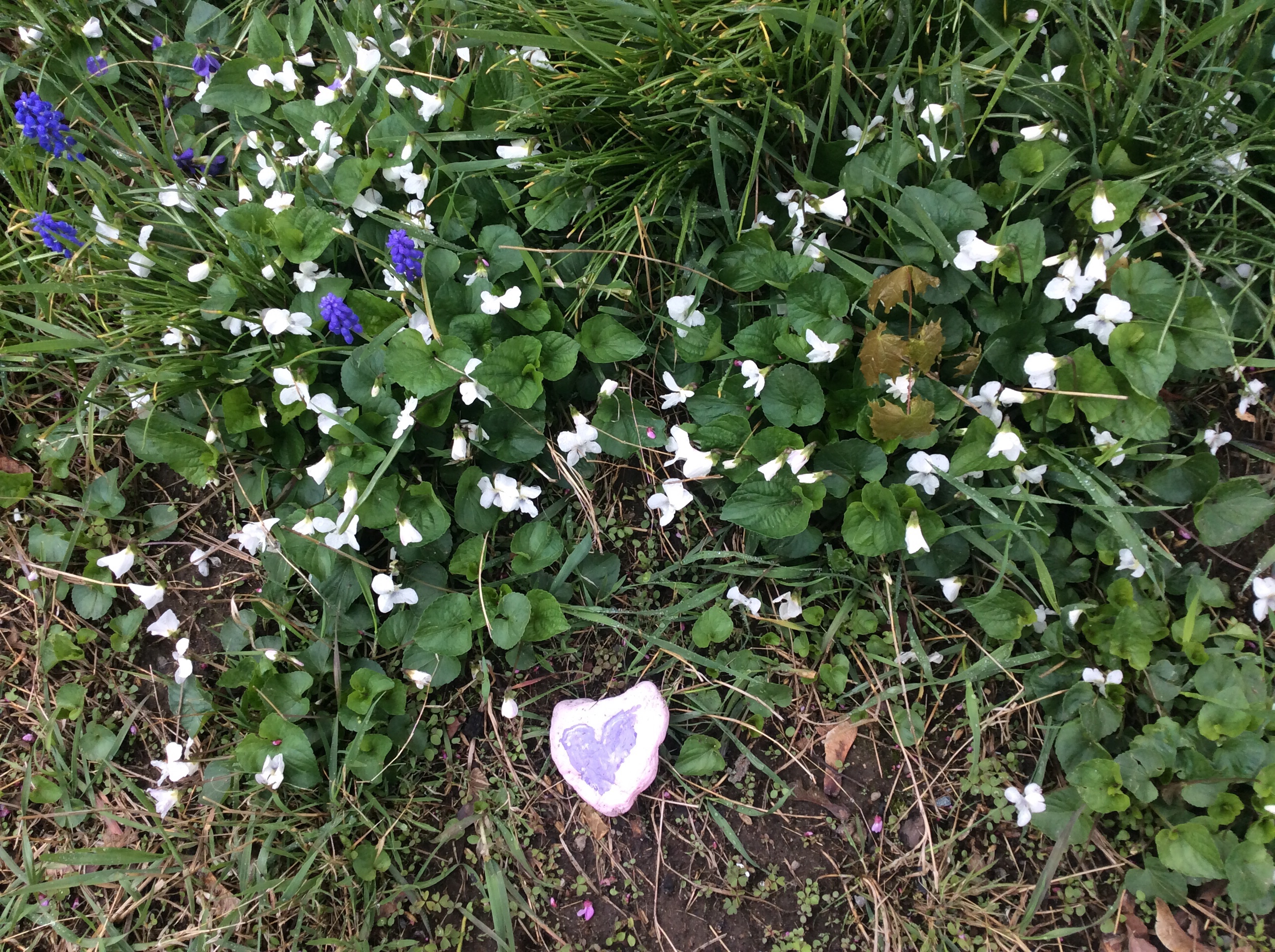
There’s one more event in my neighborhood worth sharing. About two weeks ago, my husband came in and said, “Did you see the painted rock out front?” What? I walked outside and at the front of our yard was a rock, about four inches across, painted blue, with a white heart! I later realized that many of my neighbors had painted rocks placed on their front yards, too. We have no idea who the rock fairy is, but have further proof of the goodness in our neighborhood!
It is seldom that we truly change, though it sometimes happens. Here’s my story of more than a change, a transformation really, that happened to me. It involves gifts and it was a gift.
Growing up, I loved gifts, both giving and receiving. Giving was actually better, because I got to plan and choose the gift, with surprise being an important feature. To surprise someone, whether friend or relative, with a gift they would truly value, that was one of the delights of Christmas season for me. Of course, I liked receiving gifts, too, but not as much as really surprising someone with the perfect gift.
My mother was one of the best recipients, partly because I knew her so well. I was good at choosing clothing for her that was just a little bit funkier than she would have chosen for herself and that fit her perfectly. And she knew my taste exactly, so her gifts for me always surprised and delighted me. On the other hand, I didn’t understand my grandmother’s constant response of, “Oh, you shouldn’t have got me anything,” until decades later. Loving someone meant giving them gifts at Christmas.
Over the years, of course, I sometimes received a gift that was disappointing, a dud. It’s funny that I can’t remember anything in particular right now. I do remember that, regardless of my actual feelings, I feigned joy as I thanked the giver. How could I not?
I’m skipping a few decades until I was in my mid-forties, newly married to my second husband, who was not a gift-giver and did not like to receive gifts. Even on his birthday, when greeting cards arrived for him or if someone handed him one, he would wait a few days until opening them. It was not a pleasure for him. We were a great match in many respects, but not in gift-giving.
So, as we approached our first Christmas together, I had long conversations with myself, telling myself not to expect anything on Christmas morning and not to be disappointed. He was a generous person and would give me anything I wanted, but my longtime ritual of surprising someone with the perfect gift was just not his thing. I stressed, wondering how I was going to feel and how I would deal with it.
So, Christmas morning arrives and he hands me an envelope. “What’s this?” “It’s your gift, he said.” I opened it, with a giant excitement. It was a gift certificate for a one-hour massage, once a month, for the next year, with a woman on whom I occasionally splurged.
That was probably the last time he surprised me with a gift and it was 30 years ago. He’s still my husband and he still delights me, but not with gifts. The transformation has been that, though I don’t understand how or when it happened, my desire or need to be surprised with gifts is gone.
It doesn’t mean that I don’t give gifts, however, I no longer feel a compulsion to buy gifts for particular people or to give a gift when someone gives one to me. My mother died about 12 years ago and, until then, I always had a gift for her and received pleasure from it. Even my son and I no longer exchange gifts at Christmas, though I continue to give him books on his birthday. Last fall, the woman he was engaged to 25 years ago and is with again, after his 15-year marriage to someone else, surprised me with a perfect birthday gift, a silk scarf with the Constitution! So, I’m not beyond receiving pleasure from a great gift. It’s just no longer a necessity or a disappointment if it’s missing.
And, there’s more, one final piece that makes me very grateful for this transformation. The climate justice work in which I have been heavily involved has started to spread the message that consumerism’s cost to our climate is high. The tech and fashion industries are among the largest polluters in the world. Most of the profit from non-essential holiday gifts goes to the 1%.
I want to rethink gifts, to benefit the recipient, not the giant retailers. In the meantime, I’m happy to receive a scone from the local bakery, which my husband just delivered!
Hearing the powerful poem (Lenox Hill) of the elephants falling off the cliff in Kashmir returned me to the mood I awakened with this morning. Well, not the horror, but the deep sadness I felt. The reason? Two weeks ago, I had decided on my next protest action, planning to travel to Minnesota to stand with indigenous people to prevent continued work on line 3. The pipeline was to be on sacred native land, ready to contaminate the Mississippi and another dozen rivers. I had clarity, thinking I needed to do my part to stand in its way.
Then, yesterday, I realized that I just couldn’t do it, that taking care of my physical self had to take precedence over my desire to stop the pipeline. I was acutely conscious of disappointing others who were counting on my company both for travel and in being there. They, being true friends, understood my decision, but I awoke filled with giant disappointment in myself.
When I was dressing, I pulled on a pair of last year’s pants, but they were too tight, and I couldn’t blame it on the laundry. Another disappointment, on top of what I was already feeling. I added the pants to the good will pile and grabbed another bigger pair. Just then my husband walked into our room and caressed me, saying, “You are so beautiful.” It was partly the words, but more his sincerity that moved me so much. Isn’t there a song with the words, ‘the eyes of love’? He definitely sees me with the eyes of love.
I didn’t feel like it, but I went to Wegman’s anyway. This weekly trip is usually a treat for me, a half hour drive with favorite tunes playing, then plugging in to their free electric charging station while I shop. I arrived there about 7:30, during old-people-shopping time, so the store was not crowded.
Halfway there, my mood started to lift. Then, at the store, a couple of things raised my spirits even more. Outside the store, where the plants are always appealing, I saw hanging baskets of red begonias that needed to be by my front door. Inside were fresh peaches, the first I’ve seen this season! Of course, they’re not local, but looked so good, so I added a few to my cart.
When I was at checkout, the woman helping me seemed to be extra careful packing, rearranging so the grapes and peaches were on top of the heavier things. When I thanked her for the extra attention that she was giving my groceries, her smile in response reminded me that the best way to make yourself feel better is to do something nice for someone else.
My ride home was delightful, filled with tunes from the seventies. I had plenty of time to put away the groceries and to hang the begonias — actually, to ask my husband to hang them — before my zoom tap class started. My energy level fluctuates from day to day, and today it was good. I could remember most of the steps and enjoyed the music, this time ending with Frank Sinatra’s Summer Wind for the cool-down.
When I think to what lies ahead for today, I am immediately calmed as I anticipate Zen meditation at 6:30, on Zoom, of course. This is usually followed by the Monday night local social justice group, but tonight I’m going to play hooky, so I can celebrate Bob Dylan’s 80th birthday with the Nields during their Monday night concert. Today will end well. All’s well that ends well, even on a moody Monday.
With this past year’s interest in working from home — telecommuting — and the many discussions about what will happen when it’s not required, my mind frequently returns to 1995, when I first worked from home. My memory being imperfect, some of these details may be out of order, but the main facts are correct.
In 1995, I was working as a computer specialist in the Boston office of Price Waterhouse, one of the world’s major accounting and consulting firms. Technology had progressed enough that working from home appeared possible and to me, desirable. I asked if I could work from home two or three days a week to test the possibility and was granted consent.
Back then, Zoom was far in the future; the technology we could rely on included heavy telephone usage, remotely sharing files that lived on computers in the office, and conference calls, sort of Zoom without the visuals. Moving, sharing, and modifying files was an important part of the work being done.
Software that made this possible was Lotus Notes, a product that we were experimenting with and using heavily worldwide. Notes was a groundbreaking software design that made it easier to communicate and share data in ways not previously possible. I was deeply involved in its use and, in 1994, was asked to be the technical advisor for the first book on its usage, Creating Lotus Notes Applications. Today, the Internet and cloud storage serve similar needs.
Back to working from home: After I worked from home for a few months, I was asked to be the firm’s national telecommuting manager. This meant that I was to create guidelines for those working from home, establish technical requirements, and approve applications from those wanting to telecommute. When someone suggested that it would be important to have carbon monoxide detectors, I bought one for my own home. This work involved establishing guidelines for those working from home, to create boundaries between their work lives and their home lives. My company was never opposed to anyone working overtime; however, there was clear recognition that it was not healthy for anyone to be working constantly without breaks.
As one example, we recognized that someone with children would need to have established childcare, as they would not be available to attend to their children while working. We offered simple suggestions for how to create needed barriers, such as placing red or green signs on their office doors to indicate whether they could be interrupted.
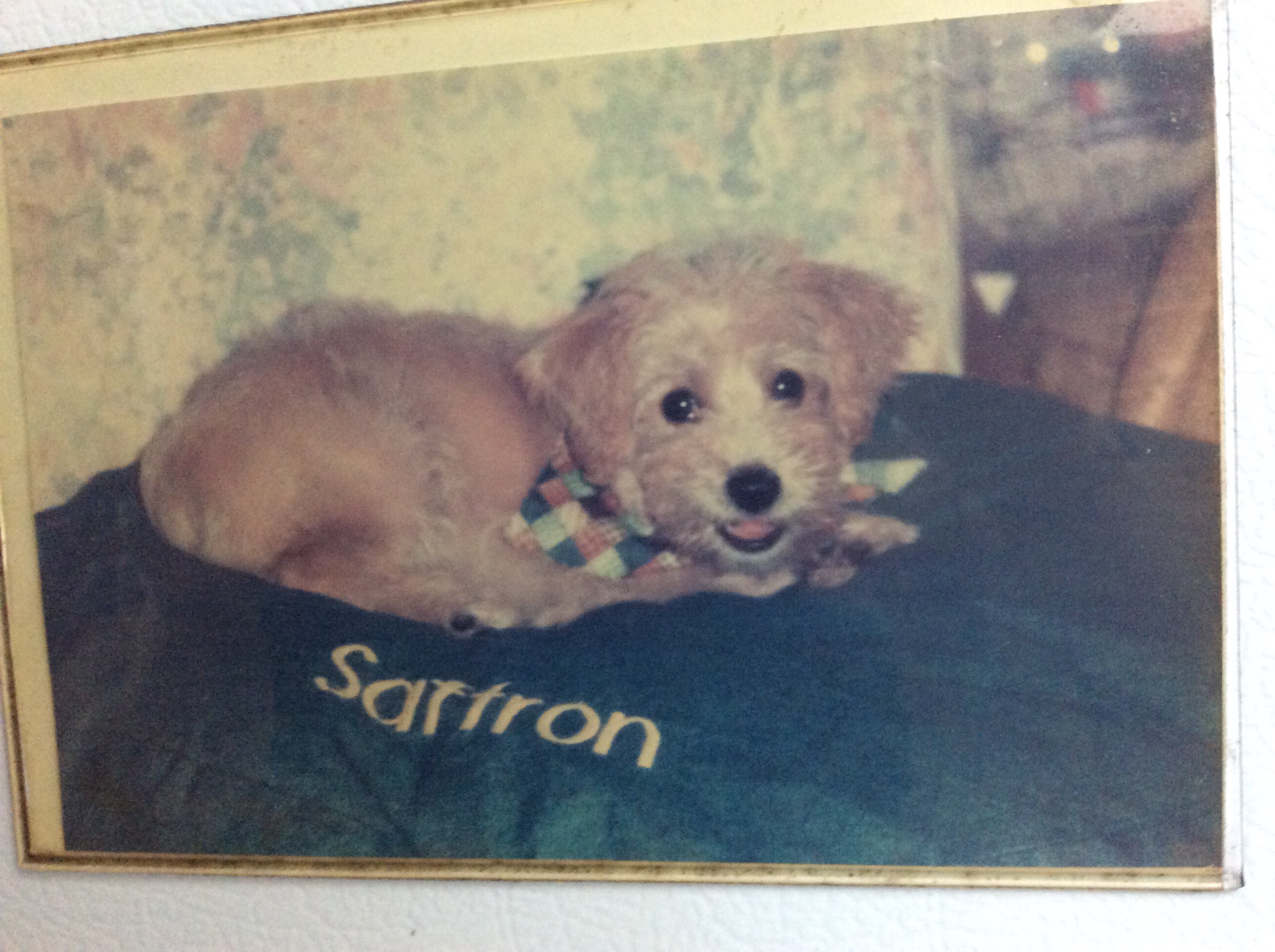
A strong memory from those first telecommuting days was that my husband and I got a puppy, Saffron, who we adored. It seemed reasonable that I could attend to him as needed, taking a break and taking him outside. Much of my work was scheduled calls, with looser time in between, during which I had some flexibility.
One day, when Saffron was doing well in his training to signal when he needed to go outside, he signaled when I was on a critical phone call. I no longer remember the focus of the call, but I remember that I needed to continue with it and was unable to stop for a puppy-break. So, I watched as Saffron, trying to do what was right, could no longer hold it and peed on my office floor. If it were today, I could simply carry my phone outside, with Saffron on a leash.
During my time as telecommuting manager, I came to recognize some of the characteristics of those who were successful telecommuters and those who were not. People who were not well organized experienced many more challenges working from home. People who believed their jobs would be easier at home were often disappointed, because the jobs weren’t easier, in fact, were often more difficult. On the other hand, people who wanted to eliminate a long commute, expecting stronger work focus, were often successful.
Now, as Covid fears lessen and more people are vaccinated, who will want to return to the office? In my experience, successful telecommuters were proficient at connecting with others, even from home. Those who felt isolated were less successful, often choosing to return to the office, if given the opportunity. This past year has allowed many to telecommute who might not have chosen it otherwise. If given a choice, will they go back to the office or stay at home? And the companies, if they have the chance to reduce the cost of office space, will they even give their employees the chance to come back? My guess it that, mostly, it will work out and, inevitably, some people will not be happy with their options.
Part II
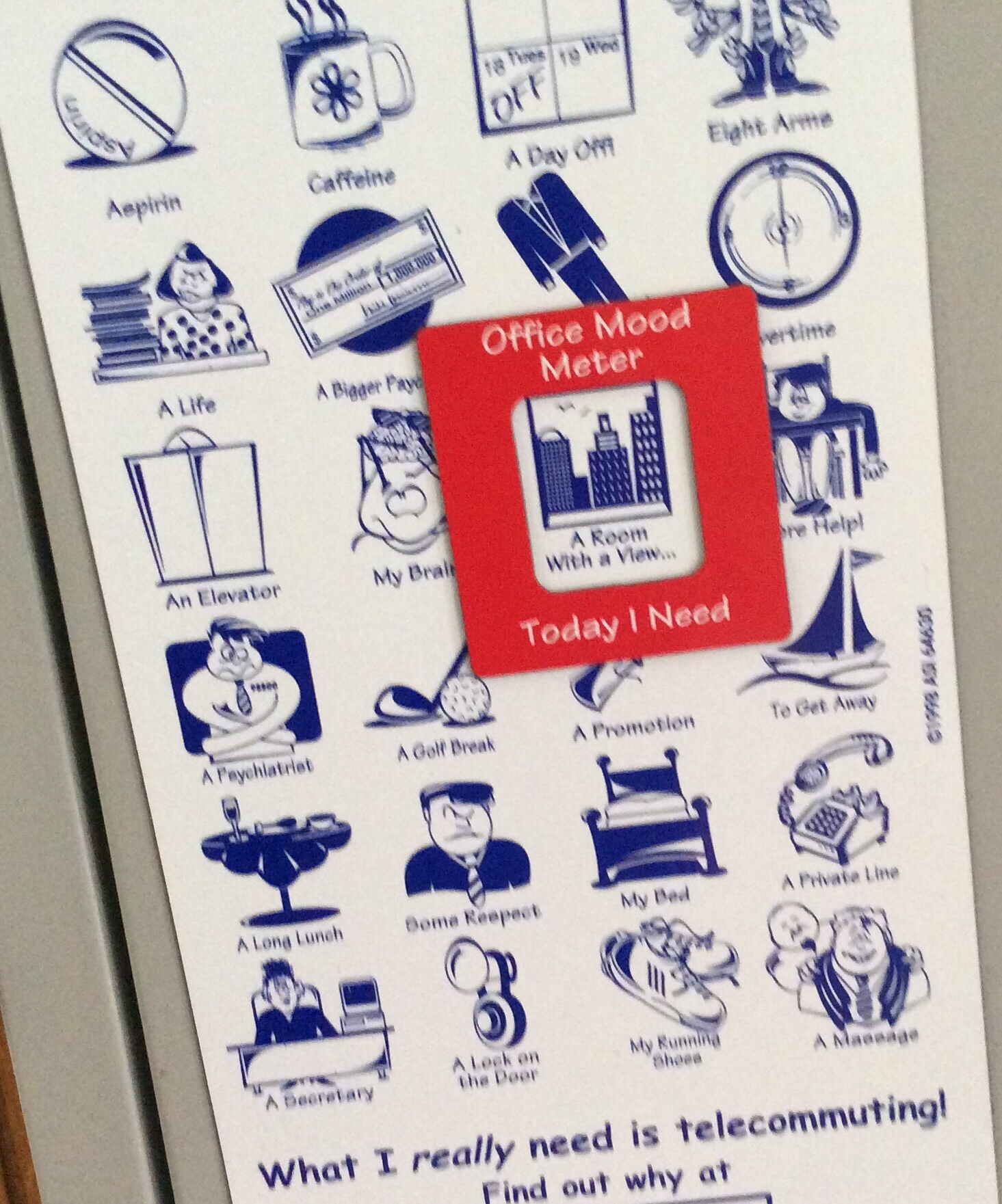
As my mind wandered through these memories, I recalled the first telecommuting expert that I knew, all those decades ago. Maybe the reason that I remembered him is because magnets that he provided so long ago are still on my metal file cabinet in my office. One of them has the heading, “What I really need is telecommuting!” and Gil’s contact information. Over the years, I have discarded most of the trinkets I had collected, but for some reason, I kept this.
Maya Angelou said, “People may not remember what you said, but they’ll always remember how you made them feel.” Well, I remembered Gil’s kindness. I googled the website from long ago and it was still there, though the most recent entry was 2007.
Despite this, I sent an email to his at-least 25-year-old address, reminding him of our long-ago connection and inviting him to a Zoom call. He responded. Even more amazing, he agreed to a Zoom call, apologizing that he didn’t remember me. I assured him that, had I not kept his magnet, I would not have remembered him either.
The call was scheduled for later the following week, the first time we had the same time slot available. I anticipated the call with excitement and wasn’t completely sure why. We’d not had a personal relationship, just a relatively brief business connection. Nevertheless, I was excited to learn about his life, expecting that, like me, he would have retired several years ago. I wondered whether his work had continued with telecommuting consulting or if he had changed direction.
Our call time arrived and, there he was, onscreen, looking good! I hadn’t remembered what he looked like, so had no expectations. We talked easily and comfortably. He, like me, had transitioned to retirement about four years ago, after working part time for several years. He shared his joy in his four grandchildren and his sense of having had a good life. I heard in everything he said his appreciation for his family and a lifetime with a fulfilling career.
We talked about the changes in telecommuting over past decades, each of us recalling and relishing our chance to be at its beginning. Of course, we discussed the challenges that people experienced last year, being thrown out of their offices and classrooms, with no personal choice involved, no time for preparation, and relatively little support.
Then, we each shared a bit of our personal lives, which in important ways were quite similar. I told him about my volunteer work for social justice and climate activism. He described his work in making menstrual products available in his community, without charge to those in need, work that I also support locally. He is president of his synagogue, an extremely challenging task right now, with the Israeli-Palestinian conflict such a controversial issue.
We talked for about an hour, never running out of topics for conversation. When I mentioned my writing classes and my new-found desire to write, he disclosed his recent writing endeavors and generously allowed me to read it. He described how his desire for clarity informs his writing. That he successfully maintained and grew his telecommuting business over decades was strong proof that he was clear in his communications, yet he was conscious of this new writing and a different need for clarity.
Based on my reading and the many comments added to his site, his family and friends felt considerable appreciation for the details he included. He is not writing on a blog, but on Caring Bridge; he has pancreatic cancer.
Who knows what his future holds — or the future for any of us? What I do know is that Gil has invested in his life, his colleagues, his family, and in his community in the best possible way. Our conversation was a gift he gave to me, and I hardly know him. Thank you, Gil. Enjoy all of the days of your life.
This story has three chapters, with a clear beginning, middle and end. Paul and I had been married about 10 years, petless. I had a corporate job, worked from home when I wasn’t traveling, and was managing the new work-from-home program throughout the country. It seemed like a good time to get a dog, so we began to consider it. We agreed on many things, such as the size (not too big) and that neither of us would bring a dog home until after we both agreed to a particular dog. What we imagined to be our future house rules included that he would be well-trained and would never be allowed on any furniture, especially our bed.
We didn’t like the idea of getting him from a pet shop, thus supporting puppy mills, so we looked elsewhere. One day, responding to a newspaper ad from a local family, I went to see a new litter of miniature snoodles, Schaunzer-poodles. I fell in love and wanted to bring a particular one home, but I remembered our agreement, so drove home to tell Paul about the puppy I wanted. His initial reaction was that he didn’t want any kind of terrier and it sounded like one to him. My response was, “don’t make me choose between you!” I couldn’t believe how strongly I felt for this little creature, not yet ours.
So, Paul and I returned together, and he got a chance to fall in love, too. When the puppies were born, the owners tagged each one with a name beginning with S. Ours was tagged Snickerdoodle. It took about a week of arguments before we could agree on his permanent name and this little 6-pound blondie became Saffron.
I’ve forgotten when we threw out the rules we’d made, but it wasn’t long until Saffron was invited to sit on any furniture he wanted. Maybe it was a couple of months before he was in our bed, too.
I loved the puppy classes and Saffron was so smart! By the time he was 20 pounds and two years old, I was taking him to training for pet therapy. We passed the test with flying colors. I could throw any food on the floor in front of him and tell him, “Wait!” and he wouldn’t touch it until I told him it was ok. Normally high energy and jumping all over the place, he learned to be quiet and still when we walked through a hospital or a nursing home.
After passing the test, we earned the right to purchase the red bandana that Saffron would wear when ‘working.’ We began to visit a local nursing home. I initially declined when we were invited to visit the Alzheimer’s unit. We visited the same nursing home once a week and I continued to say no to that request. Then, one day, a nurse told me that, although the people we were visiting appreciated our visit, people in the Alzheimer’s unit would appreciate it much, much more. So, one day, I said, “Yes.”
Saffron’s bandana, worn only when ‘working.’
During our first visit to the Alzheimer’s unit, we entered and a patient started to talk to Saffron, laughing and telling him jokes. She paid no attention to me, only Saffron. We visited with her a while, then stopped to make the rounds and let others pet him. A week later, we returned for a similar visit. A nurse took me aside to say that the laughing woman was sullen and quiet during the week, talking and laughing only when Saffron was there. Somehow, Saffron reached a part of her that no one else could.
He traveled with us, whether by car or plane. His first flight was nonstop, in a soft-sided pet case stored under our seat, to San Francisco. That trip was successful, so we didn’t hesitate to fly him with us when we visited my son, Jack, in North Carolina. He also joined us when we traveled to France, via Germany, for a canal boat trip. When we landed in Germany, I identified him as a Schnauzer; in France, he was a poodle, of course. The French love dogs! He was allowed to go almost everywhere there, including all restaurants; however, he was not welcome in butcher shops and cathedrals.
Saffron’s pet therapy career lasted for about 10 years before the last chapter of his story, which is too sad to tell. His life added a enormous pleasure to our lives that is still a joy to remember.