Stretching

This is not about stretching as physical exercise, but personally stretching beyond our comfort level. My earliest memory of stretching in that way was when I was about sixteen years old. I was at Mass, Catholic Mass, in the early 1960’s. One of the church announcements invited teenagers to try out for the color guard of St. Mary’s Cardinals Drum and Bugle Corps. I didn’t even know what a color guard was, but something in me stretched at hearing about it. I must have talked about it with my parents, though I have no memory of it. Regardless, I showed up at the designated time at the local Catholic grammar school for tryouts. I learned that, to ‘try out’ involved receiving instructions for marching and carrying flags (i.e., the ‘colors’), practicing together, developing synchronization over several days, and finally, being observed while the selection took place. I have no memory of how many of us were rejected or accepted; I simply know that I was accepted, chosen, and that I was proud.

I have recently been mesmerized by the Webb telescope images of faraway galaxies, huge beyond my imagination and far away, light years away. What I am examining here is the opposite, something infinitesimally small, that tiny quality that made me step off my comfort cliff to try something new, with unfamiliar people, to stretch my boundaries, for no apparent or obvious gain.

I want to contrast that with two times that I said ‘no’ to that tiny voice beckoning me. Once was during that same period, as a teenager. I was walking downtown and was approached by a stranger, who told me that I was beautiful, that he was an artist, and that he would like me to model for him. What a mix of reactions engulfed me! First, of course, flattery. Here is an artist, someone with a discerning eye, and he thought I was beautiful. Now, I’m sure I was beautiful, as every teenage girl is, but I’m quite certain that my looks were nothing special. Of course, I fleetingly considered that he might have a different, more deceitful intention in mind, but I believed him, trusted him. There was no discussion about whether it was merely my face that intrigued him, or what clothing or lack of it would be required, although my mind considered each possibility. I felt this tug to consent, but pulled back and declined his offer.

The second time I said ‘No’ to an offer that felt similar to me was when I was in my thirties, as a mother wearing eyeglasses, working part time as a cocktail waitress. My uniform was a fitted tuxedo jacket, over a ruffled shirt, with black panties, black stockings, and high heels. I wasn’t used to feeling sexy, but I felt sexy in this outfit. One of my regular customers was very complimentary about my appearance and one night, offered to buy contact lenses for me, an item that was out of our price range for my husband and me.

I wanted to accept his offer, despite the clear inference that my appearance was being compromised by wearing eyeglasses and the obvious line I would cross by accepting money from a man who was not my husband. I declined his offer.

These three occasions each provide examples where I was invited to stretch beyond my comfort zone. Only once did I accept the offer. That stretching was significant, leading to exciting years marching in that corps and ultimately marrying a drummer, who became the father of our son. Beyond that, it became the first of many unknown groups that I joined, each time saying yes to that voice inviting me to stretch out of my little space. These groups include the American Association of University Women (AAUW), North Shore Friends (Quakers), the Gloucester Gig Rowers, Senior Tap-dancers, Landmark School (where I became a special ed teacher at age 59), and many others. Occasionally, the invitation is to stretch alone, as it was for me when I chose to walk the Camino on my own. (See previous blog about this.)

Last night, I was in the audience at the Cabot for a presentation, “Students as Change-makers.” High school students from area schools presented, then answered questions about their various passions, the causes that had invited them to stretch beyond their comfort: human rights, gender stretching, and racial discrimination. I compared them to fireworks, released from earth rather quietly, rising without much attention, before bursting into colorful images beyond us. I celebrate them and each one of us, who answers that call to stretch beyond our comfort.

So these are completely different examples of circumstances that call us to stretch. Nothing like the spaciousness depicted by the Webb telescope images, but more their opposite, a seemingly tiny, momentary pull within us. It certainly is not obvious what they have in common. None of us responds positively to each invitation, nor should we. The clue to a stretching invitation is that momentary twist of discomfort that we experience when we’re in decision mode, actually in indecision mode. Should I say ‘yes’? Or should I say ‘no’? The choice to stretch or not is always up to us.

Copyright © 2022
Being in a Parade

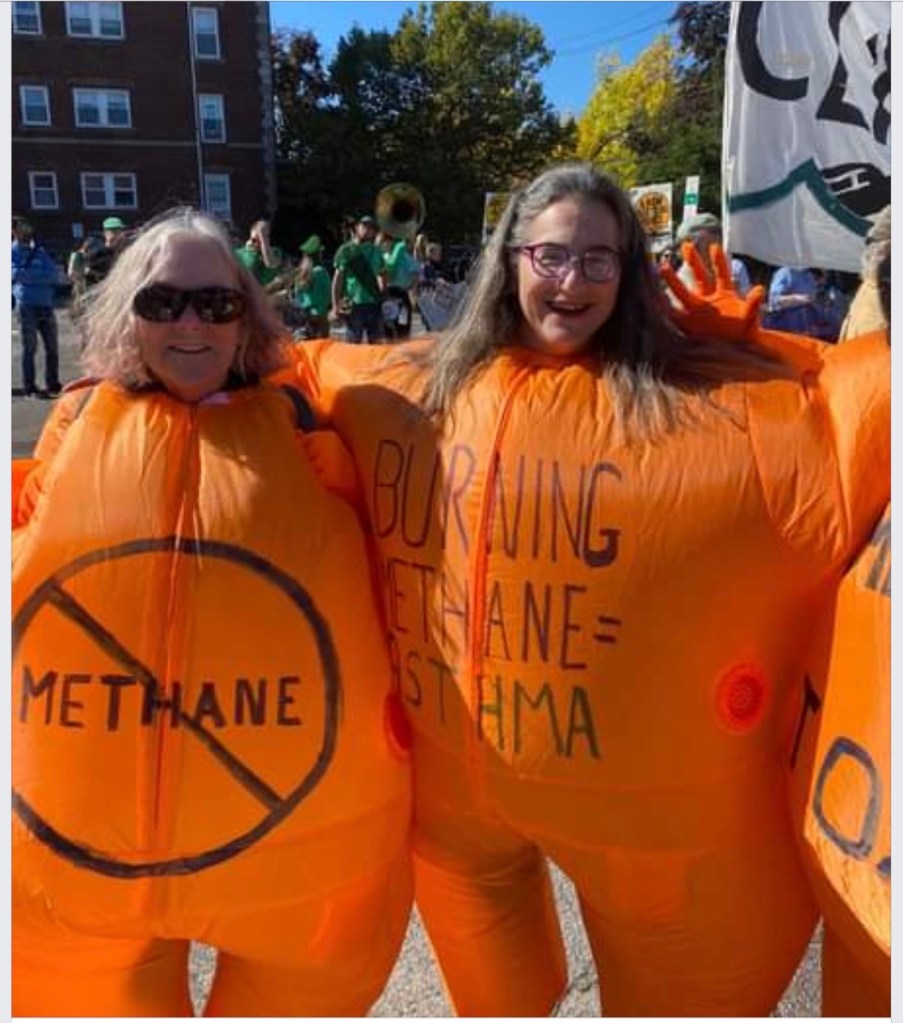
On Sunday, I was in Cambridge, walking two miles in the 17th annual Honk parade, costumed as a methane molecule. The Honk parade celebrates all things activist, this year accompanied by twenty bands. The weather was glorious, the route from Davis Square to Harvard Square packed with people of all ages, all happy, celebratory, and appreciating our antics.

Amanda and me, Honk parade 2022

As an adult, I’ve been in other parades, participating with my Mass-350 climate activist node, including last winter as a reindeer in Gloucester. This time unexpectedly brought back crisp memories of the 1960’s when, as a teenager, I marched in many parades as a member of St. Mary’s Cardinals Drum and Bugle Corps, carrying a flag in the color guard. The overriding emotion experienced in both periods, teens and seventies, was joy. Let me go back to my teens . . .

When I joined the Cardinals, actually, tried out for the color guard, I had no idea what they were or what was involved. It was simply a new activity and I was up for an adventure. The first time that we were in the school basement, putting on our uniforms, then walking out into the sunshine, I was bedazzled by the sunlight shining on the gold sashes we wore. We had been transformed by the maroon and gold uniforms into something magical, something other-worldly and I loved it!

When we then assembled and marched onto the street to find our place in the parade, I instantly stood taller, prouder. All of the tactics we had learned during hours of indoor practice clicked into place, as we marched, in synch, to the music of the drums and horns. Then, when we marched through crowds of familiar people to excited applause, WOW, I did love that so much.

During the three years of that drum corps experience, I loved every minute, the repetition, the minute corrections to synchronize our bodies with each other’s, the cold days and the hot, sweltering under the sun, I loved it all, including every parade wearing the mid-calf white leather boots that I polished before each performance. There were also white cotton gloves, one more part that had to match everyone else’s. I never tired of it, never got over the thrill of marching down the middle of the street, loving the cheers of the watching crowd.

Last Sunday, marching in the Honk parade, these memories returned to me seemingly multiplied by the six decades that have passed in between. My body’s capabilities have diminished during those decades, but not my ability to revel in the excitement of the parade and of my part in it. In fact, not being certain that I would be able to march the two miles, I had exit strategies in place, which, fortunately, I did not need.

I may not have danced as much as my sister methane molecules, but I didn’t stop smiling. I especially love the grinning children along the side, eyes wide at seeing our strange, fat, orange suits. I often approached them, to their delight, while I said, “All of this is for you, you know, just for you!” Their parents confirmed this, acknowledging that our ongoing climate protests are not for our benefit, but for the children who will inherit this world.

Copyright © 2022

The World and Me

Thinking about the world and me, my place in it, and my responsibility to it — these are topics for a book, not an essay! However, I will compress my thoughts into an essay. Gratitude, wonder, awe, and something else, something beautifully conveyed in Cavafy’s poem, Ithaka, destiny perhaps, are among my responses to our world. However, here I will not express those sentiments, but rather, my sense of responsibility about my presence in this world.

I have been alive for three-quarters of a century on this planet, most of the time in high appreciation for it. My planetary view was recently modified by the images conveyed by the Webb telescope’s images, which impress upon me that I am personally less than a grain of sand in this glorious universe. How can I combine that reality with the equally valid reality of my personal presence, emotions, thoughts, and feelings? These conflicting scales are impossible to hold!

Nevertheless, I accept these scales and dimensions as reality, aware that my depth of understanding is minimal. This helps me to scale and accept my personal drive towards being a responsible, though tiny, human being in this massive universe. I experience a strong drive to being a responsible user of limited resources on this finite planet and also to encourage others to live similarly. How does this drive take form for me?

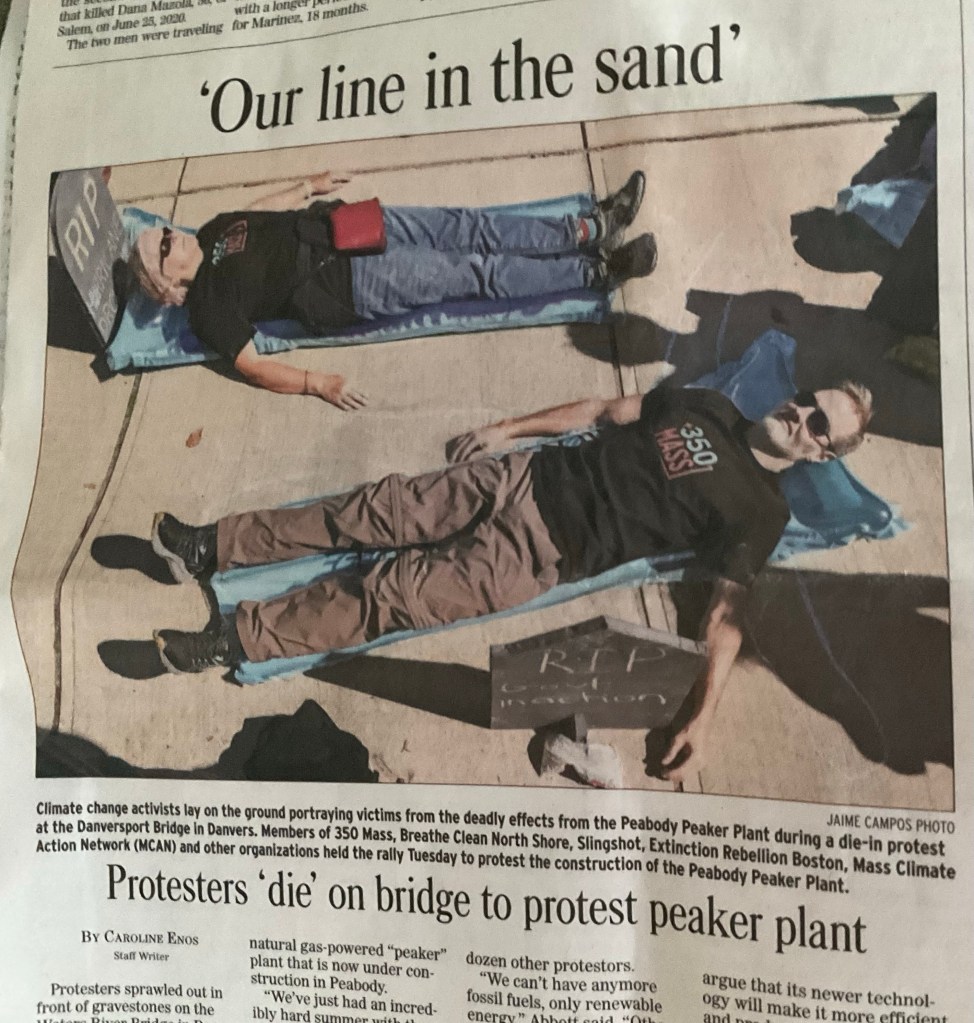
It includes a mix and ranges from recognizing my personally limited resources (physical, mental, and emotional energies) to identifying multinational organizations, such as Chase Bank and ISO, builders of fossil fuel powered plants, whose greed overrides any realistic negative sense of planetary destruction achieved through their financing and promotion of fossil fuels. Among my actions taken both to promote greater understanding within the general public and to deter the greedy proponents of fossil fuels have been: joining others to remove coal from a coal-powered plant, resulting in arrest; standing in front of a coal-carrying freight train, videotaping my cutting up of my Chase Bank card, before returning it to a branch bank; and participating in a ‘die-in’ near the site of a proposed power plant. (Note my picture from 9/28/22 Salem News front page.)

9/28/22 Salem News front page

Other actions connecting me to the world result from my relatively new understanding of the lies I learned growing up concerning the role of indigenous people in New England. My reactions, beyond surprise, have been to increase my awareness, to act with intention towards people with that heritage, and to recognize and share the land history where I live.

My relationship to the world also includes my relationship to the people in it. As my understanding of that has changed during past decades, I have also modified my actions to include promotion of Black Lives Matter and GBLT gatherings and active protests of anti-Semitic and other acts that denigrate any minority groups. For me, this is the conscious result of recognition of the interconnection among us all.

To close, all of these occurrences of enormously different scales are interconnected. It is very easy to take it in and end up feeling small, as if it makes no difference what one person does. My belief is that it is just as easy to take it in and believe that we each must act out of goodness, out of belief that we each matter, and that our actions matter, whether or not we can see an immediate result.

Copyright © 2022

A Quaker Sheriff?

Recently, a friend who attends our Quaker Meeting intermittently with her two children announced that she was considering running for county sheriff. Although I liked her very much and we always enjoyed having her children present, I must admit that I felt some confusion. As a non-Quaker friend said to me, “I’m not sure I’ve ever heard ‘Quaker’ and ‘sheriff’ in the same sentence before!

Virginia Leigh, known to us as Ginger, asked for a clearness committee, which resulted in her clarity to run against the incumbent sheriff, who had previously been a police chief. He certainly matched the image that I carried of a sheriff.

Our Meeting quickly came together to support her in this endeavor, which would culminate in the September primary election, as a primary race between Democrats. Her foundation for running was her background as a social worker and her conviction that “Sheriff’s work IS social work!” While supporting her, I learned that the Massachusetts ACLU had coincidentally just released a public education video, “Know Your Sheriff,” because, like me, few of us had any understanding of the sheriff’s job responsibilities.

Briefly, the sheriff’s job is NOT rounding up the bad guys or performing law enforcement; it’s overseeing our jails’ residents. Some are awaiting trial and some are serving their sentence. Many have addictions requiring treatment. Thus, the primary responsibility of our sheriff is overseeing these people and insuring their safety and and maintaining their health while they await hearings and trials or during transportation between locations.

During Ginger’s campaign, I learned of the high suicide rate among both jail personnel and residents, especially high for residents during the first two weeks of their confinement. Additionally, the recidivism rate has approached 50% during the incumbent’s six-year term. Only after Ginger announced her candidacy this year, has he introduced new programs to attempt reduction of this revolving door.

Having heard about the high cost of inmates’ telephone calls, I was shocked to learn that, not only does the sheriff’s department receive a percentage of those fees, the current sheriff of Essex County accepts substantial campaign donations from the current vendor, not recognizing the inherent conflict of interest.

Little by little, as I heard Ginger speak on multiple occasions to varied audiences, sometimes including her opponent and his supporters, I learned more about his history and hers. Evidently he has recently been the defendant in a case brought by the ACLU, after he refused to provide needed medication to an inmate. Also, little by little, I began to understand her byline: Sheriff’s work IS social work. The people incarcerated in our jails comprise a considerable percentage of the state’s mental health patients. They need — and deserve — proper care and consideration, from a social worker perspective. With that proper care, they increase their chances to become more useful members of society, to integrate successfully back into society, and to avoid returning to jail.

That perspective is purely humanitarian. What about the financial implications? The cost to us, citizens of Essex County, is about $77,000 per year per inmate. Therefore, for the 45% who return to jail within a year of their release, that cost continues, rather than is eliminated. If attention were given to recidivism deduction, the cost savings to us would be considerable.

As a sidebar, I learned from Ginger that Quakers were originally responsible for the idea of a penitentiary, based on the word, ‘penance.’ Originally, prisoners immediately faced their sentence, such as being executed or having a hand cut off. Quakers introduced the idea of each person being worthy of redemption, of having a chance to learn better behavior. Unfortunately, as Ginger pointed out, Quakers were also responsible for introducing solitary confinement to the prison system.

When Ginger announced that before the election, she would walk across the county, about 27 miles, our Meeting planned to hold a Meeting for Worship midway, followed by providing lunch for the walkers before they continued on their way. We worked out the timing to accommodate a press conference in front of the sheriff’s headquarters, following Worship and prior to the picnic lunch. Worship was held beside a pond on a beautiful Sunday morning with a slight breeze.

The night before the election, Ginger invited a dozen of us to her home for Worship. We were all filled with anticipation, not really having any idea what outcome to expect. Ginger continued to display the calmness that had been her trademark throughout the campaign, then expressed her appreciation for our support, before sharing her personal desire to accept the next day’s results with continued calmness.

On election night, many of us gathered with her and welcomed the early results: the race was close, with many North Shore communities, including Beverly and Gloucester, where several Friends live, giving Ginger a majority of their votes. It remained close overall, with Virginia holding almost as many as the incumbent, until 11:00 pm. Then, with only half the ballots counted, I left for home. The next morning, as the remaining ballots were counted, the incumbent sheriff maintained an edge, with 53% of the votes. Virginia had lost. 🙁

Of course, I am hugely disappointed; nevertheless, I stand in awe of Virginia’s courage, determination, and steady stamina. Additionally, seeing that she came so close to winning, despite being an unknown, unconventional, and first-time candidate, makes me recognize that her message reached many people and may affect future actions in our jails.

Copyright 2022

EV Charging and Community

My newest community consists of EV chargers, that is, people who are charging (or waiting to charge) their electric vehicles with me. This is a completely new community, as I’ve only experienced it three times; however, those three times have all occurred during the past month. Yesterday (August 11, 2022), it happened during my return trip from the 362nd annual Meeting of the New England Society of Friends (Quakers) at Castleton University, Vermont.

Experience 3: I stopped in Lebanon, NH, at the same location where I had charged when I arrived last Friday. Today, no cars were plugged in; last Friday, I had to wait my turn.

I parked my car, plugged in the charger, then tried to enter my credit card information onto the console, unsuccessfully. A helpful gentleman looked over my shoulder, cautioning me to slow down, because the response was exceptionally slow. This was the first time I’d ever encountered a person who was apparently working there, so I expressed my appreciation for him. I learned that Patrick was servicing the charger that had not been working the previous Friday, while simultaneously talking to someone at the office, letting them know about the slow response at my station.

When my charger finally started to charge, he asked me if I’d like a free charge — of course, I said, “Yes!” He disconnected my charger, then reconnected me to the one he was servicing, in order to check its functionality. It worked, and while I received a free charge, another EV pulled in, this one a new Ford truck. It was a Lightning, a brand new model, in fact, not yet delivered to anyone! Its driver, John, clearly proud of it, welcomed questions. His job was training people about EVs, and he was currently working for Ford. He asked me about my experiences using chargers, wanting to know how his company could make the experience more pleasant.

It was John who suggested that this was actually a new kind of community, us charging our vehicles, sharing tips while we waited. Now, another new car pulled in (a Genesis?,) driven by Bill, who gladly joined our conversation. John commented that there used to be full service gas stations, with attendants who would check the oil and wash your windshield. “How long has it been since those have been around?” I asked, thinking maybe ten years. John said, “About forty years,” causing me to ask his age. “Forty,” he said, “I’ve never seen them.”

From the left: Bill, Patrick, and John, each part of my new community!

Then, Bill reflected on the time of horses and buggies, when there were stops with water troughs and possibly a farrier, to care for the horses’ shoes. I laughed and said, “You don’t look that old!” He confessed to being 85, though appeared younger to me. Our talk evolved to what would make the charging experience more pleasant. It was lovely to imagine possibilities, though it was marvelous to simply enjoy this company on a beautiful day. I stayed after my charging had ended, continuing to chat.

Experience 2: On the Friday before, on my way to Castleton, when I stopped to charge, there were three vehicles charging, with one charger out-of-service, so I had to wait my turn. One of the vehicles was a brand new truck, a Rivian, just a few days old. The people were quite friendly. The only annoyance I noticed was that when one car was fully charged, its owner missing, the next person in line unplugged that car and connected to his own. When the owner returned a few minutes later, she was less than fully friendly. It seems to me that a necessary charging courtesy is to be with your car as it completes its charge.

While we were there, another new truck pulled in, not needing a charge, just wanting to check out the situation. This definitely feels like a community, even though all we have in common is electric vehicles. We span a variety of ages, genders, and vehicles.

Experience 1: Just a few weeks ago, my husband and I had planned a trip to western Massachusetts, to the Berkshires, for a Tanglewood concert. The day before, we’d had an argument, Paul wanting to take his (non-EV) truck, and me, of course, wanting to take my electric Mini Cooper. He doesn’t like the uncertainty of charging, while I consider it as a bit of an adventure. He conceded and we charged once, uneventfully, then stopped again in Lee, twenty minutes away from our destination. The charging station had two chargers, both in use, and two cars before us, waiting. I appreciated the friendly demeanor of everyone involved and the clarity of who was next, although we knew we’d be late for the concert.

It wasn’t long before another car pulled in, then a new Rivian truck. We continued following the etiquette that had been established and chatted amiably. One woman, Ann, and I immediately recognized a connection. We were both part of 350 Mass, a climate protest group, though in different subgroups. We shared some friends in common, notably Judith Black, and had a delightful conversation. Paul and Ann’s friend, Tony, a civically conscious Watertown city counselor, got along well, too, and our waiting went quickly and pleasantly.

By the time we completed charging, the concert would have been half over. We decided not to continue driving and then be forced into the exiting traffic. So, feeling very satisfied with the conversations we’d enjoyed, we just turned around and traveled home. Paul didn’t even complain, but who knows what will happen the next time we decide to take a little road trip?!

P.S. Clearly, the many people currently taking delivery of EVs, some ordered many months ago, has affected the number of us needing to charge while traveling. The number of charging stations will soon catch up. In the meantime, I’ll enjoy this new community!

For the curious, each charge was less than $5.00, except one that was $14. Each location and electricity vendor set their own rate. A round trip of about 300 miles cost less than $20 in ‘fuel’ (electricity.) In contrast, for a gasoline-powered vehicle getting 30 miles per gallon, if the price were $4.00 per gallon, the gasoline cost would be about $40. Note that my EV does not require routine oil changes; additionally, mufflers and exhaust systems never need replacement, because they don’t exist. Do I love my EV? Yes!

An Ordinary Day

There’s nothing special about today. As usual, I woke up beside my dear husband, with a couple of errands on my schedule and a doctor’s appointment in mid-afternoon. Another task that awaits my attention, time-sensitive, though not critical for today, is to begin the organization of tasks needed to serve my court sentence. That is, to perform thirty hours of community service, which will be serving as volunteer coordinator for our New England Quakers annual session, to be held in Vermont beginning August 6.

I serve with love and with gratitude that I am able to do this needed task. Right now, however, I am feeling the stress of the initial task amid the unknowns. Until Covid, these Sessions were entirely in-person events, with 500-700 attendees from throughout New England. During the past two years, Sessions have been virtual. This year, it will be hybrid, so we have no idea how many will attend in person.

So, this morning, my intention was to identify the myriad of tasks that I must accomplish, as well as the individuals whose help I need. STRESS! To ease my burden, I went to a downtown coffee shop for breakfast. Now, I’ve never been a drug user (other than a few times with pot in the sixties, but that doesn’t count.) I raise this now because my experience of some specific minor events feels like what I imagine drug usage to mimic, a shot of good feeling. I walked into one of our several non-chain coffee shops, Kaffmandu, and immediately saw a friend, Rod, who introduced me to his companion. Rod is a casual acquaintance, perhaps not a real friend; despite that, the brief encounter with him before I ordered my breakfast sandwich and cappuccino provided me with a shot of good feeling. Was it because of mutual respect or because I was reminded of the other events that we’ve shared or simply because connection with another good human being is a jolt of good feeling? I don’t know, but it lifted me.

I ordered and received my breakfast, then sat down at a little table facing the door. I could see a Jeep with Texas plates, then a woman packing the back of it with care, as it was stuffed full. My sandwich was half eaten and my beautiful cappuccino barely sipped, but I stood up and walked outside to her and her vehicle, feeling drawn to meet her and discover the goal of her trip. Driving here from Texas is no small achievement!

Her smile was genuine; she was clearly comfortable in her own skin. I introduced myself and told her that I’d noticed that she was from Texas and was curious about her travel. She didn’t answer me immediately, but asked what I was curious about. I said that I’d traveled a fair amount in a variety of ways, that I loved to travel, and I was curious about where she was going and the purpose.

While we talked, two younger women (in their early twenties, perhaps) joined us, Susan’s daughters who had flown in to spend time with her here. One daughter was particularly interested in Salem. I learned that Susan was combining work and pleasure. Her job? Checking cell phone towers around the country! Who knew that such a job existed?! She mentioned that her son-in-law worked as a drone pilot, checking cell towers for things such as accumulated bird poop. Another job that would not often be someone’s goal, but doesn’t it sound interesting?

Although we only spoke for a few minutes, our conversation gave me a sustained shot of joy, no drugs needed. She’s in this area quarterly, so I invited her to contact me and stay in our upstairs, formerly Airbnb, space. I hope our paths cross again.

I went back to my cappuccino, happy that it had not been cleared. At the window counter sat a young couple, clearly appreciating each other, smiling big smiles. I was tempted to approach them and acknowledge the blessings that surround us, but I contained myself.

It’s not even ten am, and I must move on to my procrastinated tasks. I’ve received enough joy-shots to keep me going.

Copyright © 2022

Pronouns and Gender

During an unexpected conversation among four people who were meeting for the first time, I was presented with multiple reactions to the pronoun dilemma that now confronts us. We were each attending a Harvard North Shore alumni lunch and were at one end of the picnic-style table. I include here the genders and approximate ages of each of us, though not their real names (except for me.) Across the table from me was Joe, 85 years old, who initiated the dialogue among us. To my right, at the end of the table was Sam, a retired English professor, about 65. I am Carole, aged 75. To my left sat Susan, about 65.

Joe was commiserating the fact that there are not enough people with technical skills in today’s work force.

Joe: “There’s just not enough guys to do the work.”

I interrupted: “Did you mean to say ‘people’?”

Joe continued: “No, there’s not enough guys to do this kind of work.”

I responded: “You know, women can do this work, too, not just ‘guys.'”

Joe answered me: “You want me to be careful about how I use these words. I’m too old to be bothered with that.”

Me, again: “You’re not too old and it matters!”

I then proceeded to recount the story of being turned down for a job forty years ago and being told that the reason was, they wanted to hire a man. So, am I particularly sensitive to male-gender defaults? Yes, I am.

Joe continued with his story, sticking with ‘guys.’ During the next pause in the conversation, Sam turned to me, “Can I assume that you don’t accept ‘guys’ as being gender neutral? The reason I’m asking is that my family frequently discusses this topic, because we value gender-neutrality.”

I told him that his assumption was accurate and, in response to his next question, that he could quote me. I loved it that it was a continuing family topic for him.

Then, Susan joined our conversation. She lamented the lack of a gender-neutral word for adult offspring. We have sons and daughters and also, kids or children, each far more verbally comfortable than ‘offspring.’ Susan has one offspring, born a male, who is transgender, not to a female, but rather as non-binary. Susan’s dilemma is referencing this person as offspring, wanting another word to use, though it doesn’t exist. These were not problems to be solved today. However, I felt relative satisfaction, simply knowing that three of the four of us recognized the predicament.

Earlier that week, another related situation presented itself. During our first zoom meeting of about twenty people from around the world with plans to meet for multiple sessions, we were invited to introduce ourselves and our preferred pronouns. One person with a traditional woman’s name, Sally, said that she did not want ever to be referred to with any pronoun. You may be able to see the problem: In my previous sentence, in order to respect Sally’s wishes, I would have needed to say, “Sally said that Sally did not want ever to be referred to with any pronoun.” That second ‘Sally’ is awkward and avoided only with constant deliberation.

At any rate, despite our best efforts and multiple apologies, we were not successful in avoiding Sally’s pronouns and she dropped out of our group.

Fairly recently, I considered the goal to be simply remembering, then using, a person’s preferred pronouns, despite my personal reticence to using ‘they’ when referring to an individual or using ‘she’ when referring to someone who looks like a man. However, I AM overcoming my desire to employ conventional English usage.

I have some awareness of the profound effect on people of having even one other person showing respect for them. I don’t ever want to be that person who knowingly was disrespectful of another’s changing or emerging self-awareness.

Copyright © 2022

Rejection

It was 1981, I was 34 and had just completed my bachelor’s degree in physics and math, graduating with honors, feeling quite invincible. I had not often, if ever, been knowingly rejected and was not aware that it was in my immediate future.

I looked with delight at all the help-wanted ads, each one launching for me images of a different future. The one that drew my sharpest attention was from a local company, Pennsylvania House, with a reputation for making high-quality furniture. Its job posting was for an industrial engineer. That sounded to me like the perfect place to use my skills in physics and math. I applied and was invited in for an interview.

Being invited back for a second interview fueled my confidence that my skills matched their needs and that I would soon be offered the position. After meeting with other managers there and continuing to feel positive about my prospects, I was called back to the hiring manager’s office. “I’m going to be honest with you,” he said. “I think you’re the best candidate for the job. But, they won’t let me hire a woman.”

Have I mentioned that I am a woman? Do you remember that it was legal then to hire based on gender, even when it was not related to the tasks to be performed? Remember when airline attendants were all stewardesses?

Our meeting ended quickly and I left in confusion, in a mix of emotions, including appreciation for his honesty and resentment that I felt powerless to change the result. I considered further actions, but could not imagine any that would be fruitful. Finally, I turned my attention to other job opportunities and quickly secured a new position as an ultrasound technologist in cardio-vascular surgery at a local teaching hospital, Geisinger Medical Center, despite the fact that I had never taken a single biology class! It was an emerging career path that promised future opportunities.

Personal computers, newly available in the world-at-large, were accessible in the department and I was fascinated with them! I experimented at every opportunity, collaborating with the surgeons in their research by setting up databases to hold and analyze their data. After three years, I applied for another job that attracted me: a systems analyst in a small company, North Central Digital Systems, that sold and supported PCs. I knew this was a stretch for my knowledge and experience, but applying felt like an adventure.

I was interviewed by a manager in the company, then called in to speak with the owner. I clearly remembered the other interview that had resulted in rejection and considered options available to me. So, when the owner said to me that they had decided to offer the job to someone else, I asked if he would do me a favor. I asked, “Would you go through the qualities needed for this position, to help me understand where I fall short?” He replied, “Sure,” and we continued.

“Technical skills,” and he nodded.

“Personal skills,” and he nodded again.

“Management skills,” and again, he nodded.

“Creative skills,” and this time, he said, “OK.”

“OK, what?” I asked.

“OK, you’ve got the job.”

My redirection of his attention to the skills needed for the work invited him to refocus away from whatever else distracted him from the task at hand: hiring the right person for this job.

So, that person who had been honest with me about the reason I was rejected, not offered the job as industrial engineer had, in fact, done me a favor. If he had not told me the real reason, I would have assumed it was because of a shortcoming of mine, that I was not good enough. His honesty enabled me later to redirect another’s attention to my skills, which were good enough.

Copyright © 2022

Who is Time?

We meet. So much time has passed and who is time?

She was my friend, mostly because we worked together. We began working on the same day, me 59 and she, about half my age. She was the one who seemed to me to be the most together of all the new teachers. We taught for 11 years, then both left teaching, me for retirement, her for less clear reasons.

About a year later, her picture was on the front page of the local newspaper, for stealing $15,000 over a five year period from a family who trusted her. Some months later, after she pleaded guilty, she was sentenced to a year in jail. I felt shock and perhaps sadness, not because she had been a close friend, but because I almost felt abused myself: I had trusted her. She had not cheated me out of anything, but she had not had the opportunity.

I also felt angry at her. How could she have stolen from people who trusted her? I considered my own naivety, adding feeling stupid to feeling angry and sad. I determined not to have any contact with her ever again. That wouldn’t be a problem, because we hadn’t been seeing each other routinely anyway.

Time passed and who is time? Whoever it is, it added to my thoughts these kernels: What about her baby, less than six months old? What about her husband: had he known about her theft and was he standing by her? What about Covid and its affect on inmates? Was anyone visiting her or writing to her? I tried to locate her online, to find out what prison she was in, but no luck.

Finally time twisted me into a place where I wanted to contact her, to reach out to her. I had no clarity about what I wanted or needed to say. I finally experienced clearly that I needed to reach out, but how?

I sent a Christmas card to her and her husband at their home with my contact information, not knowing whether he was still living there, asking him to forward my card and offering to write to her, if he would provide me with her contact information.

I heard nothing until mid January, when I learned she had been paroled, in part because of Covid. She messaged me, thanking me for my card, telling me how much it meant to her.

I asked if we could talk or Zoom. She accepted and we set a time to Zoom the next day.

I had no idea how to begin our conversation, but she made it easy. When we started to talk, she said, crying, how much it meant to her to hear from me, because she had no idea who would have anything to do with her any more. Then she said, “when I was in jail, I realized how much I have to be grateful for.”

Well, that was about the last thing I expected to hear!

During our 90-minute conversation, she shared a lot with me and left me feeling that she had learned something important from this. I don’t want to say “learned her lesson,” though that comes to mind. I also retained the sense that I would be foolish to completely trust her and, likely, will not have contact with her again.

Who is time? It has continued to pass. I still don’t know the answer, but it doesn’t always change anything.

Copyright © 2022

One City — Bangkok

Among the many amazing cities that I have had the privilege of visiting is Bangkok, Thailand’s capital. During a month in spring of 2001, traveling alone In Thailand without an agenda, I was in Bangkok three times: my first few days, my last two nights, and two nights in the middle of that month. My arrival is described in another blog entry, Fear.

During my planning for this trip, I read extensively before making reservations for the first two nights and the last two, leaving everything else up to spontaneity and chance. For my first two nights, I picked a hotel recommended in a trusted, low-key travel guide, Lonely Planet. When I described it to the owner of my favorite local Thai restaurant, he expressed alarm, saying that it was not a safe location, because it was where transients stayed. I listened to him, recognizing that was what I wanted, to be with fellow travelers, not with folks on a fancy tour. It turned out to be ideal. Once there, I immediately met long-term, low-budget travelers, who shared with me their experiences in lesser-known areas. That well known book, The Road Less Traveled, had always been a favorite of mine, along with its philosophy.

During those first few days, I emerged myself in Bangkok, walking the streets, using their Metro, the tuk-tuks, and the river taxis. The tuk-tuks were three-wheeled open motorcycle taxis, sometimes bicycles. I loved the challenge of deciphering the systems and using those systems with reasonable confidence, knowing that occasionally I would end up someplace other than where I’d planned. It was always an adventure. Because of Bangkok’s prevalent pollution, it was common to see local people wearing masks, similar to those that are familiar to us now, during the pandemic. Twenty years ago, it seemed bizarre to me.

One of the pleasures was eating the street food, never disappointing. I had learned enough Thai to be able to communicate that I was vegetarian, so that I wouldn’t buy something with meat by mistake. Because being vegetarian was common in Thailand, it was an easy message to convey. I was glad to take a chance on unknown foods, as long as I wasn’t taking a chance on meat! Among the many treats that I encountered was roti, a street pancake prepared to order, garnished with fruit, chocolate, or cream. Another common street food was pad Thai, that familiar dish, made to order, on the spot. I never got tired of that or of the plentiful fresh fruit, available on almost every corner: pineapple, watermelon, guava, mangoes, and more.

During my meandering those first few days, I visited Bangkok’s version of Central Park and participated in public Tai Chi, which I had learned at home. I was very moved when, walking across the park, music began to play and others signaled to me that I should stop moving. Later, I learned that it was out of respect for their national anthem. I read about a performance to be premiered in two weeks and that the Thai princess would be attending. The play was to be based on the true story of conjoined twins, Chang and Eng. Knowing that those original twins were from the country then called Siam, now Thailand, I bought a ticket, planning the remainder of my trip around this return trip to Bangkok.

After two weeks of exploration of southern Thailand, beginning with a delightful overnight train ride on crisp white sheets, interrupted by local vendors hopping on the train at local stops to sell their food and wares, I returned to Bangkok, to the same hotel, having been completely satisfied with its convenience to public transportation. My evening at the fancy theater was in sharp contrast to the rest of my backpacking month. The play was astounding, the actors portraying the joined twins remarkable, the entire story marvelous, literally, a marvel. I loved being present for it, being a witness to it. It was a night unlike the others of this month of exploration.

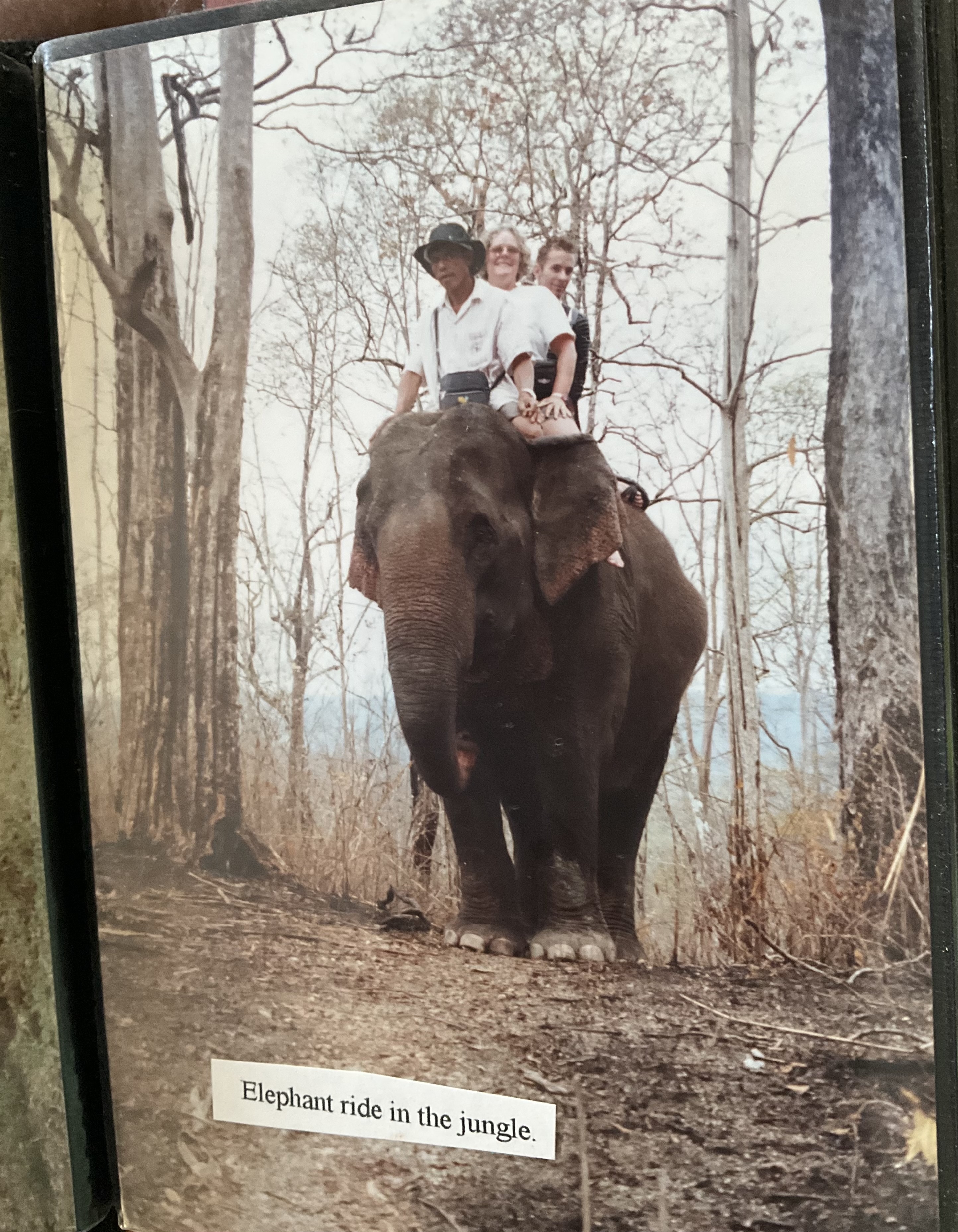
After sleeping in the following morning, I boarded a bus to northern Thailand, where I rode an elephant, explored Chiang Mai, visited ornate Buddhist temples, and enjoyed much Indian food. After another two weeks of glorious adventure, I returned for the final time to Bangkok. This time, I stayed at an exclusive resort, which I had reserved with points secured from extensive business travel. It was not convenient to public transportation or to the bustling city streets that I had quickly learned to love. Of course, it had wonders of its own, including elegant dining. But, I might as well have been in a great hotel in New York City! In a conversation with another guest, she shared that she had been warned to avoid street food, as it wasn’t safe. I didn’t say anything, because she was leaving the next day, but thought to myself how much she had missed by playing it safe.

Have you considered a trip that includes Bangkok? I highly recommend it, knowing that if you play it safe and take no chances, you’ll have a wonderful time and experience a bit of the exotic culture. However, if you’re willing to stretch a little, to take a few reasonable risks, you’ll have an adventure that extends well beyond the ordinary.

Copyright © 2022