This story began in 2007 and came to fruition today, January 10, 2021. During June of 2007, Paul and I were celebrating our 17th wedding anniversary on Vancouver Island. It was a lovely vacation and on one glorious day, we were bicycling, something we did rarely. We were on a quiet two-lane road, covered with a natural tree tunnel in a rural area, going fast downhill with no traffic. I was in front of Paul.
All of a sudden, there was an eagle flying beside me, taking up the entire other-direction lane, with her right wing covering part of my lane, as well. My initial reaction was thinking with wonder, “Is this really an eagle?!” Then, a heartbeat later, I thought, because she was flying in the wrong direction in her lane, “What if a car comes and she moves toward me?” I was irrationally thinking she would know that she was in the wrong land and move to get into my lane. Her wingspan was more that her side of the road; she was huge.
I considered my options. We were at the high part of the road that downhill in front of us and a downhill drop to either side. I imagined myself tumbling down the heavily treed hill beside me – not a desirable option! Before I needed to make any choices, the trees opened up and she flew away. My sense of time was not intact, but maybe one or two minutes had passed.
When I could, I slowed down and pulled off to the side, wanting to talk with Paul. I hadn’t been drinking or doing any drugs, but I didn’t trust that what I’d experienced had been real. When Paul pulled in next to me, I asked him, “What just happened?” “An eagle was flying beside you,” he said. It was true. It really happened.
I shared the story with a few friends at the time, then forgot about it until about six months ago. I didn’t know why, but as I remembered the event, it became clear to me that I wanted some kind of picture or illustration of what had happened. I began to ask some of my artist friends for suggestions.
A friend suggested another friend who she thought was a good match for my energy. I looked over some of her work online and responded to her at once. Then, I found out we had a couple of mutual friends who I really liked.
We talked on the phone, then set up a meeting time last October, where she showed me some sketches of what she imagined would capture my experience for me, which she called mystical. She also suggested that perhaps the reason that the memory had come up for me recently was because of the significance of the eagle and the United States and the pre-election turmoil.
Today, I picked up ‘my’ eagle, fully satisfied with the artist’s work. Additionally, that it was completed during the same week as the Capitol attack makes me certain there was a reason for this 13-year-old memory to kick in when it did. Another memory that has just found its way into my brain is Neil Armstrong’s voice saying, “The eagle has landed.”
Well, that doesn’t sound so inviting, does it? Let me explain, because I’m certain that each of you has some past events that fall into this category. Just because you’ve never thought about it like this doesn’t mean you won’t in the future.
There have been a few times in my life when someone did something for me that was so kind that it has fallen into a special place in my memory where I ‘use’ it again and again. As a reminder, for my research for a master’s program in psychology, I studied gratitude. Before that, I valued gratitude highly; after my research and learning of its incredibly positive effect on human beings, my respect for it only increased.
So, back to ‘reusing’ old gratitude. Multiple times each day, we say or think, “thank you,” whether it’s because someone passed us the sugar, opened the door, or offered us a cup of coffee. A friend, Ingrid, just told me about her recent visit to Tahiti, where a common greeting is ‘moruru,’ whose meaning is ‘gratitude.’ That is, instead of saying, ‘how are you,’ people say, ‘what are you grateful for?’ How lovely is that?!
Again, back to reused gratitude, or recycled, which might be better, more in style. There are two particular occasions that I recall with this special brand of gratitude. The first occurred when I was sixteen or seventeen years old, in the 60’s, with my new driver’s license. I was driving my mother’s car, standard transmission, of course, up a local hill on Federal Street. It was winter and the road was snowy and slippery. I was halfway up and I couldn’t change gears, so the car was stopped. I do not remember the actual details of what happened, but I was distressed , crying, and a man offered to help. Somehow, I must have secured the emergency brake and let him get into the driver’s seat, so he could drive it to the top of the hill. I was incredibly grateful to him for helping me. I have no idea who he was, but his kindness is indelibly etched into my brain and remains as my primary example of recycled gratitude. If gratitude offers any benefit to the recipient, this man, whoever he is, must be surrounded with blessings.
Another example occurred about five years ago, during recovery after heart surgery, a triple bypass. I had been hospitalized for a week following my heart attack and for another week following surgery, during which time I had not been allowed out of bed. Bathing had been limited to a sponge bath and I wanted a real shower so badly! Of course, my chest had been split open and was then filled with tubes and wires, helping my incision to heal and measuring my changing heart beats. Finally, the tubes and wires were removed and I was told that a nurse would help me bathe. Although I wanted that so much, I couldn’t imagine how it could actually happen, that water could flow freely over this giant chest wound, so recently split wide open. Additionally, my motion had been severely limited; I was not exactly walking around freely.
The day for my bath arrived. The nurse helped me walk the short distance to the shower room, navigating my IV wires beside me. She assisted me in sitting down on a plastic bench, somehow maintaining my anatomical privacy, then started the spray of water at just the right temperature. I had been wanting this so much, but now I was afraid to have that spray touch my enormous incision. The nurse — I’m sorry that I don’t remember her name — described her actions as she carefully performed each step, somehow sitting beside me without getting herself soaked. She used many wash clothes, never repeating use of any one, using such care with such gentleness, and, surprisingly, always keeping me under the gentle spray, so that I was consistently warmed, never chilly.
The process continued until my hair was washed, along with every part of my body, me doing what I was able, though without lifting my arms, which could have strained my heart. She was so gentle, but thorough. Then, the water was off and the process of gently drying my body began. By the time I was back in my bed, I was exhausted, but had never felt so clean and cared for. Perhaps, for that nurse, this was simply another day, another patient, another task to be performed. For me, five years later, every time I take a shower and see that scar, I relive her kindness, her gentleness to my injured body, her gift of caring.
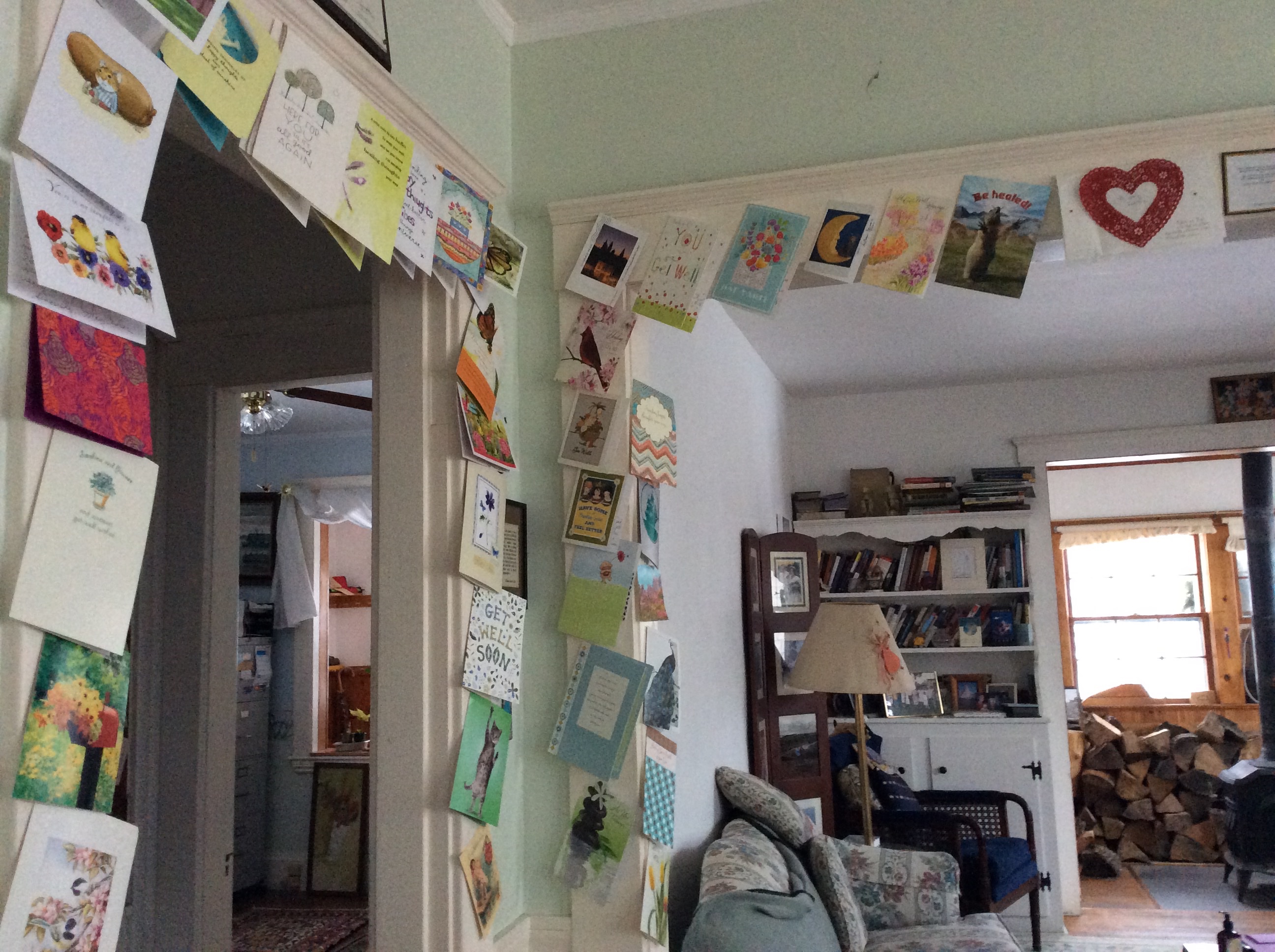
Greeting cards of caring received after my heart surgery
Recycled gratitude — it is a gift to me every time I recall the actions of that man who helped an inexperienced teenage driver on Federal Street in Beverly or that nurse at Mass General, just doing her job, assisting a patient after open heart surgery. What are your own examples of recycled gratitude?
The main character is a woman. She’s fictional, so the constraints on real women are not required. Is she a superwoman? Yes and no. Just being a real woman, overcoming all of the restrictions upon us every day, requires us to be super people. Nevertheless, what super-person power will my fictional woman have? Aha! She never needs to sleep. Every time she blinks her eyes for a microsecond, she has the power to recharge, in the same way that hours of sleep actually recharge a normal human woman.
So, this fictional woman, Yolanda, never needs to actually sleep. She is fully energized all day and all night, never feeling lack of energy. How does she use all this energy? Why, performing good in the world, of course.
At this particular time of her life, she is single, living alone, though in the future, Yolanda will be a wife and a mother. Right now, she’s exploring herself and the world and the best places to use her many talents. She’s an attorney, available to underserved individuals, with seemingly unlimited time to examine details of their cases, preparing for court. The prosecuting attorneys never stand a chance against her, because their single most limiting factor is time. There is never enough time for them to concoct a reasonable story that would convince a jury to find the client guilty.
One case involves climate disobedience. The strength of the case is Yolanda’s ability to examine the complexities of evidence of climate change in the world and then, to select the specific facts, figures, and diagrams to clarify for a jury the compelling need to take action to change the direction of human beings. The goal, in one sense, is complex: to capture the history of climate change, the current role of human beings in bringing about those changes, the reasons for people to take those actions, and the reasons they do not.
The most troubling aspect of the reasons for the earth-altering changes is greed. Among the millions of actions that result in the climate-changing actions, the overriding factor is greed: individuals guiding corporations for an opportunity for profit invite others who are simply earning a living to share in the profits. Unfortunately, these others do not gain on the same scale as the owners, although they experience their own desire to profit.
We all recognize that single-mindedness is an arrow for success. What follows is that the person who has a single interest in his own profit has the advantage, when paired against another whose interests are split between profit, fairness, and justice.
The reason? Time. Time is truly the most valuable commodity we possess. Which of us would not trade all the money we have for an additional healthy year of life? Without time, what value is there to money or the things it can buy?
So, to my fictional character, Yolanda, the most powerful superpower I can bestow is time, given by drastically reducing her need for sleep. During my life, I have routinely needed at least nine hours of sleep. In my twenties, married with a second-grader, I read somewhere that by including a two-hour afternoon nap in our days, only four hours of sleep were needed at night. I tested this by lying down for my nap two hours before Jack returned from school, so I wouldn’t oversleep. Then, I started a project at about nine in the evening, such as baking bread, to keep my mind and body occupied until about 2 am, going to bed when I needed to be awake four hours later, to get up with Jack for school. I did this for a few weeks. Although the results were reasonable, they were not encouraging enough to induce me to give up on my nine hours each night.
So, as an alternative, I bestow this superpower of time upon my fictional character, Yolanda.
Once upon a time, I was on a jury, maybe twenty to thirty years ago. My memory of it continues to be strong, at least of the important facts, though not many specific details. The trial was of a man accused of drunk driving or DUI. The trial lasted a single day, evidence, deliberations, verdict, and sentencing.
When my co-jurors and I left the courtroom to begin our discussion, I expected it to be short, because to me, he was clearly guilty. I expected immediate and full agreement amongst us. Was I wrong! When we were asked for our initial opinions, I was the only person who believed him guilty, beyond a reasonable doubt. Every other person thought him innocent.
Then, we began our discussion. One person brought up the idea that no one had been hurt. Another (maybe me) reminded us that the judge had said that whether or not anyone was injured was not the issue. The defending attorney had suggested that it was perhaps due to a disability that the accused had walked so crookedly, not necessarily because of intoxication. We were reminded (again, perhaps by me) that evidence of a disability had not been presented. One by one, we discussed each juror’s idea of a reasonable doubt and, one by one, we dismissed them. A couple of people disclosed that they, in fact, sometimes drove after drinking and, if no one was hurt, they determined that it was acceptable for them.
Finally, in another vote, we were unanimous in declaring him guilty. We rejoined the courtroom and presented our verdict, before being thanked for our service and dismissed. I reentered the courtroom in the general gallery and listened to the sentence presented by the judge. Actually, I don’t remember the sentence. What I remember is that the judge reported to the attorneys that the defendant had been arrested multiple times before for other DUIs, but not convicted. It appeared clear that he was a repeat offender.
So, I am left without many details. The most prominent memory is that, when I recognized that I was the only person who thought him guilty, I had a moment of self-doubt. What if I had given in to that doubt and gone along with the others? A guilty man may have been acquitted and been given the opportunity to harm another with repeated drunk driving.
I am left considering the average jury: are they usually of medium intelligence, mediocre, not especially bright, inquisitive, or thoughtful? Does it stand to reason that at least one or two will fall into the top ten percent of intelligence? Does it often happen that one or two will guide the others to the ‘right’ decision? Maybe. Initially, this thought was disturbing to me. However, upon reflection, it seems inevitable. These two phrases, ‘a jury of your peers’ and ‘beyond a reasonable doubt’ are indeed essential to our justice system. I am proud to have served on a jury and glad that I stuck with what appeared right to me, despite being the minority voice.
What regrets do I have about my choices that may have changed the direction of my life? Well, I have no regrets about my own choices. It would have been nice to be able to sing on key, but it certainly has never been my conscious choice to sing in a way that others ask me not to. I love my brother very much, though would have preferred a different sister, but again, not my decision. Last week, I was personally faced with many questions about some of my past actions that have been questioned by others, but regrets, no.
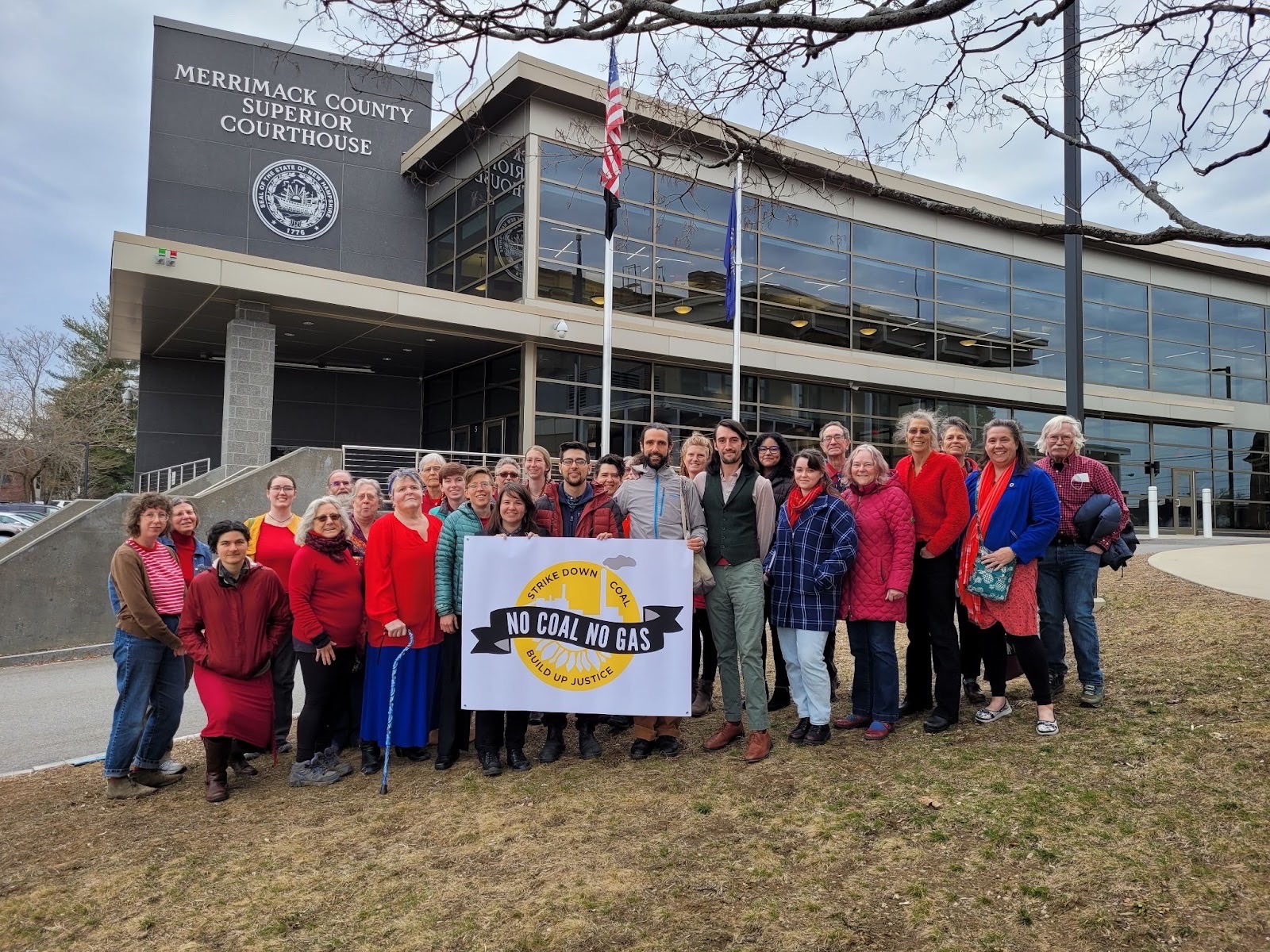
Last Tuesday, Judge Shulman was well enough to call court to order for my five friends, defendants in the Merrimack County (NH) Superior Court case for the crimes of trespassing and trespassing on railroad property. One defendant, Johnny, was also accused of resisting arrest. About thirty of us gathered to show our support for them, meeting with them before and after court outside the courthouse. Because of Covid, the number of people allowed inside the courtroom was limited. Fortunately, we had access to a conference room about two blocks away, with a videoconferencing setup and lots of snacks. We made a plan to swap people between the locations, so that everyone would have a chance to actually be in the courtroom sometime.
Somehow, I was among the lucky first batch of folks to be inside the courtroom and entered with the others before 9, the scheduled time for court to begin. So many of the court’s procedures are familiar to all of us from movies and television, yet it felt rather dramatic when these events actually occurred. For example, a courtroom attendant announced the judge’s entrance, “Please stand for the judge,” and of course, we did. Before he entered, one of the court police officers approached our group to let us know we could not take pictures or talk among ourselves during court, and to remind us to spread out, to not sit too close together.
Defendants and supporters, March 2022
The judge, who looked like Dr. Fauci, apologized for being out sick and provided us with details. He had come down with a cold last Friday, then woke up with a fever on Monday morning. He tested and it wasn’t Covid, then he slept all day. He was feeling much better now, 90% of perfect, he said, and was ready for work. He, like all of us, was wearing a mask. Before the jury was invited to enter, the attorneys conversed with the judge about which enlarged photos would be shown to the jury. Additionally, discussion ensued about the limits of climate-related comments to be used. The judge had advised that this case was not about climate change; however, he acknowledged that beliefs about climate change may have influenced the mental states of individual defendants, therefore, could be admitted.
Then, when our two attorneys and the prosecutor’s two and the judge determined they were ready, at 10:22 am, the court attendant announced, “Please rise for the honorable jury,” and fourteen people entered that special part of the courtroom. I noticed that the judge also stood as they entered. The jury had a certain amount of variation in size, gender, height, and style, but not in skin color, at least not visibly. I felt an intense desire to know them, to understand their motives, their values. But, of course, I never would.
The court attendant swore them in, using ‘swear or affirm’ before their promise to act honorably. Judge Shulman repeated his apology for being sick the previous day, appreciating the inconvenience it had caused to some. I liked this judge; he was very human and conscious of the effect of his actions on others.
Although I had originally decided to be present only Monday and Tuesday, Wednesday was when my friends would be testifying. I couldn’t miss that, so, despite my emotional exhaustion, I drove back to Concord again on Wednesday. I knew from my time watching from the conference room that witness testimony had been difficult to hear, because of the placement of microphones.
We’d been moved to a larger courtroom, where all of us could be present. Additionally, a group of high school students in a leadership group were observers. I loved that they were present to hear my friends testify to the urgency of climate change, the power of direct action, and the importance of community in their decisions to take this action.
On Thursday morning, I was again exhausted, plus it was raining, so the ride to Concord was not inviting at all. I decided to stay home and watch court on my computer. It was to be closing arguments and instructions to the jury, no witnesses, so the sound should not be an issue. It was lovely to hear Logan and Kira, our attorneys, present arguments for my friends, emphasizing the part that climate change played in the decisions each had made to be on that railroad bridge.
Unfortunately, the prosecution had the last word and they used it to remind the jury of the accusations and the facts concerning trespassing and my friends’ actions. Finally, the judge gave clear instructions to the jury, strongly emphasizing the importance of ‘beyond a reasonable doubt.’ One juror had already been excused, so Judge Shulman identified the alternate juror and then the foreperson, asking him if he was willing. He was, so the jury was excused for lunch, to be followed by their deliberations. Judge Shulman then described to the rest of us the possibilities for timing of his sentencing. He was not to work the next day, Friday, and he said that, if the jury returned with their verdicts at 4:00, he could not ask other court personnel to remain beyond that time. That meant that sentencing would not happen until at least next week.
When he left the courtroom, the video link ended. I spent the afternoon calling in about every half hour; at about 4:00, the link was alive again and the courtroom was filled. The jury had just started to report their verdicts, beginning with Emma, not guilty on both counts of criminal trespass or railroad trespass! I was ecstatic! Then, the reporting continued: Dana, guilty on both counts, the same for Dan, Jay, and Johnny, who was found not guilty of resisting arrest.
I was confused, baffled. I didn’t know how to absorb this mixed information or how to feel. It was only after the jury had been thanked and dismissed that Judge Shulman set the date for sentencing on May 13, because of the attorneys’ varying schedules and because the defendants were not local.
The question remains: do I regret the actions that I took that will place me on trial this summer? No, even before I know what sentence my co-conspirators will receive, I am ready to speak as a defendant, to accept whatever penalty my climate protest actions may bring, no regrets.
I knew Monday was going to be a busy day, but I could never have predicted the actual events. It has been unexpected, but delightful. What I knew was that I had made a commitment to be present at the beginning of the trial of five of my coconspirators, the five who were arrested during one of our coal-train stopping protests, more than two years ago. Their jury trial was to begin today in Concord, NH, at the Superior Court and last at least through Wednesday, possibly Thursday. The plan was for supporters, like me, to gather outside the courthouse at about 8:15 am, for our reunion, a little mutual admiration, and some direction from our coordinators, before entering the courtroom or gathering at a location three blocks away, in a conference room for overflow. The direction to us included the strict advice to not engage in any conversation with the jurors, who would be clearly labeled with badges. Planned overflow was because the courtroom is under Covid guidelines, with strict guidance for numbers present.
As previously for the many hearings we’ve endured and enjoyed, nearly all of us were dressed with some shade of red, our leaders easily identified with red masks. Just in case you’re reading this in the future, these are Covid-required masks, not robbing-a-bank masks.
Many of us who gathered at 8:15 came with snacks to be shared. My busy weekend had included a trip to the grocery store for oranges, rice cakes, dried apricots, and bottled green teas. My day today began with my alarm at 6 am, a shower, dressing in red, in the car before 7, a MacDonald’s breakfast, and arrival at the Concord courthouse by 8:15. I was among the first to be there and quickly found Sue, the organizer of snacks. By 9 am, we were about 30, when the defendants arrived, to much jubilation. Just about then, we learned that the judge had called in sick, so court was canceled for the day.
What?! This had never occurred to me, that a judge could be sick, though, of course, why not? We were told nothing about his illness or the prospects that it would continue into tomorrow or beyond. This was a nuisance, an inconvenience for me, but what about others who had to deal with transportation issues or missing work?
We were invited to the nearby conference room to continue our mingling or to leave, as we wished. I gladly walked to the conference room, for continuing joyful conversation with old friends and new. One of my new friends was Barry, who’d arrived early. It was his first time ever to one of our events; he’d decided that although he had not ever participated, he wanted to, at least by supporting us. What a joy to welcome him and to know that others are still being inspired by concern about our planet and our climate. We walked the three blocks together to the conference room.
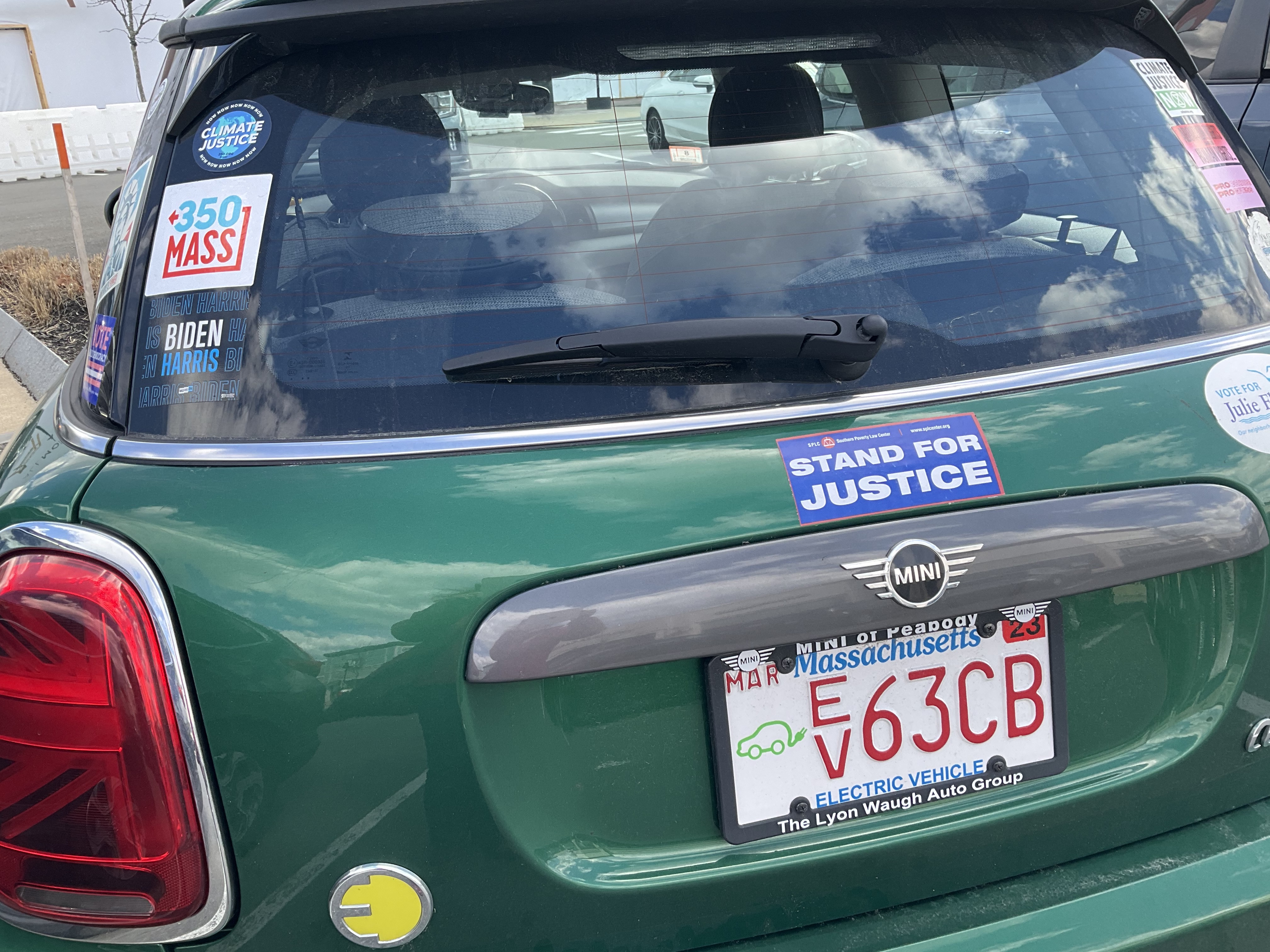
After a little more auld lang syne, I walked back to the courthouse to get my car, knowing I needed to charge the battery before returning home. I headed to the closest charger, about six miles away. It was working, but quickly shut off without charging. After a few iterations of that, I called their help number and immediately reached a kind, helpful person. After five minutes, when she was unable to determine the problem or the solution, I thanked her, hung up, and drove five miles to the next charging station, which happened to be at a Whole Foods. Shortly after me, someone else from our courthouse arrived, a guy named Bob, who had been among the 67 arrested with me and had driven today from Vermont.
My Mini, fully charged
Here’s where you find out what a hypocrite I am! For me, part of being an activist involves being conscious of how I spend money. As a result, I do not use Amazon, including Whole Foods, now owned by Amazon. At this point, I had only about ten miles left, so choosing another charger location was not feasible. I can easily justify recharging my car. Harder to justify is going into the store and buying a slice of pizza, because it was almost noon, I was hungry, and I was stuck here for half an hour. But I did. The pizza was delicious.
The timing worked out so that I could log on to my writing class and participate during this last class of a ten-week session. Hearing what the others have written reminds me of how much I’ve come to love each of them and their stories!
During my ride home after class ended, I was enchanted by the layers of fluffy, puffy white clouds against the pure blue sky. Tonight I’ll attend a city council meeting, where I’m signed up to read our land acknowledgment statement, identifying the Native American tribal lands on which we meet. Tonight is also the meeting of National Grid with our counselors, for which I want to be present. It’s to be a contentious meeting: National Grid primarily concerned about their profit and we citizens concerned about environmental harm and safety of residents.
Then, tomorrow, if the judge is no longer sick, I’ll come back for the trial. Just another day in the life of an activist.
I’m old, 75, and the telephones I’ve used have changed a lot, perhaps as much, maybe more than shoe styles. The first telephone I ever used was at my grandmother’s house, where my family lived until 1952. Her phone was black, as that was the only option, and the number was 2438. Of course, there were six other numbers, the area code and the local exchange, but back then, locally, you needed to know only the last four. We didn’t even need to dial. We picked up the phone and an operator said, “Number, please.”
My memory is not clear about this, but I believe this phone did not have a rotary dial; the only option was to pick up the phone and wait for the operator. There was no dial tone. The local operator was my mother’s best friend, Dot. I loved hearing her voice when I called someone, or, more likely, my mom did. Sometimes Dot had a minute to chat before she had to get back to work. That was the middle of the last century, so long ago.
My grandmother’s phone, maybe without the dialing circle
When my parents bought their own house, our new phone was bigger, clunkier, rotary, and I remember it being beige, probably about 1958. Our number was 0492, but by then, we needed to dial 922 first, actually WAlker 2. Area codes weren’t required, as we rarely called anyone outside of our area code. Long distance calls seemed like a big deal and we’re expensive.
My next phone memory is quite vivid. For my sixteenth birthday, in 1962, I asked for my own phone and received it! Ok, I get it now; I was really spoiled. It was a baby blue princess phone, oval and smaller than the family phone, with its own number, which I don’t remember. Rotary was still the only option . How I loved that phone and how grown-up I felt!
I have no idea when rotary was replaced with push button; funny how some transitions are easily forgotten, while others create strong memories. What I remember about the transition from rotary is that my grandmother’s phone, the first I had ever used, was still in that same house, then used by my aunt and her family. They had never chosen to switch to rotary, never mind push button, and finally, the phone company, Bell (remember Bell?) visited and took the phone, saying that phone no longer worked in the system.
Another vivid phone memory occurred in 1964. My father and I spent a month in Europe for my high school graduation gift. Yes, I know, I’ve already admitted to being spoiled. My mom’s birthday took place in the middle of the trip, so my dad and I wanted to call her. We needed to make a reservation for the time of the call with an international operator. I don’t remember the cost, but at the time, it seemed expensive and extravagant and a big deal, to call to wish her a happy birthday.
The next piece of phone history that I have to share occurred in the mid 70’s, when I moved to rural Pennsylvania with my first husband. We bought a former one-room schoolhouse in a village with about two dozen homes. When we contacted the phone company to request telephone installation, we were asked, “Four-line or eight?” Private lines were not available. I don’t remember which we chose. I think we went with with four-line. Our neighbors quickly let us know who else shared our line and that we should be prepared to have others listen to our calls. A particular ring pattern would alert us to when the call was intended for us. This phone service was incredibly inexpensive. As private lines became available and others dropped off our shared line, we ended up with a private line, with low shared-line rates!
The next significant related memory was in the mid-90’s, when I worked in technology management at Price Waterhouse. It was at the beginning of video calls, not actually involving a phone, if you can remember when they were unusual, expensive, and required advance planning. I don’t remember the occasion, but we arranged for our first video call with a west coast office, talked with folks there in wonderment that we could see each other and chat.
So, I’m at the end of anything that feels like history and up to current times. I’ve left out changing to wireless and video technology. Recent changes have made video calls ordinary. Growing up, it seemed like fantasy, science fiction. Writing this, I’m reminded that I was recently forced to replace my flip phone for a smartphone, as 3G was phased out. Reminds me of my grandmother and her old black phone!
Now, we buy new phones almost as often as we buy new shoes.
Maybe one of the reasons that I write is to learn who I really am. I get glimpses every day, but by writing, I can see it better. So, here’s my latest insight. Or, first, here are the circumstances that have come together that allow me to see myself more clearly and to question some of my assumptions.
I have chosen to be a Quaker, from more than thirty years ago. Even before that, I considered myself a pacifist and believed myself to be. During the Vietnam war, I believed it to be wrong, believed all that killing to be wrong. As a woman, I could not be drafted and believed that, if I had been, I would have refused to fight, refused to go.
But, of course, I never had to make that choice. That belief did not require anything of me, except to march in peace rallies near home or past the White House.
I have sat comfortably in these beliefs for many decades. Yesterday, my beliefs were challenged by events happening in Ukraine. With Friends (capital F, because they are Quakers, too), I took the train into Boston to attend and participate in a peace rally on Boston Common. I had attended a similar rally two weeks ago, just outside the Park Street T station. After arriving, when we left the station, we noticed a large rally a short distance away, surrounding the bandstand, with dozens of bright yellow and blue Ukrainian flags. It was not the rally we had come for, but it appeared to be similar, so we joined it.
Boston Common Ukranian support rally
There were many speakers, including Mayor Michelle Wu and Congresswoman Ayanna Pressley, all pledging to support and stand with Ukraine. Occasionally, there were Ukranian phrases repeated, as well as phrases that I chanted, along with everyone else, “Ban Russian Oil,” and “No Fly Zone.” Among the hundreds of people present, many draped bright Ukranian flags over their shoulders. Some women displayed traditional Ukranian flower headdresses and some leashed dogs were wearing blue and yellow flowers in their collars. A couple of people wore bright yellow jackets, pants, or shirts.
My heart was in unity with the voices and their messages, wanting Russia to stop fighting Ukraine, to stop killing people in Putin’s attempt simply to extend his dominance. Some of the speakers raised the concern that these events are reminiscent of early Nazis, prior to World War II, and that this might be the time that stronger resistance is needed, to prevent World War III. One message was, “Say your prayers — and move your feet.” That was my belief as well, that it is not enough to pray; action is also needed. I wondered if this action I was taking, being here, adding my voice to the crowd, was enough. Was more than my presence required?
After about an hour, we headed back to the T station, only then noticing the much smaller rally, the one we had actually come in to attend. The message of this one was also for peace, with a stronger emphasis on ‘no war’ than on alignment with Ukraine.
During the train ride back to Beverly, we discussed pacifism and whether each of us was really a pacifist. One Friend challenged me, “Did you really think that was a peace rally?”
If I believed that armed force against the Russians was required to prevent a Third World War, would I still be a pacifist?
I want to say yes, but I do not really know. I do not know.
Thank you, Martin, for the term, ‘peace activist,’ to replace pacifist. That fits me.
I’m sure that my dad must have made many recommendations to us, but the one that I remember most clearly was, “I don’t care what you do, but don’t lie about it.” He often described how being caught in a lie left other people wondering what else about you couldn’t be trusted.
I need to write about a recent experience that is currently affecting my piece of mind. Last Sunday, a friend who I fully trust called with a request of my husband and me. My friend and her husband had been housing a young man for a couple of weeks, who would otherwise be homeless. My friends were going to be out of town for a week and asked if we would provide him housing for two nights, as he had reservations for a flight on Tuesday morning. They told me he was friendly, walked a lot, had family problems, and smoked pot, but would leave the house to do so.
Without hesitation, I said ‘yes,’ not even checking with Paul, as I was certain that he would agree. We have comfortable upstairs space, recently offered through Airbnb, now available for family and friends. So, two nights and one full day didn’t seem much of an imposition, actually felt as if we were simply doing a good deed.
Our friends arrived with 29-year-old Danny (not his real name) and joined us for tea. Danny had coffee with Paul, saying he wanted the caffeine. We spent the afternoon engaged in conversation, learning that Danny had lost his job selling pot at a local shop and was headed to Los Angeles, where a similar job awaited him, along with housing. He was quite proud of his associate’s degree education and of his in-depth knowledge of many varieties of marijuana. He described the generous tips he received from customers who appreciated his excellent recommendations of specific remedies for specific ailments and needs. He also described in length the many ways that his family had repeatedly let him down.
We ordered pizza for dinner. By the time he went to bed that night, I felt exhausted, recognizing that Covid has left me unused to being with others for more than brief periods. Additionally, Danny’s life, centered on pot, was so very different than my own. When Paul got up the next morning and brewed coffee, Danny came downstairs to join him at 7 am, highly energized and talkative. I hadn’t even brushed my teeth yet and didn’t want to talk to anyone. Danny declined an offer of breakfast, just drinking coffee.
He was out a good part of the day, then had dinner with us at about 7 pm, during which he told us that he would not be leaving in the morning, after all. He said that his brother had promised him money for the flight and that he had made arrangements with the airline to pay for his ticket in the morning. He had just learned that his brother was not going to give him the money. Warning! . . . Danger! . . . Red flashing lights! . . . Does this sound fishy to you? Well, it did to me.
So, these are the pieces that came crashing together in my head: my desire to be a good person, my desire not to be used, my certainly that we had been lied to, and my concern that this person had no other place to stay. The first desire took precedence and I assured Danny that he could stay with us until my friends returned home. Of course, I had no idea whether they would want him back with them.
We talked about plans and Danny said that in the morning, he would go to the library to use a computer and then go to the hospital to talk with a psychiatrist. Have I mentioned that he’s talked about being depressed with recent thoughts of suicide? He appears to be high almost constantly, so I don’t know what to believe. And, remember how I started this essay? I have no idea what I can trust in him.
In the morning, the morning we had expected him to leave, he headed out for the library and the hospital. I asked him to call and let us know when to expect him back. He called about 4:00, saying he’d be about an hour. He arrived about 8 pm, and we told him that we wanted him to leave in the morning. We discussed local options for the homeless and he mentioned an apartment of his brother’s where he might be able to sleep.
So, he has just left here a couple of hours ago. We feel a little guilty, yes, but not enough to have him in our home for another night. I don’t know if addiction happens with pot, but his mind is certainly unsettled, ungrounded. He is ‘a nice guy,’ but is not currently accepting responsibility for his actions. I don’t feel responsible for him. The help that he needs is beyond me.
From five years ago, if I could have looked through a crack in the door to see my life today, what would I have seen? What would I have felt? What would I have advised or said to my current self?
Five years ago, I planned to retire the following spring and I did. I expected that I had enough money to live comfortably, so I was not concerned about finances. Now, however, I have far more appreciation, even gratitude, for my reality than I expected to experience. Perhaps that’s because I have far greater awareness of my privilege now than I recognized five years ago.
I was ready to stop working for money and was not certain how my time would be filled. I anticipated the pleasure of having lots of free time. A recently retired friend had advised me to say ‘no’ to all volunteer requests for the first year, as a way to insure free time on my calendar. I didn’t heed her advise. Perhaps that was a mistake, but I don’t think so. My experience throughout my life has been that there has never been enough time for everything I want to do. Surprisingly, that remains true. I’ve never understood how someone can be bored.
I had thought that I might want to get a part-time job, something fun, like working in a bookshop, but, there’s no time for that. There is still not enough time to read everything I want to read or go out to lunch with everyone I want to have lunch with. This sounds as if I’m grumbling, but I don’t mean to. I love my life completely and certainly make time for activities and people who are most important to me.
Something that would have seemed impossible and even undesirable to me five years ago has become a sparkling part of my life: a weekly Bible study group. The group includes Protestant ministers, Jewish scholars, and other students of the Bible, all far more knowledgeable than I. They are all accepting of both my extremely basic questions and my Quaker-based interpretations. Recently, they have also been appreciative (I don’t think they’re simply being polite) of my sharing of a new Gospels translation by a Quaker scholar.
During the past five years, my activism has increased far beyond anything I would have predicted. Of course, in hindsight, it completely makes sense, given the time I have available and the absence of work-related arrest concerns. I would not have predicted either my arrest or my willingness to proceed toward a full jury trial. Similarly, I could not have predicted being asked to preach about my activism from the lofty pulpit of a UU church!
Of course, Covid has changed many of my routine activities. Now, instead of live music and theater, there are zoom meetings and speakers. I loved seeing Anita Hill live on zoom last week, but not as much as I enjoyed James and the Giant Peach at a local theater recently. Sure, we were all masked, performers and audience, but the musical, enacted mostly by children as young as four, was pure delight. When the little actors, performing as seagulls, entered the stage wearing their white feathers and watching each other, making sure they were making the right moves, there was no space in any of us for anything except pleasure and delight.
Then, last week, nine neighbors gathered at another neighbor’s home for our bimonthly dinner and Kiva contributions. We were doing this five years ago and I might not have predicted that it would still be continuing. What I certainly could not have predicted is that after multiple Covid-induced postponements, joining each other again was so joyous!
So, I’m supposed to be offering advice from myself five years ago. I don’t need to be advised to fully appreciate and treasure these ordinary moments and occasions and people. The combination of my heart attack four years ago and Covid during the past three years has removed all subtlety from my appreciation.
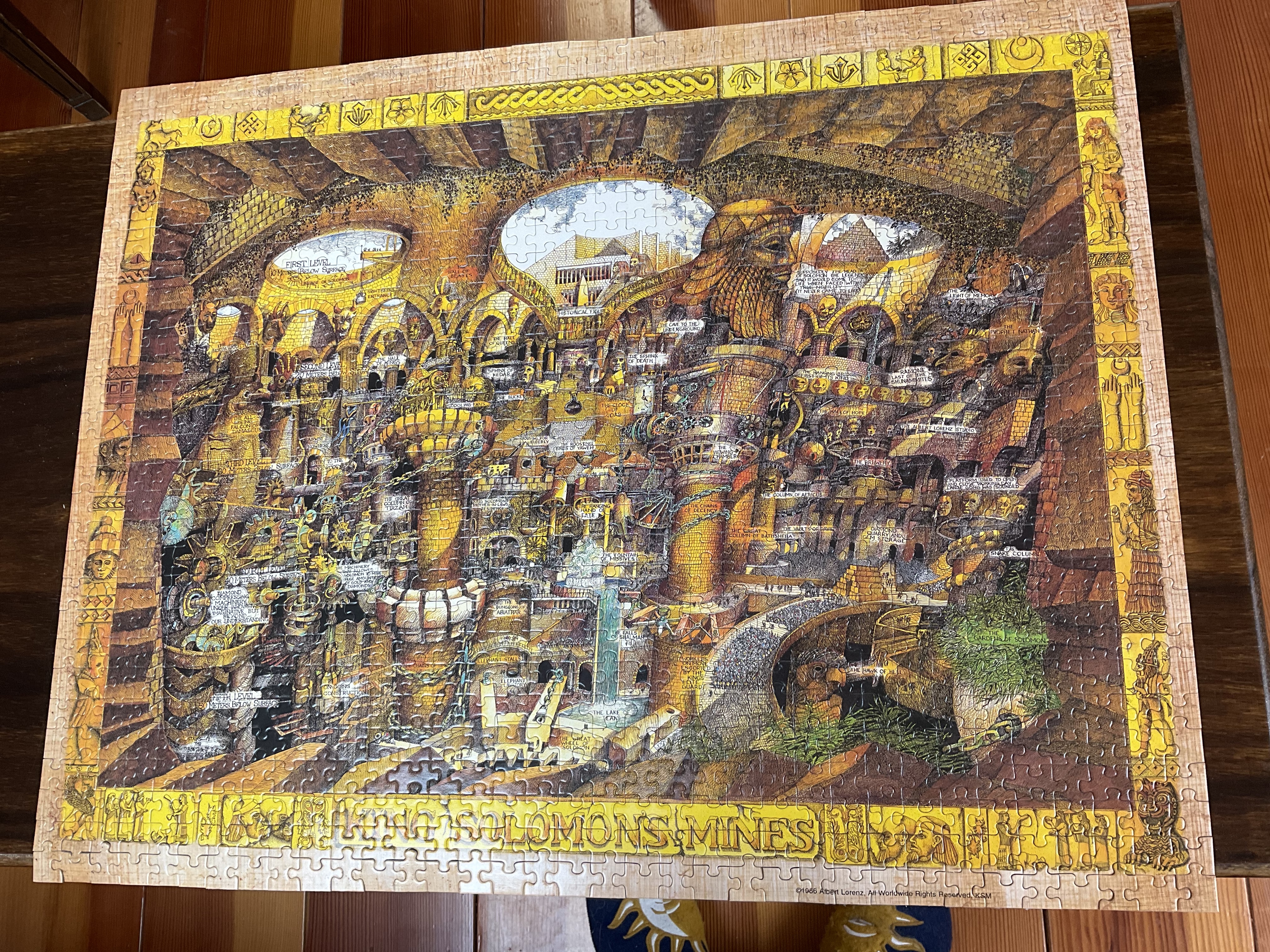
Every morning, waking up in our comfortable bed with flannel sheets, next to the man I love in our beautiful attic room, covered with a down comforter — I don’t need to be reminded to appreciate that moment, the morning, the day. Then, I get to choose how to spend the day — reading, writing, working on my 1000-piece puzzle, dancing online with Emily or Nancy, many zoom meetings, and watching Netflix. Oh, don’t forget my activist activities, which don’t occur daily, but frequently.
King Solomon’s Mines – my newest challenging puzzle!
Five years ago, would I have predicted that these would be the activities to fill my day? Would I have approved? Yes, most of them are not a surprise. The biggest surprise, for sure, is that I watch so much Netflix. Interestingly, I subscribed in January of 2019, before I’d heard of Covid, thinking I would use it for a month or two, during the winter. Needless to say, I remain a subscriber. Yes, I feel a little guilty, but not enough to end that relationship!
So, I don’t have much good advice from myself five years ago to myself today, viewed through a crack in the door. Just enjoy each moment, each season, each dear friend, and each event in my life for each day that it continues to bless me. Nothing lasts forever. I understand that now in a way that, five years ago, I did not.